

Should we sequence the DNA of every baby born in Australia? Soon, you could have your say
- Written by Sarah Norris, Associate Professor of Practice Health Technology Assessment, Leeder Centre for Health Policy, Economics and Data, School of Public Health, University of Sydney
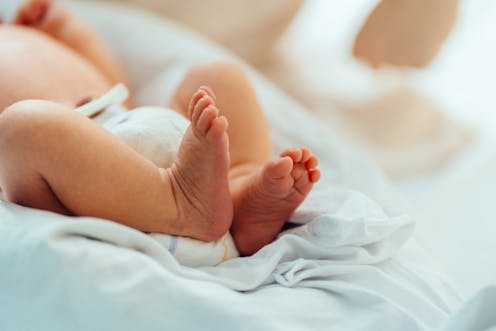
Within a few days of being born, more than 300,000 Australian babies a year have a spot of their blood analysed to screen for a range of serious but treatable health conditions.
The aim of this newborn bloodspot screening is to detect babies at risk of health conditions and to intervene early. These are conditions that could cause the baby serious harm if not treated in the first days or weeks of life.
About one in 1,000 babies (or about 300 a year) are found to have one of these conditions that would otherwise go undetected.
Australia’s screening program – which reaches about 99% of newborn babies – mainly uses tests that measure the levels of specific biochemicals in a baby’s blood. There is limited use of genetic testing (sequencing a small amount of DNA) as part of the program.
But as genetic technologies improve, researchers are discussing options for updating the screening program. This might include sequencing the DNA of every baby born.
It’s early days and we don’t yet know what an updated screening program might look like. But in a few months, we’ll ask Australians for their say.
The recommendations from this research project will be presented to all health ministers, and will be used to directly inform how we might use genomics in newborn screening in Australia.
Why are we talking about this?
Advances in genomics (the methods we use to sequence some or all of our DNA) and reductions in the time and cost of sequencing mean it may now be possible to use genomics in newborn bloodspot screening.
We don’t know exactly how this might happen. But one approach is to use genomics as well as existing biochemical testing.
This could potentially identify up to 1,000 more health conditions than the existing program.
Using genomics to detect additional conditions could mean earlier diagnosis and treatment for more babies and their families. It could also prompt relatives to be tested to see if they too are at risk or whether they might pass the condition on to future children.
While genomics in newborns has not yet been implemented in any country, many research projects around the world and in Australia are exploring different approaches to using it.

Balancing the benefits and risks
There are challenges ahead. We need to balance the potential benefits for the less than 1% of Australian babies who receive an early diagnosis from newborn screening, and their families, with potential risks for all screened newborns and their families.
Using genomics in newborns raises significant economic, ethical, legal and equity concerns.
Sequencing a baby’s DNA can reveal more about the newborn and their relatives than traditional biochemical screening.
For instance, genomics could reveal conditions for which there is no treatment, conditions the baby might develop as an adult, or conditions the baby won’t develop but could pass on to their children.
Genomics could detect less-serious conditions, and genetic changes where we can’t tell how serious the condition will be or how old the child will be when they show symptoms.
Genomics could detect genetic changes that do not end up causing disease, meaning a child would be treated or monitored unnecessarily.
Genomics also provides an enormous amount of information we don’t yet fully understand, so it cannot be used to help the baby.
Using genomics could lead to a lot more testing, genetic counselling and treatment. This would require significant additional health-care resources, perhaps more than the health system currently has available.
We will also need to make sure all the health professionals caring for newborns and their families understand the benefits and limitations of genomics and the information it generates.
 Will all the extra information genomic testing generates help the baby? And will it lead to unnecessary tests and worry?
Lolostock - Apex Studios/Shutterstock
Will all the extra information genomic testing generates help the baby? And will it lead to unnecessary tests and worry?
Lolostock - Apex Studios/Shutterstock
Questions we need to answer
Genomics could change how newborn bloodspot screening works in Australia. But there are some big questions to answer first, including:
1. How much DNA should we sequence? All of the DNA (referred to as whole genome sequencing) or only part of the DNA (for example, specific genes)?
2. What results should we give parents? Should we report everything we find or only results that can help treat the baby?
3. Are the required health services available for all newborns? Conditions identified via newborn screening require specialised health care that may not be available everywhere. Some families may also have difficulty accessing care due to where they live, language barriers or socioeconomic factors.
4. What if there is no intervention for a specific health condition? Fewer than 10% of rare conditions currently have an effective treatment.
5. What data will be stored? How do we keep the genomic sequence data, or screening results, private and secure while allowing appropriate access to guide clinical care?
6. Will the information be used for other purposes? The information could be used for many other purposes, such as predicting the likelihood the child will develop specific health conditions as an adult, for medical research, or for legal investigations about blood relatives.
7. How should we engage with families to help them make the right decision for them? How should families be engaged about this screening? How can we balance the fact that newborn bloodspot screening is typically encouraged with the inherent uncertainty of many genomic results?
8. How much will it cost? Is the extra cost of using genomics in newborn bloodspot screening a good use of taxpayers’ money?
You could have your say
As well as asking “how do we use genomics in newborns?” we need to ask “should we use genomics in newborns?”
As part of an Australian research project, this year we will be running a national Australian citizens’ jury on genomics in newborn bloodspot screening.
Some 6,000 households across Australia will be chosen at random from the Australia Post database. They will be invited by mail in late January to participate in the jury. You could be invited, so watch your letterbox.
Of those who respond, 30 people will be chosen to represent the diversity of Australians in terms of gender, age, ancestry, education, place of residence and parenting status. In March 2025, via online sessions and a face-to-face meeting in Canberra, they will learn about the issues we’ve described and develop recommendations about what we should do.
Using genomics in newborn screening is relevant to everyone. Even if you don’t plan to have children, the Australian health system will have to cover any future health care costs of the screening program, its implementation and its outcomes.
This is why it’s important we understand the views of the general public as well as the views of scientists, health professionals and policy makers.
Authors: Sarah Norris, Associate Professor of Practice Health Technology Assessment, Leeder Centre for Health Policy, Economics and Data, School of Public Health, University of Sydney

















