

To save Australia’s animals, scientists must count how many are left. But what if they’re getting it wrong?
- Written by: David Lindenmayer, Professor, Fenner School of Environment and Society, Australian National University
Humans are causing enormous damage to the Earth, and about one million plant and animal species are now at risk of extinction. Keeping track of what’s left is vital to conserving biodiversity.
Biodiversity monitoring helps document changes in animal and plant populations. It tells us whether interventions, such as controlling feral predators, are working. It also helps experts decide if a species is at risk of extinction.
However, long-term biodiversity monitoring can be expensive and time consuming – and it is chronically underfunded. This means monitoring is either not done at all, or only done in a small part of the range of a species.
Our new research shows these limitations can produce an inaccurate picture of how a species is faring. This is a problem for conservation efforts, and Australia’s new “nature repair market”. It’s also a problem for Australia’s unique and vulnerable biodiversity.
How monitoring works
Biodiversity monitoring involves looking for a plant or animal species, or traces of it, and recording what was found, as well as when and where.
Depending on the species, scientists might physically count individual plants or animals, or review sound or video recordings. Or they might look for evidence of an animal’s presence, such as scats (poos).
But long-term monitoring programs can be challenging to maintain. Robust programs typically require money, and a lot of time and expertise. A lack of funding means monitoring programs are often short lived or conducted across a small geographic area.
Such limitations can mean the results do not reflect the trajectory of a species across its entire range. We decided to test how this problem might be playing out in Australia, with monitoring of birds.
What our study involved
Our new study focused on 18 common species of birds. We have monitored them (and hundreds of other bird species) for more than two decades across more than 570 sites in Australia’s southeast. The programs aimed to gauge how the birds responded to threats such as bushfires and logging, as well as conservation efforts such as vegetation restoration.
But we used the monitoring results for a different purpose. We wanted to know if different populations of the same species showed similar patterns of change. As a hypothetical example, did a group of crimson rosellas in one area increase in size at the same rate as a group of crimson rosellas living 150 kilometres away?
Answering this question is important. If all populations show the same pattern of change over time, then the trends from a single population would serve as a good indicator for other populations.
But if there are strong differences in patterns between populations, then a single monitoring program in the middle of a species’ range would not accurately indicate how that species is faring at the edge of its range, or overall.
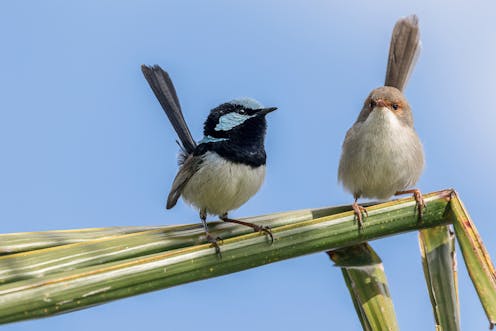
The 18 bird species we examined in detail included – aside from the crimson rosella – the red wattlebird, grey shrike-thrush, superb fairy-wren and brown thornbill.
What we found
We discovered marked differences in how many individuals of a species were detected in different parts of its range. For example, some populations of the grey shrike thrush were stable, others increased, and yet another declined steeply.
We also wanted to determine if there were ways to predict which populations of a given species might be more likely to be increasing or decreasing.
For example, if the monitoring program was at the centre of a species’ distribution – where the climate and food availability was optimal – a population there might be expected to be increasing faster than populations at the edge of that species’ distribution, where conditions could be less suitable.
Surprisingly, however, we found no evidence to support this hypothesis.
We also thought particular traits of a bird species, such as diet or body size, might affect whether numbers were rising, falling, or steady.
For instance, small bush birds might be more likely to decline due to being killed by predators or losing the competition for food to larger birds. Conversely, we expected that larger birds might be more resilient and their numbers more likely to increase. But again, we found no evidence of this.
These results indicate it is difficult to predict in advance which populations of a species will be declining versus those that are increasing or stable. It means scientists can’t reliably use such predictions when determining which parts of a species’ distribution should be monitored.
Our findings suggest that to get an accurate picture of a species’ overall trend, monitoring should cover, at a minimum, several populations of that species in different parts of its overall distribution. Importantly, this information can help identify those locations where populations are declining and conservation programs are needed.
And where a species is declining everywhere it is monitored, we should be extremely concerned. It shows a need for decisive conservation action. A species should not be allowed to go extinct while it is being observed, as occurred with the Christmas Island Pipistrelle bat.
Getting it right
Biodiversity monitoring in Australia is, overall, extremely poor. However, some excellent biodiversity monitoring programs do exist.
They include one on native mammals in south-west Western Australia and another on waterbirds across large parts of inland Australia. These programs demonstrate what’s possible when funding and resources are adequate.
The federal government is currently setting up Australia’s new “nature repair market”. Under the scheme, those who run projects to restore and protect the environment are rewarded financially. But how will we know if these projects are successful and biodiversity is increasing? Only monitoring can answer this question.
If the nature repair market is to be credible, Australia must markedly lift its game on biodiversity monitoring. Otherwise, environmental gains under the scheme may be purely fictional.
Authors: David Lindenmayer, Professor, Fenner School of Environment and Society, Australian National University


















