

The world’s second largest freshwater crayfish was once plentiful in Australia’s longest river – we’re bringing it back
- Written by: Nick Whiterod, Science Program Manager, Goyder Institute for Water Research Coorong, Lower Lakes and Murray Mouth Research Centre, University of Adelaide
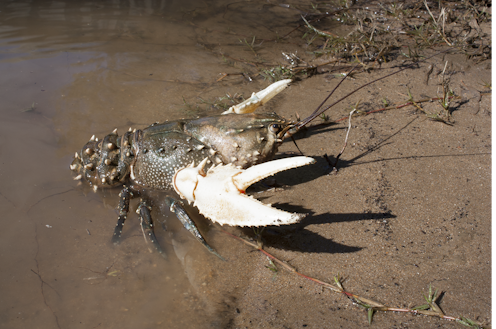
Murray crayfish once thrived in the southern Murray-Darling Basin. The species was found everywhere from the headwaters of the Murray and Murrumbidgee Rivers in the Australian Alps all the way down to Wellington in South Australia.
For thousands of years, First Nations people managed harvesting sustainably. But crayfish stocks crashed after European settlement. This was partly due to commercial and recreational harvest, which began in the late 1860s. At its peak in 1955, 15 tonnes of Murray crayfish were taken from the river in New South Wales and sent to markets in Melbourne and Sydney.
In South Australia, the commercial fishery was unsustainable by the 1960s and the species was no longer targeted. In the 1980s, Murray crayfish became a protected species in the state. But the damage was done.
Over-harvesting was not the only problem. Murray crayfish prefer free-flowing, oxygen-rich water, so they suffered from efforts to regulate river flows using dams and weirs. Poor water quality, including pollution from pesticides and other agricultural chemicals, made matters worse.
Murray crayfish disappeared from South Australia sometime in the past 40 years. Targeted surveys over a five-year period couldn’t find them anywhere in the state.
But that all changed in the winter of 2023 when our reintroduction program began. Now we’re preparing for the third release of crayfish and there are positive signs many crays from earlier releases are still going strong.
A species in need of support
Like many species from the highly threatened Euastacus genus, Murray crayfish grow slowly. It takes almost ten years for a female to reach sexual maturity, and she only produces a small number of eggs. Dispersal is also limited. This makes it hard for the population to recover in both number and range.
Following a recent assessment, the species Euastacus armatus is expected to soon be listed as vulnerable to extinction under Australia’s conservation laws.
Conservation actions such as reintroductions will be necessary to aid recovery of the species.
A long time coming, shaped by adversity
The idea of returning Murray crayfish to the river in South Australia is not new.
Two University of Adelaide ecologists, the late Keith Walker and Mike Geddes, first suggested it in the 1990s. They even conducted trials involving crayfish in cages to show sections of the river would be suitable for the species.
Then in 2007, the reintroduction idea was floated again. It was one of the main recommendations in a report identifying gaps in knowledge of the species.
But the idea really gathered momentum after disaster struck. Widespread flooding across the southern Murray-Darling Basin in 2010–11 led to a “hypoxic blackwater” event. This is where leaf litter and debris from the floodplain wash into the river, depleting levels of oxygen and causing mass deaths of both fish and crayfish.
This inspired further research into crayfish genetics, recovery potential and preferred habitat. It guided a 2019 strategy outlining how the species could be successfully reintroduced. A trial five-year reintroduction program in the New South Wales range of the species helped refine the strategy.
Then another Murray blackwater event in 2022–23, in NSW and Victoria, forced crayfish out of the water and up the riverbanks.
Vision of dying crayfish leaving the water, only to be consumed by predators or poached by people, prompted the community to respond. Guided by fisheries agencies and a fishing conservation charity, they rescued crays and held them safely in aquaculture facilities until they could be released back into the wild.
Many of these crayfish were later returned to the river where they came from. But a small number were held for release into SA as part of our new reintroduction program.
In a truly collaborative effort, a small environmental not-for-profit organisation, Nature Glenelg Trust, worked in partnership with a natural resource management agency, First Nations community, fisheries agencies from three states and a private aquaculture facility to turn the idea into reality.

Positive signs from crayfish releases
Murray crayfish were first released back into South Australia in winter 2023. It was a big moment for people who have long championed the species’ return.
A further 200 crayfish were released during winter 2024.
During each release, some of the crayfish were tagged with trackers. This has provided world-first movement and activity information. It shows all tagged crayfish being regularly detected, indicating they are flourishing.
Field surveys each season at the reintroduction site have also found the species alive and well, representing the first Murray crayfish found in the state for more than 40 years.

Returning a totemic and iconic species
The reintroduction of Murray crayfish into a closely guarded location in South Australia’s Riverland is both culturally and ecologically significant.
It signals the return of a important totem to the Erawirung people of the region, and provides a way to reconnect with the species.
Reestablishing a population of the species in South Australia, where hypoxic blackwater events have not been as severe, also provides insurance against extinction.
The species is considered a keystone species, meaning it plays a disproportionately large role in the ecosystem. So returning it to the river may have even greater ecological benefits.
 Coauthor Sylvia Zukowski is managing the reintroduction program.
Nick Whiterod.
Coauthor Sylvia Zukowski is managing the reintroduction program.
Nick Whiterod.
The first of many steps
Reintroduction programs require ongoing commitment if they are to be successful. Extra crayfish will need to be added to the reintroduced population over the coming years.
The reintroduced population will continue to be monitored to ensure numbers are increasing and the range expanding. It will remain protected from fishing by local fisheries authorities.
If successful, further reintroductions may be undertaken into other parts of South Australia.
This initiative is a partnership between Nature Glenelg Trust and the Murraylands and Riverland Landscape Board through funding from the landscape levies, with support from NSW Fisheries, Victorian Fisheries Authority, not-for-profit organisation OzFish Unlimited, North West Aquaculture, the River Murray & Mallee Aboriginal Corporation (RMMAC), CSIRO and the Department of Primary Industries and Regions SA (PIRSA).
Authors: Nick Whiterod, Science Program Manager, Goyder Institute for Water Research Coorong, Lower Lakes and Murray Mouth Research Centre, University of Adelaide


















