

Babies as young as 4 months can tell how the sounds of different languages are made – new research
- Written by: Eylem Altuntas, Postdoctoral Researcher, Speech & Language Development, The MARCS Institute for Brain, Behaviour and Development, Western Sydney University
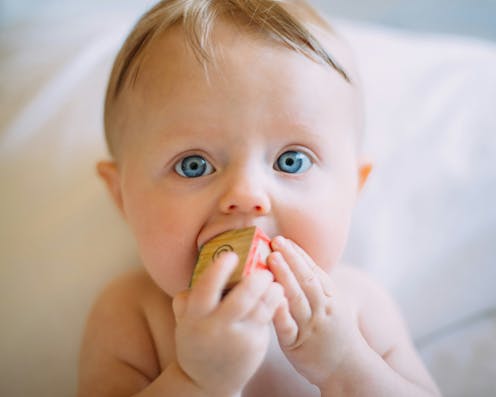
Babies are like little detectives, constantly piecing together clues about the world around them. If you’ve ever noticed your baby staring at you while you talk, it’s because they’re picking up on more than just sounds — they’re learning how those sounds are made.
Our recent study, published in Developmental Science, shows this amazing process starts as early as four months old, shaking up the old belief that babies learn these patterns only after tuning in to their native language between 6 and 12 months of age.
It also gives us an earlier window to help children who might be at risk of speech or language delays.
Sorting through a buffet of sounds
By their first birthday, babies are already fine-tuning their ears to the sounds of their native language in a process called perceptual attunement. Think of it like their brain sorting through a buffet of sounds to focus on the ones that matter most.
But in their first six months, babies can tell apart sounds from languages they’ve never even heard. For example, they might distinguish certain Hindi contrasts that are challenging for adult English speakers or identify unique tones in Mandarin, even if they’re growing up in an English-speaking household.
This incredible ability doesn’t last forever. Between six and 12 months, babies start narrowing their focus to the sounds they hear most often. For vowels, this fine-tuning kicks in at around six months while consonants follow at closer to ten months.
Think of it as babies zooming in on the sounds that matter, such as the difference between the “r” and “l” in English, while losing sensitivity to sounds they don’t hear regularly.
Until now, researchers thought this narrowing process was needed for babies to start learning more complex language skills, such as figuring out that the “b” in “bin” and the “d” in “din” differ because one is made with the lips and the other with the tongue tip.
But our study found babies as young as four months are already learning how sounds are physically made, long before this narrowing begins.

Learning mini-languages
Here’s an example to picture this. Imagine you’re listening to someone speak a language you don’t know. Even if you don’t understand the words, you might notice how their lips or tongue move to make sounds. Four-month-old babies can do this too.
To demonstrate this, we conducted an experiment with 34 babies, aged four to six months, whose parents had provided consent to participate. We created a “match-the-pattern” game using two made up mini-languages.
One language had words with lip sounds like “b” and “v”, while the other used tongue-tip sounds like “d” and “z”. Each word, like “bivawo” or “dizalo”, was paired with a cartoon image — a jellyfish for lip words and a crab for tongue-tip words. A recording of a word was played at the same time its paired image was shown.
Why cartoons? Because babies can’t exactly tell us what they’re thinking, but they can form associations in their brains. These images helped us see if the babies could link each mini-language to the correct picture.
After the babies learned these mini-languages and their picture pairings, we mixed things up.
Instead of hearing the words, they watched silent videos of a person’s face saying new words from the same mini-languages.
In some videos, the face matched the cartoon they had learned earlier. In others, it didn’t. We then tracked how long the babies looked at the videos — a common method researchers use to see what grabs their attention. Babies tend to look longer at things that surprise or interest them and shorter at things they find familiar, helping us understand how they process and recognise what they see.
The results were clear: babies looked significantly longer at the videos where the face matched what they’d learned. This showed they weren’t just passively listening earlier — they were actively learning the rules of the mini-languages and linking that knowledge to what they saw.

Connecting the dots
In simple terms, this means four-month-old babies can connect the dots between sound and sight. This early ability to spot patterns in how sounds are made is the foundation for learning language later on. It’s like their brains are already laying the groundwork for saying their first words.
This discovery changes what we thought we knew about babies’ early language learning. It suggests babies start figuring out patterns at four months, well before they begin perceptually attuning to the sounds of their native language between six and 12 months.
That opens up exciting new possibilities for helping children who might struggle with speech or language. If we can help earlier, we might make a big difference.
These findings raise several interesting questions. For example, can babies learn other differences such as voicing – whether a sound is made with a buzzing vibration, like the difference between “b” (buzzing) and “p” (no buzzing) – as early as four months? How does growing up in a bilingual home affect this ability? Could babies use this skill to learn patterns in entirely new languages?
By exploring these questions, we’ll keep uncovering the amazing ways babies’ brains set the stage for learning one of the most complex human skills: language.
Authors: Eylem Altuntas, Postdoctoral Researcher, Speech & Language Development, The MARCS Institute for Brain, Behaviour and Development, Western Sydney University

















