

New analysis of asteroid dust reveals evidence of salty water in the early Solar System
- Written by: Nick Timms, Associate Professor, School of Earth and Planetary Sciences, Curtin University

In October 2020, a van-sized robotic spacecraft briefly touched down on the surface of Bennu, a 525-metre-wide asteroid 320 million kilometres from Earth.
As part of NASA’s OSIRIS-REx mission, the spacecraft not only spent two years orbiting and imaging the asteroid, it also collected a precious sample of dust and small rocks from Bennu’s rubbly surface.
In September 2023, a capsule containing the pristine asteroid sample returned to Earth, landing in the Utah desert in the United States.
Since then, an international team of scientists – of which we are members – have been busy studying the roughly 120 grams of material collected from Bennu.
Our findings are revealed in two new papers published in Nature and Nature Astronomy today. They indicate that water may have once been present on Bennu’s parent body, and offer new insights into the chemistry of the early Solar System.
Pristine remnants of rocks from deep time
Asteroids are fragmentary remnants of pre-existing parent bodies from early in our Solar System’s history that have since been destroyed by collisions with other objects. They orbit the Sun and come in many different shapes, sizes and chemical compositions.
Asteroid Bennu was targeted for the OSIRIS-REx mission because remote sensing observations from Earth indicated it as a B-type asteroid. These asteroids are rich in carbon and hydrated clay minerals, possibly sharing similarities to the most primitive group of meteorites on Earth, known as carbonaceous chondrites.
Unlike meteorite samples, samples collected from asteroids have not been physically or chemically modified by Earth’s atmosphere and biosphere. This allows us to tackle key questions about the evolution of the early Solar System, planet formation, and the ingredients for life.
Another aim of the OSIRIS-REx mission is to link findings from samples in the laboratory to those from remote sensing techniques. This helps us corroborate astronomical observations of asteroids to improve our surveys of the Solar System.
Tiny crystals of salt minerals
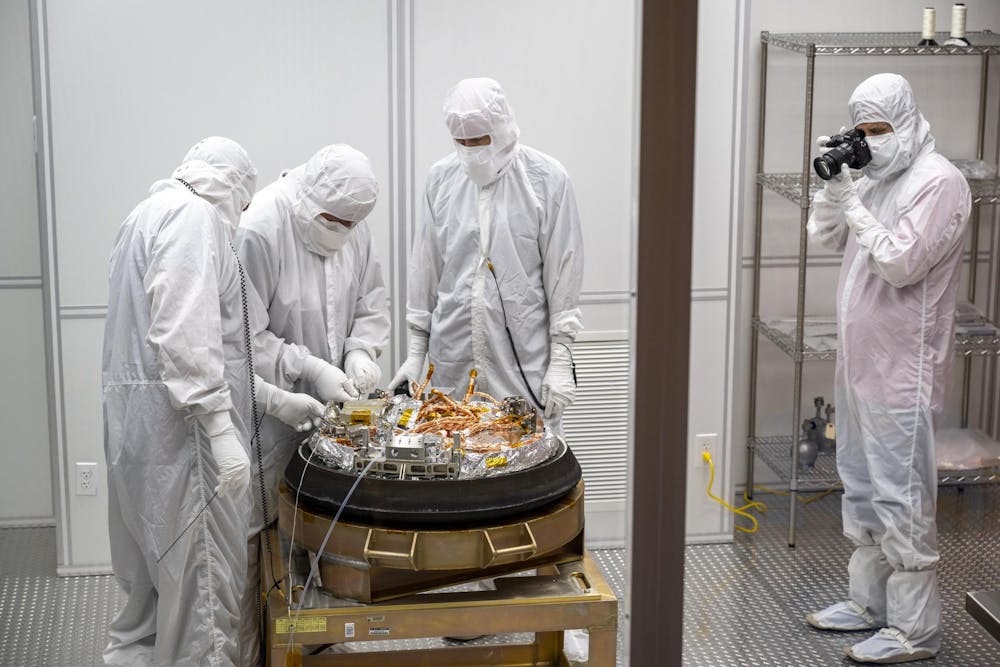
To prevent contamination, the sealed capsule containing the sample was stored and handled in a huge glass box when it was returned to Earth. This tank had rubber gloves feeding into it from the side so scientists could handle the samples without directly touching them. It had also been purged with nitrogen to keep out moisture and oxygen from Earth’s atmosphere.
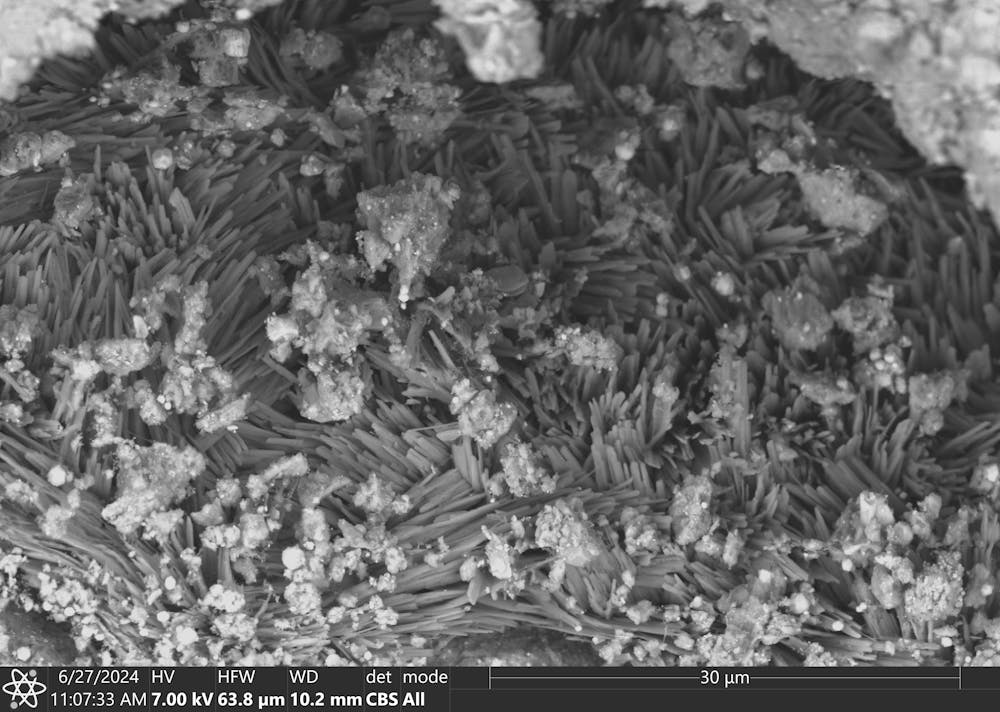
When we analysed the interior of Bennu’s dust particles, we were surprised to find tiny crystals of the salt minerals known as halite and sylvite.
This was a breakthrough discovery.
Halite is extremely rare in meteorites. It has only been found in three out of hundreds of thousands of known meteorites on Earth. We also know that halite is highly soluble. It can degrade quickly when exposed to air or water on Earth.
Other members of the OSIRIS-REx sample analysis team identified a variety of other salt minerals in the Bennu sample. These included sodium carbonates, phosphates, sulphates and fluorides.
These minerals can form by the evaporation of brines – similar to deposits that form in Earth’s salt lakes.
By comparing these results with the chemical makeup of salt lakes on Earth, a picture began to emerge of brines evaporating on the parent body of asteroid Bennu, leaving behind salts as evidence.
A variety of organic compounds
This discovery provides a new insight into water activity during the earliest times in our Solar System. But the presence of salt minerals is significant for another reason.
On Earth, these minerals are a catalyst for the formation of organic compounds such as nucleobases and nucleosides – the prebiotic building blocks of terrestrial biology.
And indeed, in a separate analysis of the Bennu sample, other colleagues on the OSIRIS-REx mission identified a wide variety of organic compounds present on the carbon- and nitrogen-rich asteroid.
These compounds include 14 of the 20 amino acids we also find in Earth’s biological processes. They also include several amino acids that are absent in known biology, ammonia, and all five nucleobases found in RNA and DNA.
Even though no life was detected on Bennu, the two new studies show that a briny, carbon-rich environment on Bennu’s parent body was suitable for assembling the building blocks of life.
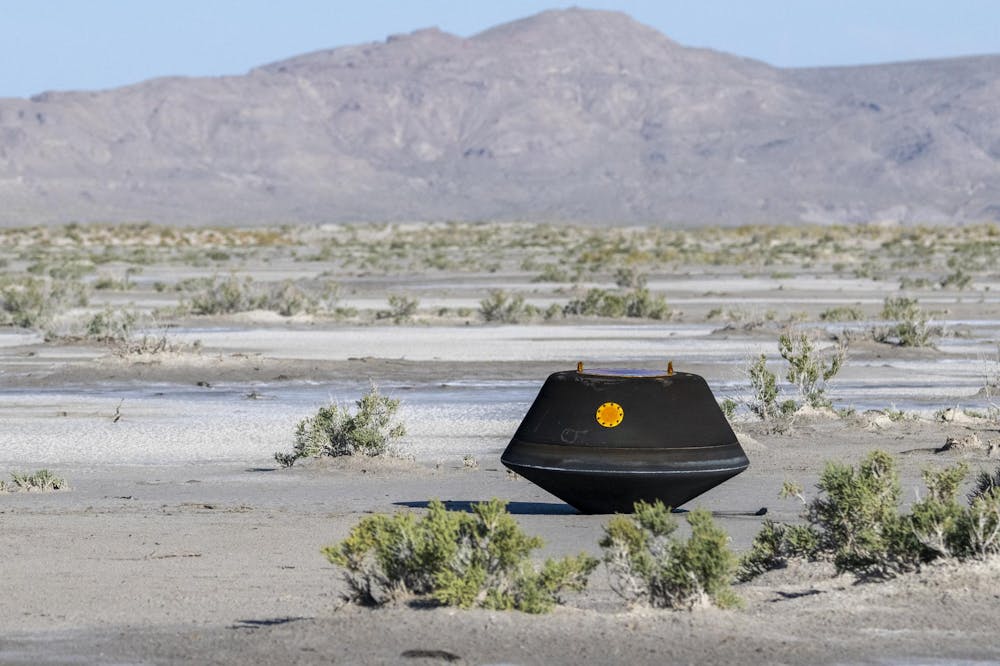 In September 2023, a capsule containing the pristine sample from Bennu returned to Earth, landing in the Utah desert in the United States.
Keegan Barber/NASA
In September 2023, a capsule containing the pristine sample from Bennu returned to Earth, landing in the Utah desert in the United States.
Keegan Barber/NASA
Ongoing investigations
The findings from returned samples of asteroid Bennu may provide researchers insight into what happens on distant icy bodies in our Solar System.
Some of these bodies include Saturn’s moon Enceladus and the dwarf planet Ceres in the asteroid belt between Mars and Jupiter.
Both Enceladus and Ceres have subsurface brine oceans. Could they possibly harbour life?
We are continuing to investigate Bennu using the pristine samples collected back in 2020. We are currently researching the timing of the Bennu parent body breakup event and looking for evidence of impacts recorded by various minerals in the samples.
The authors of this article acknowledge the contribution of the following people to the research at Curtin University: Fred Jourdan, Steven Reddy, David Saxey, Celia Mayers, and Xiao Sun, as well as the entire OSIRIS-REx team.
Authors: Nick Timms, Associate Professor, School of Earth and Planetary Sciences, Curtin University

















