

‘Digital doppelgangers’ are helping scientists tackle everyday problems – and showing what makes us human
- Written by: Alicia (Lucy) Cameron, Principal Research Consultant & Team Leader, Data61, CSIRO
As rising seas lap at its shore, Tuvalu faces an existential threat. In an effort to preserve the tiny island nation in the middle of the Pacific Ocean, its government has been building a “digital twin” of the entire country.
Digital twins are exactly what they sound like – a virtual double or replica of a physical, real-world entity. Scientists have been creating digital twins of everything from molecules, to infrastructure, and even entire planets.
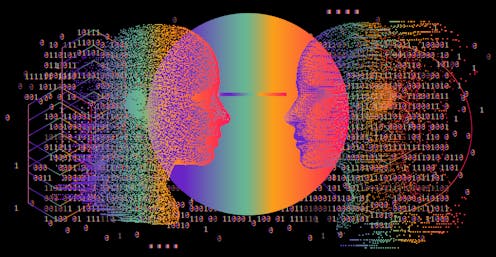
It’s also now possible to construct a digital twin of an individual person. In other words, a “digital doppelganger”.
A doppelganger is someone who looks spookily like you but isn’t. The word originated in German, and literally means a “double walker”. A number of industries are now using digital doppelgangers for a range of reasons. These include enhancing athletic performance, offering more personalised healthcare and improving workplace safety.
But although there are benefits to this technology, there are significant risks associated with its development. Having digital doppelgangers also forces us to reflect on which of our human attributes can’t be digitally replicated.
Modelling complex systems
The development of digital twins has been enabled by advances in environmental sensors, camera vision, augmented reality and virtual reality, as well as machine learning and artificial intelligence (AI).
A digital twin allows us to build and test things in cyberspace – cheaply and without risk – before deploying in the real world.
For example, we can build and stress-test infrastructure such as bridges or water supply pipes under a variety of conditions. Once built, we can use digital models to maintain the infrastructure proactively and prevent disastrous and costly structural breakdowns. This technology is a game-changer for planning and engineering, not only saving billions of dollars, but also supporting sustainability efforts.
Of course, replicating individual humans requires much more complex modelling than when building digital twins of bridges or buildings.
For a start, humans don’t live in a structured world, but rather inhabit complex social and physical environments. We are variable, moody and motivated by any number of factors, from hunger to tiredness, love to anger. We can change our past patterns with conscious thought, as well as act spontaneously and with creativity, challenging the status quo if needed.
Because of this, creating perfect digital twins of humans is incredibly challenging – if not impossible. Nevertheless, digital doppelgangers are still useful for a number of purposes.
The digital patient
Clinicians increasingly use scans to create virtual models of the human body, with which to plan operations or create artificial body parts.
By adding extra biometric information (for example, blood chemistry, biomechanics and physiological responses), digital models can also mirror real-world bodies, live and in real time.
Creating digital patients can optimise treatment responses in a move away from one-size-treats-all healthcare. This means drugs, dosages and rehabilitation plans can be personalised, as well as being thoroughly tested before being applied to real people.
Digital patients can also increase the accessibility of medical expertise to people living in remote locations. And what’s more, using multiple digital humans means some clinical trials can now be performed virtually.
Scaled up further, this technology allows for societal-level simulations with which to better manage public health events, such as air pollution, pandemics or tsunamis.
The digital athlete
Imagine being able to train against a digital replica of an upcoming opponent.
Sports scientists are increasingly working with digital athletes to trial and optimise strength and conditioning regimes, as well as test competitive play. This helps to increase the chances of winning as well as prevent injuries.
Researchers at Griffith University have been pioneers in this space, creating models of real athletes. They have also trialled wearable sensors in patches or smart clothing that can measure a range of biomarkers: blood pressure and chemistry, temperature, and sweat composition.
CSIRO and the Australian Sports Commission have also used digital humans to improve the performance of divers, swimmers and rowers.

The digital worker
As well as building virtual replicas of sports people, scientists at CSIRO have also being building virtual simulations of employees in various workplaces, including offices and construction sites.
This is helping them analyse movements, workflows and productivity – with the broader aim of preventing workplace injuries. For example, scientists can use a model of a digital worker to assess how heavy items are lifted in order to better understand how this puts strain on different parts of the body.
With 6.1 million Australians impacted by musculoskeletal conditions, preventing workplace injuries can not only improve lives, but save the economy billions of dollars.
Responsible development of digital doppelgangers
Building a digital doppelgangers requires a lot of very personal data. This can include scans, voice and video recordings, or performance and health data.
Personal data can also be harvested from an array of other sources. These include as cars, mobile phones, and internet-connected smart devices.
The creation of data-hungry digital replicas is forcing us to redefine legal rights. Think copyright, deepfakes and identity theft or online scams.
The power of this technology is inspiring. But ensuring a future in which we live happily alongside our digital doppelgangers will require governments, technology developers and end-users to think hard about issues of consent, ethical data management and the potential for misuse of this technology.
Authors: Alicia (Lucy) Cameron, Principal Research Consultant & Team Leader, Data61, CSIRO

















