

Why the WHO has recommended switching to a healthier salt alternative
- Written by: Xiaoyue (Luna) Xu, Scientia Lecturer, School of Population Health, UNSW Sydney
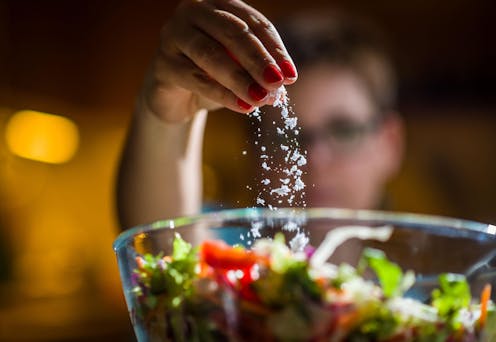
This week the World Health Organization (WHO) released new guidelines recommending people switch the regular salt they use at home for substitutes containing less sodium.
But what exactly are these salt alternatives? And why is the WHO recommending this? Let’s take a look.
A new solution to an old problem
Advice to eat less salt (sodium chloride) is not new. It has been part of international and Australian guidelines for decades. This is because evidence clearly shows the sodium in salt can harm our health when we eat too much of it.
Excess sodium increases the risk of high blood pressure, which affects millions of Australians (around one in three adults). High blood pressure (hypertension) in turn increases the risk of heart disease, stroke and kidney disease, among other conditions.
The WHO estimates 1.9 million deaths globally each year can be attributed to eating too much salt.
The WHO recommends consuming no more than 2g of sodium daily. However people eat on average more than double this, around 4.3g a day.
In 2013, WHO member states committed to reducing population sodium intake by 30% by 2025. But cutting salt intake has proved very hard. Most countries, including Australia, will not meet the WHO’s goal for reducing sodium intake by 2025. The WHO has since set the same target for 2030.
The difficulty is that eating less salt means accepting a less salty taste. It also requires changes to established ways of preparing food. This has proved too much to ask of people making food at home, and too much for the food industry.
Enter potassium-enriched salt
The main lower-sodium salt substitute is called potassium-enriched salt. This is salt where some of the sodium chloride has been replaced with potassium chloride.
Potassium is an essential mineral, playing a key role in all the body’s functions. The high potassium content of fresh fruit and vegetables is one of the main reasons they’re so good for you. While people are eating more sodium than they should, many don’t get enough potassium.
The WHO recommends a daily potassium intake of 3.5g, but on the whole, people in most countries consume significantly less than this.
Potassium-enriched salt benefits our health by cutting the amount of sodium we consume, and increasing the amount of potassium in our diets. Both help to lower blood pressure.
Switching regular salt for potassium-enriched salt has been shown to reduce the risk of heart disease, stroke and premature death in large trials around the world.
Modelling studies have projected that population-wide switches to potassium-enriched salt use would prevent hundreds of thousands of deaths from cardiovascular disease (such as heart attack and stroke) each year in China and India alone.
The key advantage of switching rather than cutting salt intake is that potassium-enriched salt can be used as a direct one-for-one swap for regular salt. It looks the same, works for seasoning and in recipes, and most people don’t notice any important difference in taste.
In the largest trial of potassium-enriched salt to date, more than 90% of people were still using the product after five years.
Making the switch: some challenges
If fully implemented, this could be one of the most consequential pieces of advice the WHO has ever provided.
Millions of strokes and heart attacks could be prevented worldwide each year with a simple switch to the way we prepare foods. But there are some obstacles to overcome before we get to this point.
First, it will be important to balance the benefits and the risks. For example, people with advanced kidney disease don’t handle potassium well and so these products are not suitable for them. This is only a small proportion of the population, but we need to ensure potassium-enriched salt products are labelled with appropriate warnings.
A key challenge will be making potassium-enriched salt more affordable and accessible. Potassium chloride is more expensive to produce than sodium chloride, and at present, potassium-enriched salt is mostly sold as a niche health product at a premium price.
If you’re looking for it, salt substitutes may also be called low-sodium salt, potassium salt, heart salt, mineral salt, or sodium-reduced salt.
A review published in 2021 found low sodium salts were marketed in only 47 countries, mostly high-income ones. Prices ranged from the same as regular salt to almost 15 times higher.
An expanded supply chain that produces much more food-grade potassium chloride will be needed to enable wider availability of the product. And we’ll need to see potassium-enriched salt on the shelves next to regular salt so it’s easy for people to find.
In countries like Australia, about 80% of the salt we eat comes from processed foods. The WHO guideline falls short by not explicitly prioritising a switch for the salt used in food manufacturing.
Stakeholders working with government to encourage food industry uptake will be essential for maximising the health benefits.
Authors: Xiaoyue (Luna) Xu, Scientia Lecturer, School of Population Health, UNSW Sydney

















