

why claims of a missing ‘fourth article’ of the Treaty don’t stack up
- Written by: Paul Moon, Professor of History, Auckland University of Technology
I sign this Treaty with my hand, but with the mana of my ancestors.
So said Hōne Heke, the first rangatira (chief) to sign the Treaty of Waitangi. To emphasise the gravity of this sentiment, he then mentioned two of his predecessors by name: Kaharau and Kauteawha.
It would be difficult to imagine a statement that could invest more mana in the Treaty than this. And Heke was not alone in his view of the agreement.
Many other rangatira similarly regarded the Treaty as a kawenata (covenant) of utmost importance, including some going as far as putting a representation of their tā moko (facial tattoo) on the document.
How each rangatira interpreted the Treaty’s provisions remains open to speculation. But what they committed themselves to abiding by was the text of the agreement (either the English version, or in the case of most signatories, the translation in te reo Māori).
That text was comprised of a preamble, followed by three operative articles. Some rangatira read it, some had it read to them. But as far as all the parties were concerned, that was the entirety of the Treaty.
In the 1990s, however, suggestions began to surface about a mysterious “fourth article” guaranteeing religious protections. It was not part of the text, but supposedly a verbal promise that amounted to a provision of the agreement.
The idea has gained sufficient traction for supporters to petition parliament late last year to recognise the fourth article, just as debate about the Treaty Principles Bill was heating up. But it is a claim that needs to be treated with caution and scrutiny.
Religious protections
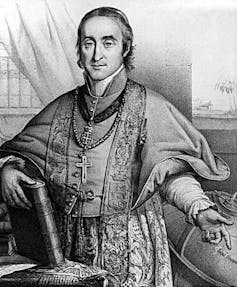
Prior to the first signing of the Treaty – at Waitangi – the Anglican missionary Henry Williams had observed that some Catholic rangatira were reluctant to commit to the agreement.
The Catholic Bishop, Jean-Baptiste Pompallier, had queried British motives and insisted Catholic rangatira should receive specific protection from the Crown. Williams then read out a hastily-prepared statement to clarify the issue:
The Governor wishes you to understand that all the Maories (sic) who shall join the Church of England, who shall join the Wesleyans, who shall join the Pikopo or Church of Rome, and those who retain their Maori practices, shall have the protection of the British Government.

Williams noted that this statement “was received in silence. No observation was made upon it; the Maories, and others, being at perfect loss to understand what it could mean.”
And there the matter ought to have ended: a peripheral detail in a momentous day. But this minor episode was disinterred from its historical obscurity in 1995 at a meeting of the New Zealand Catholic Bishops Conference.
The clerics announced that a “fourth article was added to the Maori text of the Treaty signed at Waitangi, at the request of Bishop Jean Baptiste […] This article guaranteed religious freedom for all in the new nation, including Maori.”
Some Anglicans soon endorsed this position. The “fourth article” thus entered the bloodstream of Treaty discourse and began to circulate freely.
Missing evidence
There are several objections to the claim of a fourth article of the Treaty.
Firstly, if it was regarded as a part of the Treaty at the signing on February 6 1840, then we would expect to see both contemporaneous confirmation of this, and subsequent evidence that is consistent with it.
Yet, these categories of evidence are largely absent. Indeed, mention of a “fourth article” before the 1990s does not exist.
The sentiment of the fourth article is also absent from the instructions for the Treaty issued by Lord Normanby, British Secretary of State for the Colonies, in 1839.
Indeed, far from the Crown wishing to guarantee freedom of cultural or religious beliefs, Normanby made it explicit that only those Māori customs the British regarded as acceptable would be protected:
[The] savage practices of human sacrifice and cannibalism must be promptly and decisively interdicted; such atrocities, under whatever plea of religion they may take place, are not to be tolerated in any part of the dominions of the British Crown.
Therefore, as far as one party to the Treaty was concerned, the idea of the fourth article was never in contention. What was explicitly promised to all people was the protection of the British government, and not the protection of all customs held by Māori.
Treaties are written
As every other contemporaneous source confirms, no rangatira sought this fourth article, and around 90% of rangatira who signed the Treaty (in places other than Waitangi) did not have this so-called fourth article read to them (and so could not have consented to it).

Nor was it included in the text of copies of the agreement that were subsequently circulated around the country, and neither Hobson nor Pompallier suggested it was an “article” as such.
International law requires that treaties be in a written form. This certainly has been the convention as far as European treaties are concerned, extending back several centuries.
It makes any suggestion Hobson admitted an oral article extremely problematic. Likewise, New Zealand’s domestic law also specifies the Treaty contains only three articles.
Furthermore, if spoken commitments have the status of an article, then what about other verbal commitments made at some of the Treaty signings? Singling out one statement as a presumed article is inconsistent. Either the principle of all verbal commitments in such a setting constitute articles of the Treaty, or none does.
Previous attempts to insert the fourth article into the country’s constitutional framework have gone nowhere. And in the absence of more persuasive historical evidence, it’s likely to stay that way.
As the late Kingi Tūheitia succinctly put it: “The Treaty is written. That’s it.”
Authors: Paul Moon, Professor of History, Auckland University of Technology



















.jpg)