

Sydney Festival artists witness climate change, and imagine our post-apocalyptic future
- Written by: Blake Lawrence, PhD Candidate (Design) and Performance Artist, University of Technology Sydney
The first weeks of 2025 have seen catastrophic wildfires locally and internationally, record global ocean temperatures, and unprecedented coral bleaching events.
Trump has signed executive orders to exit from the Paris Agreement, and locally, the Coalition continues its decades-long campaign of climate denial
Species fall swiftly and silently to extinction. The language of bird-song collapses. For many peoples, and for many species, apocalypse is past tense.
For climate risk researchers Laurie Laybourn and James Dyke, politics illustrates a doom loop, a political diving-towards apocalypse.
Artists in this year’s Sydney Festival imagine exit strategies from this doom loop – and dream of taking root in its post-apocalyptic rubble.
Anito
Phasmahammer is the alter-ego and ongoing creative project of artist Justin Talplacido Shoulder. Anito is the latest in a series of their theatre-scale works that blend live performance with mythology, story-telling, costume and ceremony.
We begin in the cavernous Carriageworks foyer with a living miniature fig tree.
Damun (as it is known in the Gadigal language), Ficus rubingosa (Latin), the Port Jackson fig, is known for establishing itself insurgently in the pavements and gutters of the city’s colonial (apocalyptic) architecture.
Here, the bonsai sits like a welcome party, stifled and vibrant in its little pot.
In an introductory speech, Shoulder’s collaborator Matthew Stegh acknowledges the city of Sydney as “a theatre and a prison” – tripling in reference to both the experience of producing theatre for institutions, and the stunted experience of our little fig.

He pays homage to the ecological and cosmological traditions of Gadigal Country, and to the ancestral Philippines of Shoulder. In the next breath Stegh shifts his homage to Sydney’s histories of queer and counter-cultural performance, to sex workers, strippers, clowns, club kids and drag queens.
He offers reflections on apocalypse and ruin, referring to the “cultish suicide pact” of white supremacy, capitalism, imperialism and colonialism – to doom loops.
We are led into the auditorium, where Shoulder and fellow performer Eugene Choi animate a series of hallucinatory images.
Using their bodies, costume pieces, puppetry and inflatable set design, they work with immaculate sound (Corin Ileto) and lighting (Fausto Brusamolino).
A ghostly hologram of the buttress of a great tree fills the stage. Metallic roots writhe at its foundation. Shoulder and Choi emerge, and from there, eruptions: the first man and woman, a pair of thunder-lizards, bickering, a quadruped. A scale-bending colonial ghost smothered in lace searches tragically for something among planetary ruins. A stony reef of polyps and anemones blooms and dances. A single clap by three pairs of hands. The Big Bang.

By design, it is often hard to discern exactly how these images are performed. They are both magic and bewildering.
For philosopher Ben Ware, thinking about the horizon of the extinction of all biological life on Earth poses a paradoxical opportunity. The only thing that can thwart the end of this world – “a world of converging and multiplying catastrophes” – is the recognition that the politics of this time have one outcome: “the slow unravelling of intimately entangled forms of life”.
The fantasy theatre of Anito makes those intimate entanglements visual. We must begin from understanding that the way the world is organised produces its own end.
Like Shoulder, artist communities of the Pacific know this intimately.
Re-Stor(y)ing Oceania
Re-Stor(y)ing Oceania is an exhibition led by artists of the South Pacific Ocean.
Originally conceived for the Venice Biennale, and curated by Taloi Havini, the exhibition comprises two commissions by Elisapeta Hinemoa Heta and Latai Taumoepeau.
 This is a space for conversation, performance, song and activism.
Giacomo Cosua/Sydney Festival
This is a space for conversation, performance, song and activism.
Giacomo Cosua/Sydney Festival
The rooms of a freshly-renovated Artspace in Woolloomooloo are transformed by Heta’s architectural interventions. In one, a mass of bricks creates an altar-like structure, on which bowls of coconut milk sit in concentric circles. In another, pavers form a platform for a circle of seats. They function as stages or gathering places for conversation, performance, song and activism.
Within these happenings, Havini and her artists speak to the narrative and politics that have produced and compounded catastrophe in the South Pacific.
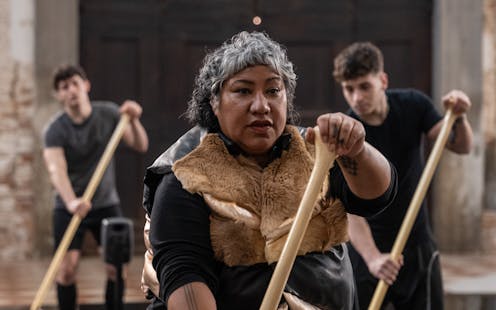
Taumoepeau’s interactive installation Deep Communion sung in minor (ArchipelaGO, THIS IS NOT A DRILL) requires visitors to row on standing-paddle-board-like treadmills, which activate immersive songs sung by Taumoepeau and her collaborators.
 The physical exacerbation and the ecological trauma on the screens coalesce in our bodies.
Giacomo Cosua/Sydney Festival
The physical exacerbation and the ecological trauma on the screens coalesce in our bodies.
Giacomo Cosua/Sydney Festival
In conversation with Heta’s installation, these songs rise and fall, the edges of the artworks and activations become blurry. Visitors paddle towards projections visualising the rubble of marine-ecological wastelands produced by regional deep-sea extraction.
The physical exacerbation and the ecological trauma on the screens coalesce in our bodies. To drop the oar enacts the fading of the song from the speakers. We are left with reflections of the connections between bodies and calamity, and the labour of working towards futures beyond ruin.
Plant a Promise
Henrietta Baird’s Plant a Promise, like Anito and Re-Stor(y)ing Oceania, is a performance with blurry edges. Its roots spread out of Bangarra’s Studio Theatre to incorporate installation, in-situ yarns (storytelling and conversation) and tree-planting projects across the city.
Inside the theatre, three contemporary dancers animate recorded stories of Indigenous experiences of bushfires beside frustrations with the surrounding political footballing. The sentiment is clear: less talk, more action.
 Plant a Promise beckons audiences into attentiveness to the lives of trees, fire and people.
Stephen Wilson Barker/Sydney Festival
Plant a Promise beckons audiences into attentiveness to the lives of trees, fire and people.
Stephen Wilson Barker/Sydney Festival
At its finale, audience members are invited to the stage to collaborate in the transformation of the set. We are led to take handfuls of verdant eucalyptus and acacia leaves and implant them into large woven columns that have functioned theatrically as abstracted tree-forms. The stage is transformed into a forest of our making together.
Through its many stories, Plant a Promise beckons audiences into attentiveness to the lives of trees, fire and people.
In the shadows of catastrophe, the roots of Indigenous knowledge systems and environmental science cross-pollinate to share and enact care for Country.
 The stage is transformed into a forest of our making together.
Stephen Wilson Barker/Sydney Festival
The stage is transformed into a forest of our making together.
Stephen Wilson Barker/Sydney Festival
Generously, we receive a gift as we exit the theatre. The exchange of a native sapling invites us into casual conversation – into reflections on Country, and how we might, all of us, commit to it.
Again, we begin, from the recognition of an end. More rubble. More roots.
Putricia
At the time of writing, Sydneysiders are enamoured with the life of another plant, gathered around livestreams and making excited trips to the city’s Botanic Gardens.
Putricia, the resident titan arum, or corpse flower (Amorphophallus titanium), has thrown her immense flower spike into the air. She has commenced her slow strip-tease after a week of tantalising her admirers.
In a few weeks we have become attentive to her story of life and renewal. She will likely have bloomed, wilted and returned to the soil before this text goes live.
 Putricia near the end of her 24 hour bloom at the Royal Botanic Gardens on January 24 2025.
AAP Image/Dan Himbrechts
Putricia near the end of her 24 hour bloom at the Royal Botanic Gardens on January 24 2025.
AAP Image/Dan Himbrechts
Performances like Putricia’s blooming, Anito, Re-Stor(y)ing Oceania and Plant a Promise offer new vantage points from which to understand ourselves in relation to the natural world, and to glimpse myriad alternatives to what feels like a diving towards our own demise.
Performances of aliveness beside and within the ecologies we inhabit move us beyond what Ben Ware sees as a naïve sense of “hope”. Instead, these stories make material, make cultural, make real, the impossible task of imagining what comes next.
Amid the smell of rotting corpses, the pillowy puppetry of a theatrical coral spawning event, the planting of a forest or the singing of invocations for the protection of the planet’s oceans, we might yet find ourselves. This is not a drill.
Authors: Blake Lawrence, PhD Candidate (Design) and Performance Artist, University of Technology Sydney


















