

Habitat restoration is a long-haul job. Here are 3 groups that have endured
- Written by: Nigel Tucker, Research Associate in Environment and Sustainability, James Cook University
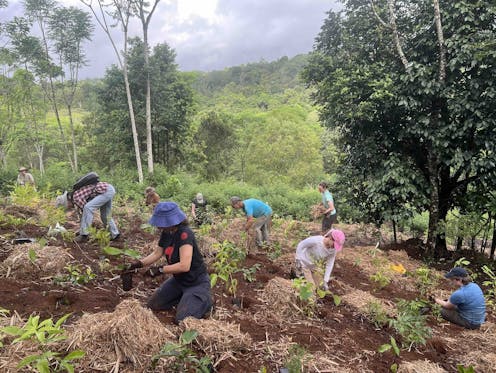
Like ferns and the tides, community conservation groups come and go. Many achieve their goal. Volunteers restore a local wetland or protect a patch of urban bush and then hang up the gardening gloves with a warm inner glow. Some groups peter out while others endure, tackling the ecological problems facing today’s Australia.
One of those problems is fragmentation. Let’s say you have a national park in one spot and another large tract of habitat ten kilometres away. It’s too hard for many wildlife species to make it across open ground to get there. Over time, this means wild areas can effectively become islands.
This is where habitat corridors come in. Potentially, if you restore habitat between two isolated areas, wildlife can begin to safely move between the two. Over time, these corridors allow seeds, pollen, native birds and animals to disperse across today’s landscapes.
In my work as a restoration ecologist, I’ve come across many of Australia’s community groups devoted to the job. Three of these are LUCI – Lockyer Upland Catchments Inc, which began in 2015, the Big Scrub Rainforest Conservancy, founded in 1993 and TREAT – Trees for the Evelyn and Atherton Tablelands Inc, which began in 1982. Each of these has gone the distance. Here are some reasons why.

Where are wildlife corridors most needed?
Australia’s Wet Tropics are especially threatened by fragmentation. This region is World Heritage listed due to its remarkable biodiversity. Tropical forests have grown here for at least 130 million years. Fragmentation directly threatens this.
In the tropical uplands of the Atherton Tablelands, there are three popular national parks – the Crater Lakes of Eacham and Barrine and the Curtain Fig Tree. But while visitors might see them as pristine, each is an island surrounded by pasture and settlement. Over time, this will take its toll on the species within.

Staying the course
For a volunteer group to reverse the effects of fragmentation, and embark on a long term project such as this, it needs three things.
First the group has leaders committed to a long term cause, usually scientists or naturalists as well as locals with knowledge and drive. Leaders have to be able to work with governments and group members of all persuasions.
Second, the group has to be guided by science. You need current information on local plants, animals and habitats to make sure on-ground work has direct conservation benefits.
And third, networking skills. Harnessing the technical expertise of other groups, government and experts in project planning, execution and monitoring is vital.
Each of these three groups has these traits, even though they take different approaches to the challenge.
LUCI is an alliance of private landholders in Queensland’s Lockyer Valley, west of Brisbane, who work to protect remnant vegetation and expand habitat. Their work on threatened species monitoring, protection of remnant vegetation on private land and community engagement reflects their emphasis on education.
Before European settlement, lowland subtropical rainforest covered 75,000 hectares of land in what is now Byron Bay’s hinterland. But 99% was cut down. In response, Big Scrub members have replanted around 600 hectares – doubling the size of what was left – and established an innovative genetics program to assist in maintaining and enhancing the gene pool of trees planted.
 Only a tiny fraction of the Big Scrub is still intact, at reserves such as the Andrew Johnston Big Scrub reserve. Farmland and acreage surrounds it.
Peter Woodard/Wikimedia Commons, CC BY
Only a tiny fraction of the Big Scrub is still intact, at reserves such as the Andrew Johnston Big Scrub reserve. Farmland and acreage surrounds it.
Peter Woodard/Wikimedia Commons, CC BY
TREAT is based on the Atherton Tablelands in far north Queensland. This region has long been prized for agriculture, which comes at a cost to habitat. In response, TREAT has worked to reconnect isolated tracts of rainforest. The group collaborates with Queensland Parks and Wildlife to grow many thousands of native rainforest tree seedlings for planting each year.
 TREAT grows tens of thousands of seedlings annually, alongside Queensland Parks and Wildlife. Pictured: Hicksbeachia seedlings.
TREAT
TREAT grows tens of thousands of seedlings annually, alongside Queensland Parks and Wildlife. Pictured: Hicksbeachia seedlings.
TREAT
All three groups recognise the importance of countering habitat fragmentation. This slicing and dicing forests into smaller and isolated patches severely threatens Australia’s biodiversity.
Wildlife corridors are deceptively simple in theory. But as I know from long experience restoring habitat, it’s harder than it seems.
Does it work?
Planting corridors sounds like a sure thing. But success is not guaranteed. For one thing, it takes work and time. You need baseline surveys, expert analysis of data and monitoring, ideally over decades. Given these challenges, it’s unsurprising that wildlife corridor restoration is little-studied.
In the 1990s, TREAT volunteers planted 17,000 trees to reconnect a 498 hectare fragment around Lake Barrine to the 80,000ha Wooroonooran National Park 1.2 kilometres away. This corridor is now more than 20 years old. It’s known as the Donaghy’s Corridor Nature Refuge, after the Donaghy family who donated the land for corridor restoration.
 Donaghy’s Corridor Nature Refuge in Far North Queensland connects two areas of rainforest.
Biotropica Australia, Author provided (no reuse)
Donaghy’s Corridor Nature Refuge in Far North Queensland connects two areas of rainforest.
Biotropica Australia, Author provided (no reuse)
My research has found this corridor is proving successful, using good data collected before, during and after establishment. Ground mammals are moving along the corridor, and breeding has taken place. We could see this in the exchange of genes between two previously separated populations of the native bush rat (Rattus fuscipes).
More recent studies have shown the corridor has been colonised by many species, ranging from threatened and endemic plants to birds, ground mammals, reptiles, amphibians and microbats. While promising, this is just one corridor. Much more data would be needed to prove this approach is broadly effective.
As habitat fragmentation continues and the effects of climate change ramp up, more and more species will need to move. The work of volunteer groups such as LUCI, Big Scrub and TREAT in reconnecting scattered pieces of habitat is only going to get more important.
Authors: Nigel Tucker, Research Associate in Environment and Sustainability, James Cook University



















