

how stop-motion films went from obscure ‘creature features’ to winning Oscars
- Written by: Jack McGrath, Lecturer in Animation, University of Newcastle
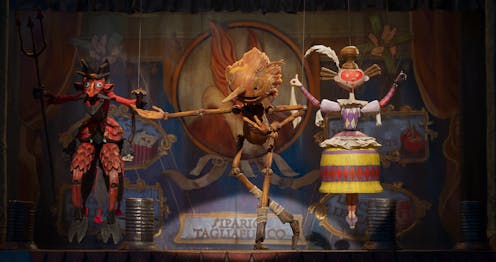
The 2025 Academy Awards could shape up to be a big one for stop-motion animation. Australian director Adam Eliott’s Memoir of a Snail (2024) has raked in a nomination for Best Animated Feature Film, alongside Wallace & Gromit: Vengeance Most Fowl (2024).
Read more: Overtly handmade and so very moving: Adam Elliot’s Memoir of A Snail is a stop motion triumph
Coincidentally, this recognition comes in what is already an historic year for stop motion. A century ago, on February 8 1925, The Lost World hit cinemas. This film is widely considered the first feature-length stop-motion production, as well as the first “creature feature”.

Audiences were captivated as they watched animated dinosaurs share the screen with live actors. The animators positioned and photographed miniature dinosaurs made of rubber, one frame at a time, to create moving sequences that accompanied full-scale shots with human actors.
This method drew from earlier works such as Georges Méliès’s 1902 short film A Trip to the Moon (Le voyage dans la lune).

Dynamation: the beginnings
After animating on The Lost World, stop-motion pioneer Willis O’Brien went on to animate King Kong (1933) and the lesser-known Mighty Joe Young (1949), where he mentored Ray Harryhausen.
Harryhausen himself would later design and animate some of the most celebrated stop-motion sequences of all time, including the famous skeleton fight in Jason and the Argonauts (1963) and the fictional Rhedosaurus from The Beast from 20,000 Fathoms (1953).
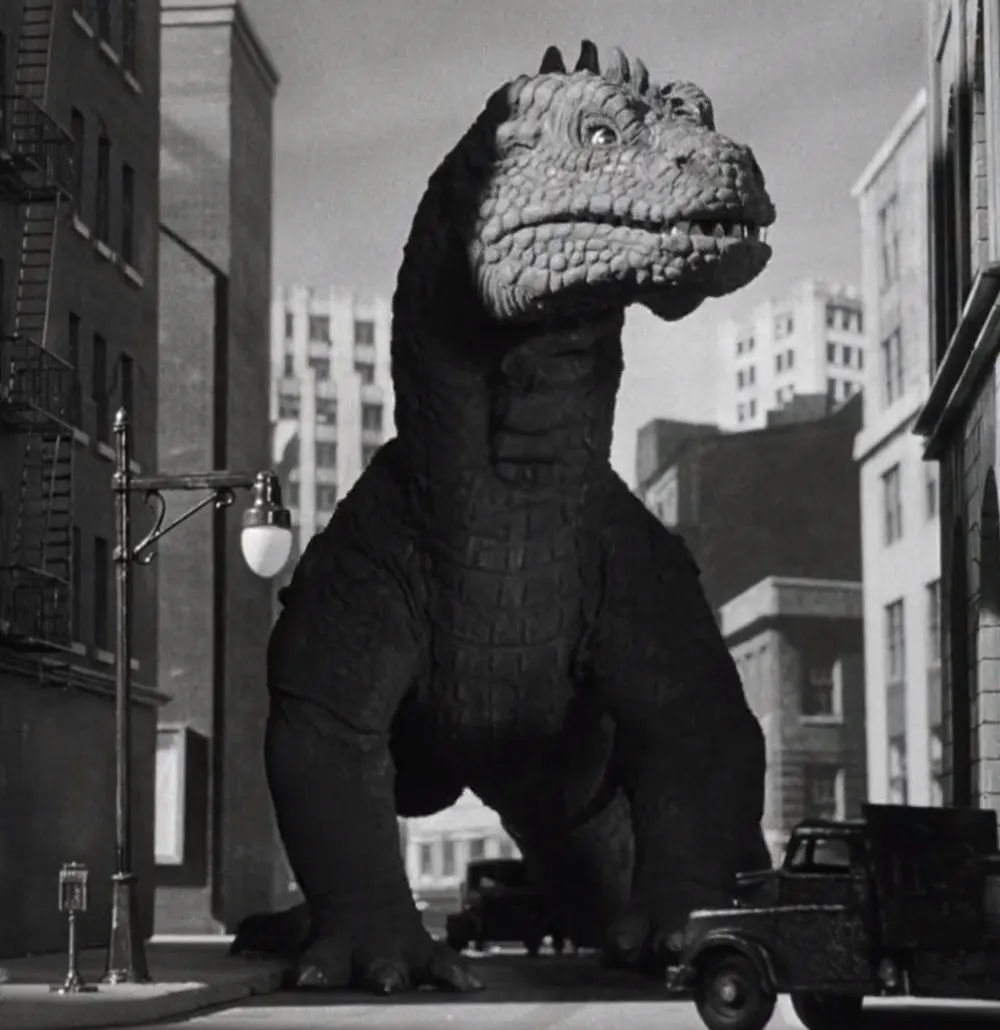 The Rhedosaurus from The Beast from 20,000 Fathoms.
Wikimedia
The Rhedosaurus from The Beast from 20,000 Fathoms.
Wikimedia
The blend of animated miniatures and live actors become known as Dynamation, as Harryhausen pushed to create ever-more integrated and dynamic sequences in which animated puppets “interacted” with real actors.
Back then it wasn’t possible to review animation as it was being shot; you could only see the puppet as it was in the moment. Sequences were shot on celluloid film, and animators had to wait for the film to develop before they could see the results.
The famous skeleton fight in Jason and the Argonauts required Harryhausen to remember the movements of seven skeletons and line up a fight sequence with two pre-recorded actors, one frame at a time. He would often work for months before being able to review his work.
In Eastern Europe, filmmakers such as Karel Zeman were also combining live action with miniature special effects and stop motion – extending a long history of Eastern European puppet theatre into cinema.
In 1958, Zeman brought Jules Vernes’ whimsical vehicles and underwater worlds to the screen in his feature film Invention for Destruction (Vynález zkázy).
Zeman’s work went on to influence famous animators such as Jan Švankmajer and Terry Gilliam.
 Invention for Destruction was later named The Fabulous World of Jules Verne. Zeman used a combination of puppetry, stop motion and live action effects for the film.
IMDB
Invention for Destruction was later named The Fabulous World of Jules Verne. Zeman used a combination of puppetry, stop motion and live action effects for the film.
IMDB
Technology advances
In the 1970s, Phil Tippet and others working at Industrial Light and Magic (ILM) – a studio founded by George Lucas – pushed the medium further through the development of “go-motion”.
This invention used a custom-made control rig that precisely moved a puppet while it was being photographed – resulting in a subtle motion blur that emulated live-action movement.
This technique allowed for more realistic animation and was used in productions such as Dragon Slayer (1981) and Star Wars: The Empire Strikes Back (1980).
In the 1980s, however, Star Wars began a trend towards photorealism and audiences became more scrutinising of visual effects. Harryhausen’s creatures in Clash of the Titans (1981) appeared especially hammy and outdated even for the time.
The CGI scare
In the early 90s, Phil Tippet and colleagues at ILM, in the pursuit of perfecting the craft, developed test dinosaur sequences for Steven Spielberg’s Jurassic Park (1993). Tippet animated the original test sequences in stop motion.
Also at ILM, Dennis Muren was experimenting with a new kind of animation for creatures made entirely using computer software. These were the early days of computer-generated imagery (CGI).
When Tippet saw an early Jurassic Park test of CGI dinosaur footage, he said to Steven Spielberg “I’m extinct”.
Nonetheless, once it was decided the dinosaurs would be created with CGI, Tippet continued working on the film. He used a dinosaur-shaped physical rig, which allowed changes to the rig’s position to translate to CGI movements onscreen. Stop-motion animators were helpful in this process because “CGI animators” as we know them didn’t yet exist.
Amid a CGI-induced scare, Tim Burton and Henry Selicks’ The Nightmare Before Christmas (1993) became the first fully stop-motion animated feature to be produced by a major studio. This film proved stop motion could be achieved at a Hollywood scale.
Stop motion took a backseat to CGI in the years that followed. Pixar’s Toy Story (1995), the world’s first fully CGI animated feature, cemented CGI as the way of the future.
The only other noteworthy stop-motion cinematic release came at the turn of the century, when DreamWorks teamed up with Aardman Animations to produce Chicken Run (2000), following a number of successful stop motion shorts, starting with Wallace and Gromit’s A Grand Day Out in 1989.
The comeback
Eventually, innovations in digital cameras and motion control paved the way back to stop motion, giving us films such as Wallace & Gromit: The Curse of the Were-Rabbit (2005) and The Corpse Bride (2005).
Working on Coraline (2008), Laika studios introduced 3D printing technology for a sophisticated form of replacement animation, in which different body and facial pieces are swapped to create character movements and expressions.
Traditionally, this technique was achieved by carving individual wooden models and swapping them out between capturing frames. This is how filmmaker George Pal made his Puppetoons films in the 1930s.
Embracing new tech brought stop motion back onto the world stage, with studios such as Laika leading the charge. Since then, we’ve seen the release of features including ParaNorman (2012), The Boxtrolls (2014), Kubo and the Two Strings (2016), Missing Link (2019) and Guillermo del Toro’s Academy Award-wining Pinnoccio (2022).
A new era of stop-motion features
Despite huge developments in CGI, audiences still appreciate the painstaking work of bringing inanimate objects to life frame by frame.
There are more stop motion films being made than ever before, with independent filmmakers and students creating quality sequences for a fraction of what it cost 30 years ago.
Some directors use the medium for its connection with real materials, and out of respect for the art form. Phil Tippet spent more than 30 years on his stop motion feature Mad God (2021) – an experimental and intense horror magnum opus that embodies the materiality of stop motion.
Wes Anderson says his approach to stop motion in Fantastic Mr. Fox (2009) was “very much about bringing to life the [characters’] performance.”
In Pinocchio (2022), Guillermo del Toro tells the touching story of a puppet, using real puppets, in which imperfection and human frailty are emphasised.
We’re also seeing the return of stop-motion creature effects, such as with Disney’s Star Wars series Skeleton Crew (2024–25), in which live action is once again integrated with stop-motion puppets.
The development of artificial intelligence (AI) is now pushing audiences and creators to question what they value in animation, cinema and art more generally.
If AI could generate high-quality films with a stop-motion aesthetic, would we value them as much as those productions that were laboured over for years on end? The recent Oscar nominees may hold the answer.
Authors: Jack McGrath, Lecturer in Animation, University of Newcastle


















