

Earth is already shooting through the 1.5°C global warming limit, two major studies show
- Written by: Andrew King, Associate Professor in Climate Science, ARC Centre of Excellence for 21st Century Weather, The University of Melbourne
Earth is crossing the threshold of 1.5°C of global warming, according to two major global studies which together suggest the planet’s climate has likely entered a frightening new phase.
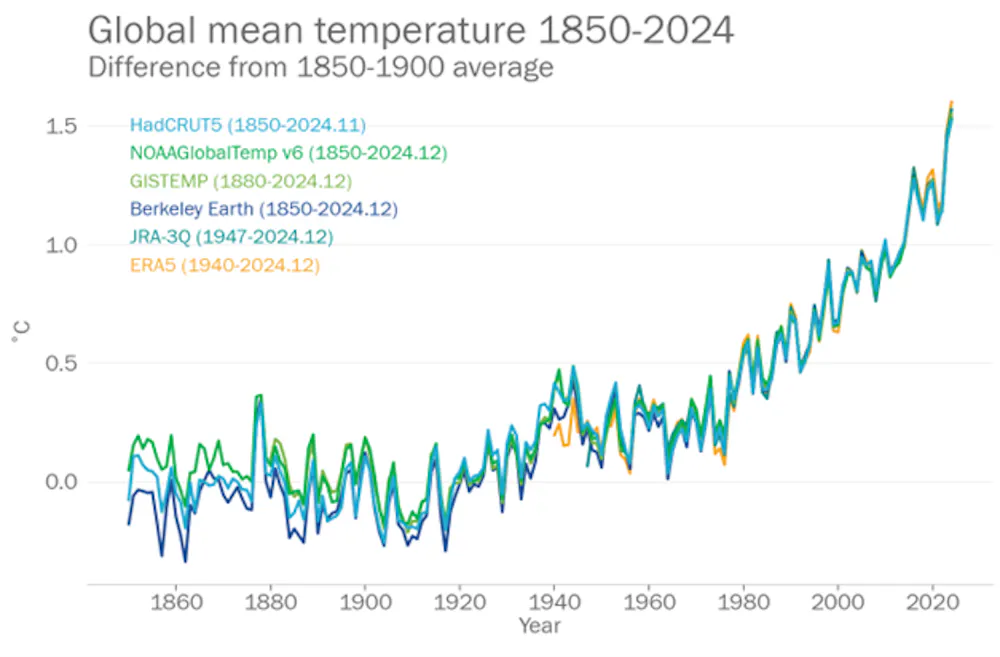
Under the landmark 2015 Paris Agreement on climate change, humanity is seeking to reduce greenhouse gas emissions and keep planetary heating to no more than 1.5°C above the pre-industrial average. In 2024, temperatures on Earth surpassed that limit.
This was not enough to declare the Paris threshold had been crossed, because the temperature goals under the agreement are measured over several decades, rather than short excursions over the 1.5°C mark.
But the two papers just released use a different measure. Both examined historical climate data to determine whether very hot years in the recent past were a sign that a future, long-term warming threshold would be breached.
The answer, alarmingly, was yes. The researchers say the record-hot 2024 indicates Earth is passing the 1.5°C limit, beyond which scientists predict catastrophic harm to the natural systems that support life on Earth.
2024: the first year of many above 1.5°C
Climate organisations around the world agree last year was the hottest on record. The global average temperature in 2024 was about 1.6°C above the average temperatures in the late-19th century, before humans started burning fossil fuels at large scale.
Earth has also recently experienced individual days and months above the 1.5°C warming mark.
But the global temperature varies from one year to the next. For example, the 2024 temperature spike, while in large part due to climate change, was also driven by a natural El Niño pattern early in the year. That pattern has dissipated for now, and 2025 is forecast to be a little cooler.
These year-to-year fluctuations mean climate scientists don’t view a single year exceeding the 1.5°C mark as a failure to meet the Paris Agreement.
However, the new studies published today in Nature Climate Change suggest even a single month or year at 1.5°C global warming may signify Earth is entering a long-term breach of that vital threshold.
What the studies found
The studies were conducted independently by researchers in Europe and Canada. They tackled the same basic question: is a year above 1.5°C global warming a warning sign that we’re already crossing the Paris Agreement threshold?
Both studies used observations and climate model simulations to address this question, with slightly different approaches.
In the European paper, the researchers looked at historical warming trends. They found when Earth’s average temperature reached a certain threshold, the following 20-year period also reached that threshold.
This pattern suggests that, given Earth reached 1.5°C warming last year, we may have entered a 20-year warming period when average temperatures will also reach 1.5°C.
The Canadian paper involved month-to-month data. June last year was the 12th consecutive month of temperatures above the 1.5°C warming level. The researcher found 12 consecutive months above a climate threshold indicates the threshold will be reached over the long term.
Both studies also demonstrate that even if stringent emissions reduction begins now, Earth is still likely to be crossing the 1.5°C threshold.
Heading in the wrong direction
Given these findings, what humanity does next is crucial.
For decades, climate scientists have warned burning fossil fuels for energy releases carbon dioxide and other gases that are warming the planet.
But humanity’s greenhouse gas emissions have continued to increase. Since the Intergovernmental Panel on Climate Change released its first report in 1990, the world’s annual carbon dioxide emissions have risen about 50%.
Put simply, we are not even moving in the right direction, let alone at the required pace.
The science shows greenhouse gas emissions must reach net-zero to end global warming. Even then, some aspects of the climate will continue to change for many centuries, because some regional warming, especially in the oceans, is already locked in and irreversible.
If Earth has indeed already crossed the 1.5°C mark, and humanity wants to get below the threshold again, we will need to cool the planet by reaching “net-negative emissions” – removing more greenhouse gases from the atmosphere than we emit. This would be a highly challenging task.
Feeling the heat
The damaging effects of climate change are already being felt across the globe. The harm will be even worse for future generations.
Australia has already experienced 1.5°C of warming, on average, since 1910.
Our unique ecosystems, such as the Great Barrier Reef, are already suffering because of this warming. Our oceans are hotter and seas are rising, hammering our coastlines and threatening marine life.
Bushfires and extreme weather, especially heatwaves, are becoming more frequent and severe. This puts pressure on nature, society and our economy.
But amid the gloom, there are signs of progress.
Across the world, renewable electricity generation is growing. Fossil fuel use has dropped in many countries. Technological developments are slowing emissions growth in polluting industries such as aviation and construction.
But clearly, there is much more work to be done.
Humanity can turn the tide
These studies are a sobering reminder of how far short humanity is falling in tackling climate change.
They show we must urgently adapt to further global warming. Among the suite of changes needed, richer nations must support the poorer countries set to bear the most severe climate harms. While some progress has been made in this regard, far more is needed.
A major shift is also needed to decarbonise our societies and economies. There is still room for hope, but we must not delay action. Otherwise, humanity will keep warming the planet and causing further damage.
Authors: Andrew King, Associate Professor in Climate Science, ARC Centre of Excellence for 21st Century Weather, The University of Melbourne


















