

Spacefarers may contaminate other worlds – but scientists have plans to keep the cosmos clean
- Written by: Kirsten Banks, Lecturer, School of Science, Computing and Engineering Technologies, Swinburne University of Technology
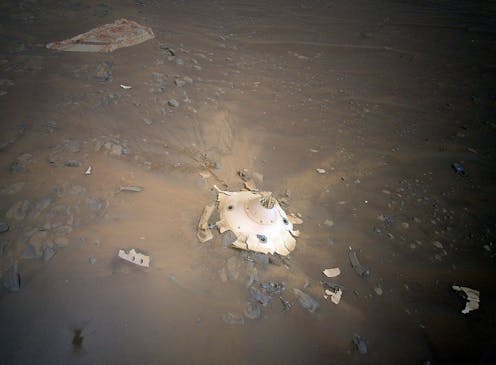
In his inauguration speech in January, United States President Donald Trump declared the US would “plant the stars and stripes on the planet Mars”.
This shouldn’t come as a surprise. In 2017, in Trump’s previous term of office, he promised to “establish a foundation for an eventual mission to Mars”. And his billionaire adviser Elon Musk is famously obsessed with colonising the red planet.
The first spacecraft to successfully explore another planet was NASA’s Mariner 2 mission. It passed within 35,000km of Venus on December 14 1962. Since then, there have been many successful missions to explore various planets, moons, asteroids and comets in the Solar System.
But in our quest to explore celestial bodies, we risk contaminating them. And if we were to inadvertently contaminate a world that has the potential to host life – either now or in the past – that could compromise all future scientific investigations. It could also affect any life that may currently exist there.
Because of this, space agencies such as NASA take the issue of interplanetary contamination very seriously. To decrease the risk, it uses a range of methods. And scientists are developing new ways to ensure biological material from Earth doesn’t make its way onto another planet.
Two types of contamination
Interplanetary contamination refers to a scenario in which a spacecraft carries biological material from one planetary object to another. Research indicates previous missions to Mars may have contaminated it with bacterial spores from Earth.
There are two types of interplanetary contamination.
The first is when biological material from Earth is transported to another planetary object, resulting in contamination. This is known as forward contamination.
The second type is when biological material from an extraterrestrial source is brought back to Earth and contaminates Earth’s environment. This is known as back contamination.

Even before the first successful launch of a human-made object to space, scientists were talking about the importance of mitigating interplanetary contamination.
For example, at the Seventh Congress of the International Astronautical Federation in Rome in September 1956, one year before the launch of Sputnik 1, concerns were raised about the possibility of contaminating the Moon and other planetary bodies in the Solar System.
Since then, space agencies across the world have implemented strategies to safeguard missions against interplanetary contamination.
High temperatures, clean rooms and death plunges
There are several strategies to minimise forward contamination – for example, using high temperatures or chemicals to sterilise the components of a spacecraft.
Scientists and engineers also assemble spacecraft in clean rooms before launching them into space.
However, these methods have limitations. In particular, spacecraft materials can be sensitive to high temperatures. Chemicals can also tarnish metals and break down essential coatings.
Strategies are also employed at the end of planetary missions to minimise the potential for forward contamination.
For example, at the end of its 13-year journey exploring the environment around Saturn and its moons, the Cassini space probe plunged into the depths of Saturn’s atmosphere.
This so-called “death plunge” alleviated the risks of contaminating moons that could potentially host life, such as Titan and Enceladus. The extreme heat experienced by Cassini essentially incinerated the probe. This likely sterilised any potential contaminants carried by the probe from Earth.
Biological barriers
Scientists must also reduce the risk of potential back contamination on sample return missions.
For example, in the recent OSIRIS-REx sample return mission, a sample collected from near-Earth asteroid Bennu was sealed in an airtight container on its return to Earth.
This ensured no extraterrestrial material could be released into Earth’s environment in an uncontrolled way. Once scientists retrieved the return capsule from the Utah desert, they carefully transported it to a specialised facility designed for handling potentially hazardous materials.
Facilities such as these are designed with biological barriers to prevent the escape of materials or organisms into Earth’s environment.
They also function as “cleanrooms” to prevent potential forward contamination of the samples from Earth-based organisms.

New methods
Scientists are also developing new methods to reduce the risk of interplanetary contamination.
For example, a recent paper in Nature described a method known as the “active plasma steriliser”.
This system uses plasma at low temperatures to effectively decontaminate materials in as little as 45 minutes.
This novel technology works on short timescales. And unlike previous methods that use high temperatures, it can be used on materials and spacecraft components sensitive to temperature.
We can learn a lot about the potential impact of interplanetary contamination from present and future space missions by looking at our own backyard here in Australia.
European colonisation led to the introduction of numerous invasive species, such as European rabbits in the 1800s. In turn, this led to widespread environmental damage.
Similarly, the arrival of foreign diseases following colonisation caused devastating losses among Aboriginal communities.
This demonstrates why mitigating interplanetary contamination is so important – not only to advance our understanding of the origins of life, but to protect any extraterrestrial environments that could harbour life.
Authors: Kirsten Banks, Lecturer, School of Science, Computing and Engineering Technologies, Swinburne University of Technology



















