

Driverless buses can help end the suburbs' public transport woes
- Written by: Neema Nassir, Lecturer, University of Melbourne
“When will driverless cars be out on the streets?” I’m often asked this question and I usually refrain from answering it. Before we ask when, we should ask ourselves what do we need from autonomous vehicles?
One answer is “suburban mobility”. It’s among the most critical challenges we face in Australian cities, and automated vehicles could offer a solution.
Read more: We must plan the driverless city to avoid being hostage to the technology revolution
In particular, automated services – either expanded and frequent fixed-route services feeding major transit hubs, or flexible mobility-on-demand door-to-door trips – could stop the downward spiral of suburban public transport.
Reviving suburban bus services
Australia’s population is expected to grow by 50% over the next 30 years. Much of this growth will be in the outer suburbs of capital cities. Almost half of our population already lives in these suburbs.
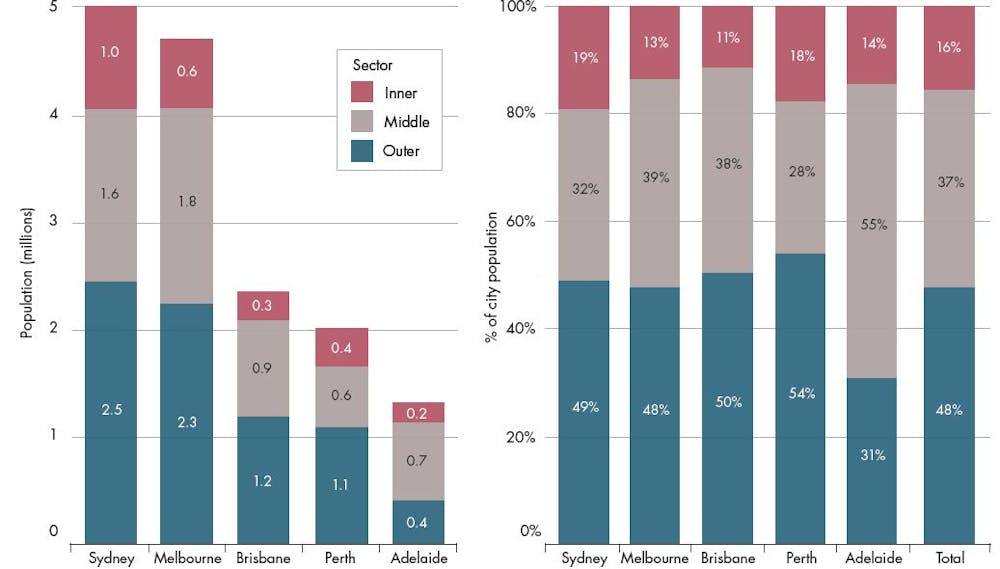 Estimated resident population by sector, as count and proportion of city population, 2016.
Infrastructure Australia 2018, CC BY
Estimated resident population by sector, as count and proportion of city population, 2016.
Infrastructure Australia 2018, CC BY
Given the growth of the suburbs, efficient mobility in these areas is essential for economic growth on par with the population. The future sustainability and livability of our cities also depend on efficient mobility options.
A 2018 Infrastructure Australia report identified the inefficiency and shortage of public transport in our suburbs as a problem.
At present, as a result of inadequate public transport and car-oriented developments, suburban residents depend heavily on private cars. Combined with rapid suburban growth, the heavy reliance on cars will lead to massive increases in traffic congestion and delays. This will cause heavy economic and environmental costs.
An effective public transport system can curb the dominance of private cars and serve as a competitive alternative that can meet our future mobility needs more sustainably and equitably. Frequent and accessible bus services in expanded suburbs, including connections to the rail network, are essential. At present, public transport is used for only about 5% of trips by suburban households.
Small driverless buses can provide connections to train services, as in the case of this trial at Tonsley station, Adelaide.Read more: Designing suburbs to cut car use closes gaps in health and wealth
A problem of costs
The problem is that suburban bus services typically fail to recover their operating costs from fare revenue. This is due to sparse ridership, longer travel distances and, most importantly, labour-intensive bus operations.
As a result, these services are uneconomical, often scarce, and depend heavily on government subsidies. Rising labour costs and worsening traffic congestion (leading to more driver hours required for the same service) mean bus operation becomes increasingly expensive.
 Metropolitan and outer metropolitan bus cost recovery, Sydney, 2008–12.
Infrastructure Australia, 2018, CC BY
Metropolitan and outer metropolitan bus cost recovery, Sydney, 2008–12.
Infrastructure Australia, 2018, CC BY
Budget deficits can trigger service cuts and fare hikes, which in turn lead to ridership declines and further revenue losses. We see this “downward spiral” for bus services around the world (for examples, see here, here, and here).
A comprehensive analysis of 25 North American cities found a sharp decline in public transport ridership over the past few years. This was mainly due to reduced bus services.
Without significant interventions, growing suburban populations will be either forced to drive or excluded from societal opportunities.
Read more: Don't forget buses: six rules for improving city bus services
Autonomous opportunity
Automated vehicle technology presents an unprecedented opportunity to transform the suburban public transport system into an effective substitute for private cars.
We can expect 40-60% savings in operational costs from driverless buses. With options of smaller vehicles and larger fleets of automated buses and shuttles, public authorities could afford to deliver more frequent, flexible services to a wider suburban area.
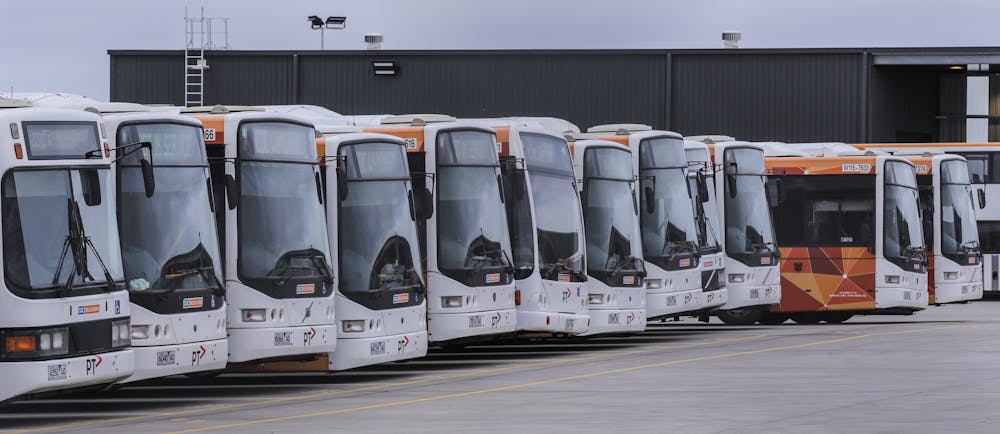 Autonomous services could halve the costs of running a conventional fleet of buses and drivers.
Wayne Taylor/AAP
Autonomous services could halve the costs of running a conventional fleet of buses and drivers.
Wayne Taylor/AAP
Such improvements would reduce passenger waiting times and walking distances – the main deterrents for users – and so could increase ridership and revenue. These outcomes can create a virtuous cycle for suburban services, leading potentially to self-sufficiency for suburban public transport.
In 2015, the Bureau of Infrastructure, Transport and Regional Economics (BITRE) estimated the societal costs of traffic congestion in Australian major cities at A$16.5 billion a year. This was projected to reach A$27 billion to A$37 billion by 2030. Automated vehicles could lower this cost.
A well-connected network can encourage people to give up private cars for public transport. Autonomous vehicles can be used to make suburban bus services more frequent and accessible, providing mobility for a growing suburban population that is prone to car-dependency. These bus services can improve connectivity to rail and give individuals access to economic opportunities, education, health care and social activities without having to drive.
Read more: Driverless cars really do have health and safety benefits, if only people knew
So when will these buses be on our streets?
Automated buses have been tested in real-world trials to identify and overcome barriers to deployment, including safety, technology and legal issues. Most of these have been in Europe, but Australia has had several trials in Adelaide, as well as in Perth, Melbourne, Sydney, Brisbane, Darwin, Canberra and a few regional centres.
The first driverless bus trial in New South Wales was at Olympic Park, Sydney.These trials clearly demonstrate that, given adequate planning and investment, fully automated buses – particularly those running on fixed routes and dedicated lanes – can operate commercially now. Flexible-route, automated services mixed with regular traffic may take longer to become a reality.
Authors: Neema Nassir, Lecturer, University of Melbourne
Read more http://theconversation.com/driverless-buses-can-help-end-the-suburbs-public-transport-woes-117258


















