

More dry lightning in Tasmania is sparking bushfires – challenging fire fighters and land managers
- Written by: David Bowman, Professor of Pyrogeography and Fire Science, University of Tasmania
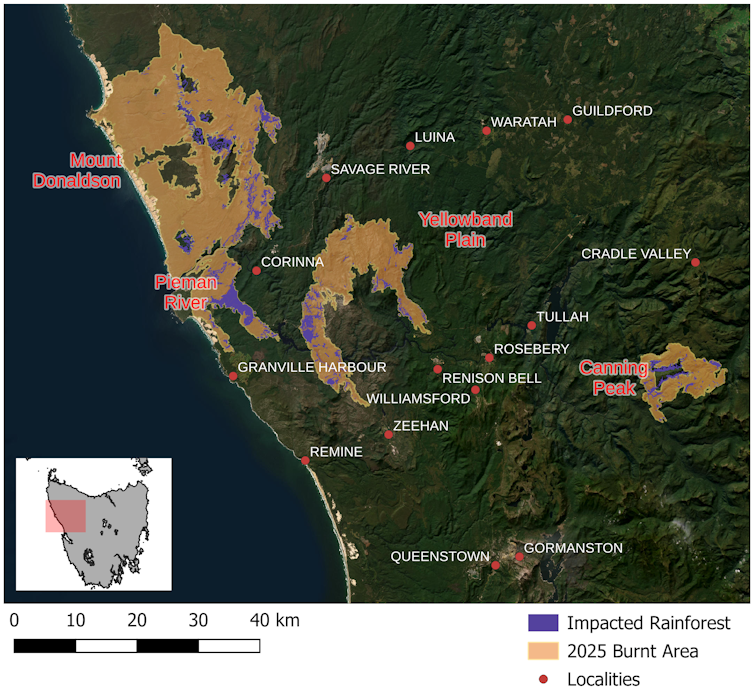
Tasmania has been burning for more than two weeks, with no end in sight. Almost 100,000 hectares of bushland in the northwest has burned to date. This includes the Tarkine rainforest and alpine ecosystems of Cradle Mountain that may never recover.
The situation has taken emergency services and land management agencies by surprise. The seasonal bushfire outlook for summer 2024 suggested Tasmania’s fire risk was nothing out of the ordinary. The state was also well prepared for bushfire fighting, particularly with specialised aircraft.
But this fire season has turned out to be anything but typical. Firefighting capacity has been stretched to the limit and interstate crews have been called in.
It all began with a massive lightning storm in the evening of Monday February 3. The incidence of such lightning fires has been increasing in Tasmania since the 1990s.
An official inquiry into the bushfires will no doubt be held, given the substantial social, economic and environmental harm – as well as the sizeable costs associated with fighting the fires from the air in remote and rugged landscapes.
Nonetheless, important lessons are emerging from these fires, which speak to the broader, worsening threat as the climate changes.
Understanding the impacts of the fires
Fortunately, direct economic losses from theses fires have been limited so far, despite significant disruption associated with evacuation and road closures. Tourism operators and honey producers have been hardest hit.
The fires caused brief but substantial smoke pollution across the state, placing a range of people with medical conditions at risk.
The full environmental effects and the benefits of prescribed burning are yet to be evaluated. Nonetheless, there is grave concern about damage to unique rainforests and alpine ecosystems. If sufficiently dry the organic soils, or peats, that supports forests and treeless areas in western Tasmania are also vulnerable to combustion.
We undertook a preliminary estimate of how much highly fire-sensitive vegetation – plant communities that will take more than 50 years to recover – may have burned. This involved comparing the current bushfire boundaries or footprint, based on satellite data and field reconnaissance, to vegetation mapping used for various purposes including fire management. We put the figure at 19,716 hectares of vegetation. However, it’s possible not all of this burned and islands of unburned vegetation persist within the broad fire boundary.
Our estimation includes 10,419 hectares of temperate rainforest (10% of the fire area) and 462 hectares of alpine vegetation (0.45% of the fire area). Neither of these vegetation types can readily tolerate fire.
Our analysis suggests about half of fire-affected rainforest areas have been previously burned by fires since 1982 (48%) and some small areas have burned twice (5%). Recurrent fires in rainforest can result in permanent loss of this vegetation. Just how much damage has been done will require further assessment.

Emergence of new fire patterns
The number of fires ignited by lightning have increased in Tasmania since the 1990s. When the lightning occurs in storms without much rain, or where the rain evaporates before it hits the ground, it’s known as dry lightning.
Concerningly, in the last decade two other major dry lightning fire events have occurred, likely a signal of a change in fire activity. As a result, fires are burning into areas that historically are rarely affected by fire, damaging the natural values of the Tasmanian wilderness.
This event could not be predicted
Going into summer, experts were concerned that soils across western Tasmania were particularly dry. This increased the fire risk in the seasonal outlook.
The recent rapid fire growth in Tasmania was caused by the unusual combination of regional drying (including dry soils), an extreme lightning storm and subsequent strong winds.
But the sequence of events that caused this fire to take off could not have been predicted more than a week ahead. That’s because it is impossible to predict lightning and windstorms outside the seven-day window of weather forecasts.
What’s more, our research shows it is currently not possible to reliably predict which lightning strikes will start fire.

Rapid attack and fire suppression have practical limits
Massive lightning storms that ignite multiple fires overwhelm the capacity of firefighters to locate and immediately extinguish all the flames.
Unfavourable weather conditions caused the west coast fires to rapidly grow. Firefighting shifted from attempts to extinguish the fire to instead contain its spread. This involved techniques such as targeted waterbombing, back burning and building fire breaks.
These approaches have been successful in some cases, notably the deployment of retardant drops to contain the Canning Peak fire, saving extensive stands of conifer rainforest. But suppression efforts were imperfect, as the loss of a private tourist facility hut on the Overland Track has demonstrated.
Managing these massive fires demands triage – making difficult choices about where to direct firefighting effort. Effective triage requires a detailed understanding of the location of areas of high economic, cultural and environmental value. High-quality mapping of these sites and involvement of specialists in the broader decision-making process is essential.
The Tasmanian government does have maps and expertise to guide triage, but there are calls for more investment to protect the region’s ecological values. This is particularly important for small, localised sites vulnerable to fire, such as groves of ancient Huon pine.
Fires continue to burn in Tasmania’s west, putting wilderness areas at risk (7.30)Broader lessons for fire fighting
Dry lightning storms are hard to predict, extraordinarily difficult to contain, and can cause substantial economic, social and environmental harms.
Technology alone – such as that which combines satellites, artificial intelligence, drones and water bombers – is not enough to eliminate these fires. What’s needed is a diverse portfolio of approaches, involving a combination of:
- reducing fuel loads by prescribed burning
- firefighting that is carefully targeted using high quality data
- expertise embedded in firefighting teams.
Researchers and fire managers must also identify the best strategies for prescribed burning to reduce bushfire risk while protecting areas of high economic, conservation and cultural value.
Climate change will bring more frequent monster fires – and fighting them demands a broad suite of investment.
Authors: David Bowman, Professor of Pyrogeography and Fire Science, University of Tasmania


















