

how 10 million refugees found homes after World War II
- Written by: Oleg Beyda, Lecturer in Russian History, The University of Melbourne
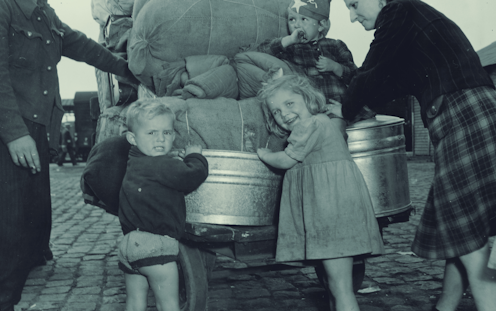
A disaster. That was the fitting word for the Europe that emerged immediately after 1945, covered in soot from cities turned to ashes. Life had collapsed.
Victorious but struggling to find their footing on the continent, the allied occupiers were overstrained with a host of minutiae: administering food, trying to prevent disease outbreaks, running prisoner-of-war camps, revamping the postal service, restoring electricity in major cities.
Then there were the roughly ten million “displaced persons”, over a million of them in what was left of Germany – a mass, and a mess, hailing mostly from Eastern Europe. There were singles and people with dependants, forced labourers, prisoners of war, potential and actual Nazi collaborators, alongside Jewish survivors of the Nazi camp system.
Review: Lost Souls: Soviet Displaced Persons and the Birth of the Cold War – Sheila Fitzpatrick (Princeton University Press)
It was Babylon on wheels: people crying, sick, pleading for shelter and medical attention in a variety of languages, bereft of food, split by political factionalism: a labyrinth complex enough to drive any foreign observer mad with confusion. Dressed in ragged clothes, they carried leaky sacks and scuffed suitcases and, with those, their hard lives.
They were supposed to be repatriated. But many of them, holders of Soviet passports, were dodging the Iron Curtain, which was crashing down all too fast. They did not want to go back. These “lost souls” very much preferred to remain “lost” to their motherland, which, upon return, would become their mothergrave. Or so they said.


Inside the camps
In part two of Lost Souls, Fitzpatrick takes us inside the camps, home to hundreds of thousands of displaced persons. Central to her argument is the idea that these people were not just little fish, beached on foreign shores by the war’s waves. They embraced the cynical joke from the acidic Soviet satire The Twelve Chairs (1928): “The cause of helping the drowning is in the hands of the drowning themselves.”
They had a host of reasons not to go back and they demonstrated immense ingenuity when it came to living one day to the next. They spun biographies to fit visa requirements and impress the visiting Allied inspectors. Having experienced daring and violent travelogues, they became keen navigators of the budding Cold War standoff, which turned them into beneficiaries of the same fates that had made them victims. They became agents and editors of their identities: crafters, narrators and audiences of their own stories.
Within the camps, many “beautiful Balts”, Ukrainians, émigré Russians, Belarusians and others crafted stories about the decades after 1917. These tales of national struggle and victimhood played an enormous role in presenting the entire cohort of displaced persons as victims of circumstances and alien oppressions, who thus deserved preferential treatment.
The stories of their homelands suffering under Soviet occupation became a form of robustly nationalist mythmaking. When the displaced persons moved into exile, these stories were brooded over for decades.
The victimhood eventually absolved some unfortunate wartime choices (who said “collaboration”?). In the West, unlike in the USSR which lost tens of millions, the emotional edge of war dissipated rather quickly. Then the dawning of the Cold War helped sweep many, though not all, of the nasty details under the rug.
This process is detailed in the third part of Fitzpatrick’s book. She illustrates how the International Refugee Organisation, which replaced the United Nations Relief and Rehabilitation Administration in 1946, handled these implicating issues and the refuseniks of repatriation, ultimately resettling them in other states.
More cynical than idealistic
The nature and scope of this highly readable book forestall many potential criticisms. With a running length of 250 pages and so many moving parts, it is unlikely Fitzpatrick set out to create the ultimate in-depth account of her subject.
In Fitzpatrick’s narrative, the displaced persons emerge as people. They are sly and scheming, tough and teary, crafty and hapless, kind and sad. One can marvel at many of the stories of misery and unlikely salvation, but overall the people come across as scheming and mercantile, more cynical than idealistic. They are always hustling to avail themselves of better food stamps and less work.
This is especially evident in a subchapter on the black market. Among other things, it tells a remarkable story about a displaced Soviet, driving an American truck, who explains how to navigate the kickbacks in the black market quadrangle of cigarettes, chocolate, eggs and ice cream, while impressing a host of village sweethearts.
At times, the scheming was systemic. Josef Rosenhaft, the Jewish leader of the Belsen displaced persons camp (located on the site of the former Nazi camp), became wealthy. According to a contemporary account, his camp was “the centre of one of the great black market rings in Europe”.
There is room here for investigation into how much nationalism – or any other form of idealism – the former Soviet subjects truly espoused. Some other “souls” could have been added to the book.
 Soviet General turned German collaborator, Andrey Vlasov (1942).
Bundesarchiv, Bild, via Wikimedia Commons, CC BY-NC-SA
Soviet General turned German collaborator, Andrey Vlasov (1942).
Bundesarchiv, Bild, via Wikimedia Commons, CC BY-NC-SA
For example, there was the tragedy in Plattling, a camp populated by collaborators: Soviet prisoners of war who had donned German uniforms and served under General Andrey Vlasov, a former prisoner of war himself, who chose to serve the Germans in 1942. In late February 1946, the Americans packed the 1,600 Vlasovites onto trucks and handed them over to the Soviets. In the USSR, filtration camps awaited them, followed by long sentences in the gulags or execution.
Or there is the intriguing case of Liechtenstein, the duchy that managed to slip through the mesh of competing foreign interests and send some interned collaborators to Argentina.
At times, Fitzpatrick’s sources seems to steer the narrative a bit too strongly. In her account, the Soviet side and its plenipotentiaries are depicted as merely reactive.
The Soviets are constantly crestfallen and indignant at the “maltreatment” of their Red selves on a diplomatic level. They abhor the slurs (and more) their representatives endure when visiting the camps to solicit the displaced persons to take a one-way ticket home. Seeing humans as their animated property, the Soviets were livid that the property dared to have a dissenting opinion.
There was ample mistrust. But Fitzpatrick might have included more concrete details about the consequences of such high tensions: aggressive Soviet counter-activities, attempts to subvert Western influence, targeted kidnappings. This would have made for an even richer account.
 Sheila Fitzpatrick.
Drunichick, via Wikimedia Commons., CC BY
Sheila Fitzpatrick.
Drunichick, via Wikimedia Commons., CC BY
The handling of so many displaced persons in the aftermath of a world war is a tale of success: a miracle of Western tenacity, goodwill and old-school professionalism – all of it achieved without excuses, spreadsheets or automated online systems.
Naturally, things were not entirely smooth. Some of the approaches would be social anathemas today. Some were plain ugly – eugenically motivated migration schemes, for one.
But still. There was shelter and food in the camps. There was some money. There was free European education. There were options and, ultimately, there were visas for many bereft people, who relocated to countries such as Australia, Belgium, the United States, Israel, Canada and the UK, as well as several South American nations. Diplomatic, humanitarian, political and other interests, though they clashed loudly, largely chimed in unison.
The displaced persons found themselves in the political crossfire at a moment of postwar optimism, a time when there was a pronounced element of naivety and a very modern belief in the good nature of transnational organisations – a belief in their capacity to handle of complex issues together.
The geopolitical deadlock that emerged after 1945 gave their sordid stories a soothing ending. The budding Western system of American dominance needed an enemy to click along as it did. The displaced persons became “victims of communism”, the way they perceived themselves entrenching itself as the Western perception.
One cannot help but see Fitzpatrick registering the current state of world affairs and reflecting on the difference between how the crisis was handled back then and how such crises are handled now. The multiple refugee crises that have unfolded in recent years seem like a poor reflection of earlier aspirations. Of the two responses, it is clear which story of benevolent efficiency towers impressively. In the 1940s, the “drowning ones” at least got themselves out of the water.
Authors: Oleg Beyda, Lecturer in Russian History, The University of Melbourne




















.jpg)
