

we asked people how they feel about sharing fitness data with insurance companies
- Written by: Dr Sven Tuzovic, Senior Lecturer, QUT Business School, Queensland University of Technology
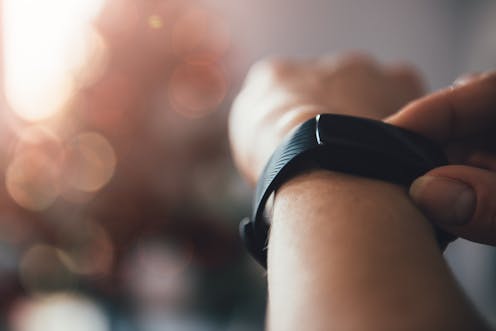
From the Fitbit to Apple’s smartwatch, wearable tech is becoming increasingly popular across the globe. Compared to other nations like US, which has seen higher adoption of fitness trackers, uptake in Australia is still less than 10% in 2019. But news reports indicate that Australians are taking to fitness monitoring more than ever before.
And wearable devices are not only being embraced by consumers, but also across insurance industries. Health and life insurance companies collect data from fitness trackers with the goal of improving business decisions.
Hollywood actor Christopher Walken was the spokesperson for Qantas’s 2016 Assure campaign.Currently, these business models work as a “carrot” incentive. That means consumers can benefit from discounts and cheaper premiums if they are willing to share their Fitbit data.
But we could see voluntary participation become mandatory, shifting the incentive from carrot to stick. John Hancock, one of the largest life insurance companies in the United States, has added fitness tracking with wearable devices to all of its policies. Though customers can opt out of the program, some industry experts argue that this “raises ethical questions around privacy and equality in leaving the traditional life insurance model behind”.
Is this the beginning of a major trend? And, more importantly, how do consumers feel about being “persuaded” into fitness tracker-based insurance policies?
In a study conducted with my colleague Professor Stefanie Paluch at RWTH University in Germany, we investigated people’s perceptions of fitness tracker-based insurance policies.
What are the concerns?
Unfair price discrimination
People are concerned that the data monitoring will lead to personal disadvantages. They don’t want to be penalised with higher insurance rates if they stop using the fitness tracker. One Fitbit user said:
The problem lies in the disadvantage if I don’t wear it.
Data protection
Consumers are concerned about how insurance firms will access, use, and store their fitness data. One person said:
I find it very important to have strict regulations, especially in these times, when personal data is collected and stored everywhere, but can also be shared, exchanged, sold and passed on to third parties, to those I don’t want […] to have my data.
Privacy
People have a wide range of privacy concerns. In general, they fear becoming “observable”, “transparent”, “predictable”, “easy to manipulate” and “rated” by the insurance provider. One user said:
The risk is that you will become so transparent and […] institutions will know about you, that is actually not their right at all, only on the basis that they somehow want to make a profit […] it’s none of their business.
How to reduce the risks?
Our study shows that the strongest opposition is based on people’s fear of unfair and exploitative behaviour of commercial data users, in particular switching from voluntary to mandatory enrolment. To avoid backlash, insurance firms should follow the following four recommendations.
1. Understand your customer
Insurance firms need to first segment their customer base to better understand consumer lifestyles and motivations to use a fitness tracker. While some consumers have a personal affinity towards self-tracking, other individuals will not change their habits. One user said:
I am not sure how this helps? If you lie on the sofa for 12 hours a day with a fitness tracker. Do you see a result? No! The insurance cannot force you to move your ass. Normally only people who are active already and do sports regularly, they wear such trackers.
2. Provide value
People wish to receive a benefit for their participation. This ranges from financial value (discounts, lower premium) to functional value, such as the quality of the device (design features, ease of use), as well as its reliability and accuracy in tracking data.
I like sports, and fitness trackers are important to me. As I said, to follow my progress, and if I can get them cheap, then I find that very positive.
The tracker itself must be good. […] I have to have a feeling that I really benefit from it.
3. Be transparent
In order to reduce privacy concerns, insurance firms need to offer transparent and fully informative privacy policies and should more clearly educate and inform users about the terms and conditions. One Fitbit user said:
…if a little more is published [about] what happens with our data, […] one can inform oneself about it […] Perhaps general education in schools or so would be desirable, too.
For me, the personal contact is important, because if someone explains that to me, then I will trust this person, and then I do not think that he/she will try to conceal any things […]. Once this has been explained to me, then I’m ok with it.
4. Give customers control
People are more willing to participate in fitness tracker-based insurance policies when they are in control of their participation. Greater empowerment increases their perceived self-determination and acceptance. Thus, participation should remain voluntary and be flexible regarding the timeframe. Two respondents said:
Well, if they [fitness trackers] are on a voluntary basis […] then I would use them.
That I can choose this bonus program myself, that I can choose the different functions from it and that I can resign at any time without any financial, health or insurance disadvantages.
As the sharing of personal biometric data increases further, we hope that our findings will contribute to an emerging public policy and legal debate about the practice.
Authors: Dr Sven Tuzovic, Senior Lecturer, QUT Business School, Queensland University of Technology


















