

Understanding dog personalities can help prevent attacks
- Written by: Paul McGreevy, Professor of Animal Behaviour and Animal Welfare Science, University of Sydney
The news of a fatal dog-bite incident in Melbourne last night has shocked dog lovers around the country.
A 61 year old man was dead by the time police arrived at the property in Mill Park; his 58 year old wife is in hospital with serious injuries. The dog in question, a Staffordshire terrier, belonged to the couple’s son.
At first glance, the dog seems almost to have led a “double life” – strongly vouched for as a deeply loyal animal who would defend its family members and protect familiar children, and yet also be capable of sudden viciousness.
Read more: Is your dog happy? Ten common misconceptions about dog behaviour
While, of course, we cannot know what exactly happened, this horrifying attack raises many questions. Are some dogs not suitable as family pets? What can we do to prevent further cases like this?
The Staffy problem
The American Staffordshire terrier is a breed (that can be registered) whereas, its cousin, the American pit bull terrier is a type (that cannot be registered and has no strict breed standard for breeding purposes). The pit bull was bred to fight other dogs: it is strong and fast, with powerful jaws. In the fighting pit, they also needed to be impulsive and quick to engage with their opponents.
However, it’s an over-simplification to declare an entire breed “too dangerous”. In every incident like this, many factors lead to the first bite and even more factors feed into a second and third bite. This is why most veterinarians call for a “deed-not-breed” approach, arguing that blaming a dog because of its genes overlooks the role of nurture and circumstance.
The reality is that any breed can defend itself when pushed. A case in point is a report from Oklahoma last year, in which a pack of dachshund crosses killed a middle-aged female neighbour.
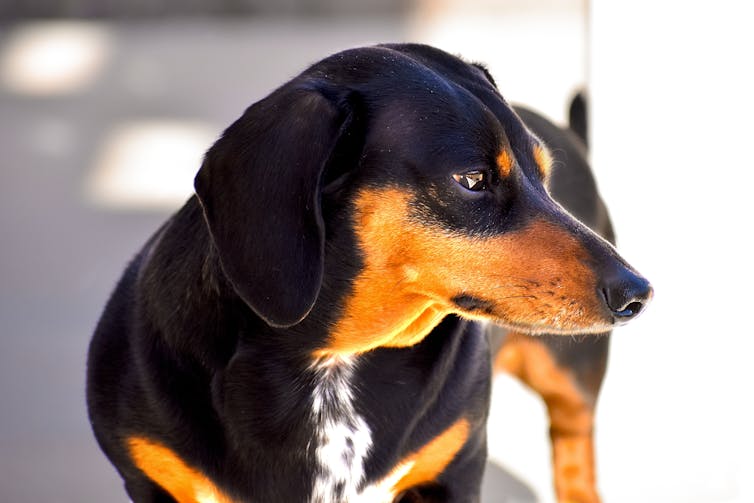 There’s at least one recorded instance of dachshunds killing a person.
Izumi Jones/Unsplash
There’s at least one recorded instance of dachshunds killing a person.
Izumi Jones/Unsplash
Unfortunately for Staffordshire (bull) terriers, many muscular breeds have attracted an unhelpful fan-base among people who feel their dog should reflect their personal machismo.
But reliable data on aggressive dogs are very difficult to come by.
“Bites” and “attacks” are both reported by local councils or counties, and the difference between the two may be significant. In Australia, dogs can be declared dangerous or menacing by local councils based on a single disputed claim or without ever injuring a person.
Hospitals record data on patients who have been physically attacked or bitten by dogs severely enough to require medical attention. However, hospitals do not investigate these cases, so the accuracy of such data is questionable.
That said, it is estimated that less than 50% of dog bites are reported to a medical or legal authority.
Social media may offer a chance to gather better first-hand data. A fascinating analysis of 143 dog-bites posted on YouTube has revealed how dogs behaved before biting people and how the people involved over-looked warnings from the dogs.
A doggy personality
Recent studies suggest domesticated dogs are uniquely good at communicating with humans. The extremely wide variety in breeds also makes them an interesting research model for investigating both human and canine genes.
Obsessive compulsive disorder is a terrific example: tail-chasing dogs are ideal models for research that may help humans afflicted with repetitive tendencies, such as compulsive hand-washing.
As it happens, the so-called “bull breeds” are over-represented in studies of tail-chasing.
In many ways, veterinary behavioural medicine has developed along similar lines to the human psychiatric field. One area particularly relevant area is the study of individual motivation and personality.
This is the focus of a series of studies by Dr Jacqui Ley, an Australian veterinary behaviour specialist. She asked more than 1,000 owners to rate their companion dogs on more than 60 personality adjectives.
Statistical analysis identified five underlying characteristics that could be used to cluster the owners’ responses into the following categories: extraversion, neuroticism (or cautiousness), self-assuredness/motivation, training focus and amicability.
These are remarkably similar to the so-called Big Five personality types described in humans: extraversion, neuroticism, openness, conscientiousness, and agreeableness.
Read more: Everyone's different: what parts of the brain make our personalities so unique?
It will be interesting to see how successful these five labels are in describing the traits of dogs as scored by behavioural tests, and how stable this system of labelling is over the life of a dog.
Impulsivity in dogs is also increasingly considered in the context of aggressive behaviour. It refers to the relative lack of impulse control and has prompted the development of a psychometric tool to assess the trait in one’s own dog.
The importance of temperament
Even though the selective pressures humans have applied to dogs over the centuries have changed, we’ve been steadily filtering out genes that weren’t useful to us.
The earliest proto-dogs were those that could tolerate being close to humans to forage in their waste. Of course, any of these ancestors unable to adapt to the human household have been removed from the gene pool, especially if they were inappropriately aggressive.
These days, responsible pet owners are encouraged to desex even the most well-adapted companion dogs. While this has brought about a welcome reduction in unwanted canine pregnancies, it has also meant a greater proportion of dogs in our community are the product of dog breeders who don’t prioritise adaptability and social skills. Instead, they select for characteristics of appearance.
So, to generalise, we now have something of a mismatch: humans who are less experienced at interacting with, training and managing dogs than their forebears, are being matched with dogs bred more for aesthetics rather than easy-going temperaments.
The clash of these cultures undoubtedly makes it all too easy for tragic attacks to take place. The media then vilifies dogs, making people fearful – which can, in turn, worsen the dog-human relationship.
Dogmanship
Dogmanship, or perhaps more correctly dogpersonship, is an emerging science that considers the role of humans in the dog-human relationship and explores why some people are much better with dogs than others.
Drawing heavily on the science of emotional intelligence, it investigates how people can read the signals each dog is giving and respond accordingly.
Common advice from education programs includes how and when to approach dogs, how to recognise dog body language that may signal fear, anxiety, uneasiness, conflict, or aggression, and how to keep safe when approached by a strange dog, as well as parental supervision at all times.
In an attempt to outlaw powerful dogs originally bred for fighting, breed-specific legislation has been introduced in many countries, but it is very controversial – not least because so many of the dogs targeted are arguably types rather than breeds.
Read more: How to talk to your dog – according to science
As our understanding of dog behaviour traits improves and as we better appreciate what characterises good dogmanship, we can expect to see fewer dog bites. Then we won’t need to wait for dogs to bite people before we identify them as a risk and begin to manage them accordingly.
Paul McGreevy is the author of A Modern Dog’s Life (2009), published by NewSouth.
Authors: Paul McGreevy, Professor of Animal Behaviour and Animal Welfare Science, University of Sydney
Read more http://theconversation.com/understanding-dog-personalities-can-help-prevent-attacks-120224


















