

when drivers look but don’t see cyclists on the road
- Written by: Giulio Ponte, Research Engineer at the Centre for Automotive Safety Research, University of Adelaide
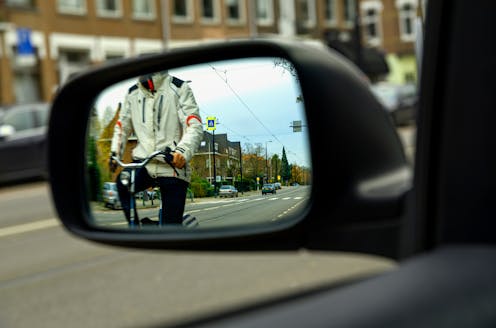
When a vehicle and a cyclist collide, the cyclist almost always emerges worse off. Globally, more than 40,000 cyclists are killed and millions more seriously injured in road crashes.
In most of these collisions, the driver is responsible.
So, what factors are involved when a cyclist and a car collide?
The most common factors
The most common types of vehicle-cyclist crashes are caused by:
When drivers ‘look-but-failed-to-see’
Many drivers fail to notice cyclists until it’s too late. Sometimes this phenomenon is referred to as SMIDSY (“sorry mate, I didn’t see you”).
Crash researchers often classify these types of crash as a “looked-but-failed-to-see” error.
Cyclists are extremely susceptible to this. They are small, not a safety threat to drivers, are outnumbered and are typically ranked low on a driver’s “attentional hierarchy”. It may also be that drivers just don’t expect cyclists to be around.
Cyclists can be inconspicuous but even if they are visible, drivers may look but not “see” them because they’re focusing on something else.
This selective attention test highlights how easy it is to end up in a looked-but-failed-to-see situation:
It is inevitable drivers will occasionally make errors resulting in near misses and crashes. Telling drivers to look out for cyclists and not crash into them won’t stop crashes with cyclists. So what might help?
Solutions with limited effectiveness
While errors are inevitable, improving road infrastructure and using layouts that highlight cyclists in potential conflict areas can help.
In practice, this means things such as advanced stop lines or holding areas that place cyclists ahead of motor vehicles at intersections so cyclists are more visible and can move off safely.
Advanced green lights (where the traffic light turns green for cyclists before it does for cars) could also help, as they allow cyclists to move off while motor vehicle traffic is still stopped.
Bicycle-activated warning signage provide a visual warning to alert drivers that a cyclist is near by.
Improved road lighting to highlight cyclists better on the network at night, would also help.
There are also things cyclists can do to improve their own safety. These include
Many roads have white lines painted on them to allocate separate space to cyclists and there are mandatory passing distance laws throughout Australia as well as in some international jurisdictions.
However, research has shown that close passing is still relatively common and that painted bike lanes may actually increase the frequency or severity of these dangerous interactions.
Speed limit reform
If we know that errors are inevitable and crashes will occur, then we should make those events survivable.
Humans are fragile. Being struck by a car at 50 km/h is estimated to result in a 90% chance of being killed. At 30 km/h, the risk of being killed decreases to just 10%.
Speed limits of 40 km/h and 30 km/h improve safety for both cyclists and pedestrians, particularly in high pedestrian and cyclist locations.
While lowering speed limits is widely supported within the road safety fraternity, more efforts are needed to promote acceptance throughout the wider community.

Autonomous emergency braking
One opportunity for reducing or eliminating collisions with cyclists (in the absence of speed limit reform) may be with advanced driver assistance systems such as autonomous emergency braking.
These systems constantly and rapidly process visual information in the traffic environment.
They can help prevent certain crashes, or reduce collision speeds, when human error occurs.
They can also help prevent “dooring”, which is where a cyclist collides with a car door suddenly opened by the driver.
However, these technologies are not 100% effective; emergency situations between vehicles and cyclists can occur suddenly, with little time for automated systems to respond appropriately.
These systems are also generally only available on newer vehicles. Given the average age of Australian vehicles is over 11 years, it will take some time before they are widely prevalent and have a significant influence on bicycle safety.
Eliminating conflicts
Dedicated separated infrastructure is optimal for cyclist safety as it avoids interactions between vehicles and cyclists completely.
However, this infrastructure often forces cyclists to share space with pedestrians such as children, dog walkers, wheelchair users, and parents with prams (which can introduce other safety issues).
Additionally, these dedicated separated paths are not always well connected, or may “lead to nowhere”, so they don’t always appeal to cyclists.
Another way to eliminate conflicts is through changes to the traffic network. For example, controlling turn movements at traffic lights with right-turn arrows means drivers no longer need to decide when it’s safe to turn.
But this comes at a cost to traffic efficiency. In our society, unfortunately, there are many who value lost time more than the cost of road crashes and injury trauma.
Ultimately, if we want to focus on the value of human life and live-ability, we need to rethink the transport hierarchy to place more value on the most vulnerable road users. This could be achieved with “presumed liability” laws, where a driver who collides with a cyclist must prove they were not at fault.
Finally, we should remember that we are all vulnerable at some point in our transport journeys.
Authors: Giulio Ponte, Research Engineer at the Centre for Automotive Safety Research, University of Adelaide


















