

Potential cost to patient safety as NZ debates access to medicinal cannabis
- Written by: Michelle Glass, Professor of Pharmacology, University of Otago
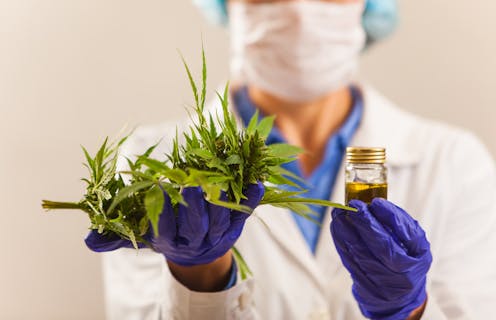
Cannabis-based products will be allowed to bypass usual processes required for medicines in New Zealand and go directly onto the market without any proof of safety or effectiveness. This unprecedented proposal is contained in the government’s consultation document on giving greater access to medicinal cannabis.
The government is introducing a scheme for regulating medicinal cannabis. The consultation covers proposed licensing, cultivation, manufacturing and product standards, and a prescription and enforcement regime.
The key driver for this seems to be that people currently access cannabis through the illegal recreational market. But even if there is no doubt that a regulated market would provide a safer environment for access, we argue that there could be a potential cost to patient safety.
From trial to market
The usual market pathway for a drug in New Zealand is the development and manufacture to good manufacturing practice (GMP) standards. This ensures each batch has the same amount of active ingredient and is free from contaminants.
Companies then run clinical trials, first on small groups of healthy subjects to establish the compound is safe and to understand how it behaves in the body. This information is essential to ascertain dosage.
Finally, the medicine moves into “efficacy” trials. This is the first time it is given to patients. These trials confirm safety and, importantly, establish effectiveness. The data are then presented to the medical regulatory body Medsafe, which decides if the drug can be prescribed.
Current medicinal cannabis regulations suggest bypassing all these processes and moving straight from manufacture to prescription. Whether or not manufacture needs to be to GMP standards is one of the consultation questions.
Read more: Legal highs: arguments for and against legalising cannabis in Australia
What are cannabinoids
Cannabis, like all plants, contains a wide array of different chemicals. Of these, phytocannabinoids generate most interest. The most highly expressed cannabinoids in dried plant material are Δ9-tetrahydrocannabinol (THC) and cannabidiol (CBD), but at least 100 other cannabinoids are present, many in vanishingly small quantities.
THC is the main psychoactive component of the plant, known to generate a “high” or sense of euphoria. Its mechanism of action within the human body is well understood. It mimics the body’s natural cannabinoids (endocannabinoids) to bind to and activate specific proteins in the brain. The endocannabinoid system is involved in lots of different physiological processes, including memory formation, appetite, pain regulation and inflammation. THC can therefore alter these functions.
There is nothing unusual about a plant compound interacting with human proteins. A large number of drugs are originally from plants. This includes morphine, which comes from opiate poppies and mimics the body’s own opiates, the endorphins.
In contrast to THC, CBD does not produce a high and is often described as not-psychoactive. But this is a mistake as it clearly alters activity within the brain. It is better described as a non-intoxicating cannabinoid. The mechanism by which CBD produces responses in the body are not well understood.
A recent review of scientific literature described more than 65 discrete molecular targets that might interact with CBD, but concluded that it probably isn’t acting within the endocannabinoid system at all.
Read more: Cannabis and psychosis: what is the link and who is at risk?
Cannabinoids as medicines
There is a commonly held idea that cannabis doesn’t lend itself to being treated as a typical medicine because it is the combination of different chemicals that produces the desired effects. But there is little scientific evidence to support this.
Many plants have medically useful compounds and these, without fail, have been isolated, either by extraction from the plant or chemical synthesis. They form the basis of medicines such as morphine, codeine, aspirin and pseudoephidrine to name but a few. This same approach has been used for cannabis. Marinol (dronabinol) is synthetic THC, Nabilone is a synthetic THC derivative, Sativex is a plant extract blending two plant varieties, one high THC, one high CBD.
Sativex is approved by Medsafe in New Zealand to treat muscle spasms related to multiple sclerosis and through the medicinal cannabis access scheme for other diseases. Although not yet approved for distribution in New Zealand, the pharmaceutical grade CBD product, Epidiolex recently became the first FDA-approved plant derived cannabinoid medication.
All of these products have been through clinical trials to establish their safety and efficacy. They come with clear recommendations on dosage, likely adverse effects and indications on their likely effectiveness in given conditions. This means the doctor and the patient can genuinely make an informed decision about risks versus potential benefits.
This information also highlights potential drug-drug interactions. For example, clinical trials on Epidiolex for paediatric epilepsy highlighted that, at effective doses, CBD changes how other anti-epileptic medications are processed in the body, sometimes increasing them to toxic levels.
Equity issues
If we already have data for these existing medicines, why don’t we just manufacture a similar product but market it more cheaply? This is a model New Zealand has already adopted for generic medicines, essentially copies of original medicines for which the drug-funding agency PHARMAC can negotiate cheaper pricing.
But even these medicines require early clinical testing. The manufacturer must test their medicine in people and prove that it is processed by the body in the same way as the established medicine before it can be prescribed. Even following these rigorous tests, differences can remain which make the copy of the drug less acceptable to a patient, such as was seen recently when PHARMAC swapped the antidepressant EFFexor-XR for Enlafax-XR.
The consultation document also raises the question of equity, both in terms of equity to access cannabis products and equity to enter the market as a manufacturer. There is an expectation that requiring cannabis derived medicines to meet Medsafe standards would push costs to prohibitive levels. But data from the Canadian College of Family Physicians suggest pricing in Canada is very similar between dried plant materials and pharmaceutical grade products.
Regardless, do any of these considerations outweigh patients’ right to safe, and proven effective medicine? Or doctors’ right to make a fully informed decision before writing a prescription?
New Zealand’s limited health care budget already strains to keep up with demand. The lack of public funding for expensive but proven cancer medications is just one example. How can we justify spending any of this budget on access to and regulatory control of products that don’t meet our standards, when we can’t afford to fund medicines that do? These are questions that should be answered before we add untested cannabis-based products into our health care system.
Authors: Michelle Glass, Professor of Pharmacology, University of Otago


















