

What is a ‘smart city’ and why should we care? It’s not just a buzzword
- Written by: Milad Haghani, Associate Professor & Principal Fellow in Urban Risk & Resilience, The University of Melbourne
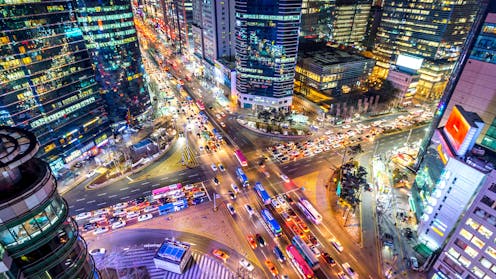
More than half of the world’s population currently lives in cities and this share is expected to rise to nearly 70% by 2050.
It’s no wonder “smart cities” have become a buzzword in urban planning, politics and tech circles, and even media.
The phrase conjures images of self-driving buses, traffic lights controlled by artificial intelligence (AI) and buildings that manage their own energy use.
But for all the attention the term receives, it’s not clear what actually makes a city smart. Is it about the number of sensors installed? The speed of the internet? The presence of a digital dashboard at the town hall?
Governments regularly speak of future-ready cities and the promise of “digital transformation”. But when the term “smart city” is used in policy documents or on the campaign trail, it often lacks clarity.
Over the past two decades, governments around the world have poured billions into smart city initiatives, often with more ambition than clarity. The result has been a patchwork of projects: some genuinely transformative, others flashy but shallow.
So, what does it really mean for a city to be smart? And how can technology solve real urban problems, not just create new ones?
What is a smart city, then?
The term “smart city” has been applied to a wide range of urban technologies and initiatives – from traffic sensors and smart meters to autonomous vehicles and energy-efficient building systems.
But a consistent, working definition remains elusive.
In academic and policy circles, one widely accepted view is that a smart city is one where technology is used to enhance key urban outcomes: liveability, sustainability, social equity and, ultimately, people’s quality of life.
What matters here is whether the application of technology leads to measurable improvements in the way people live, move and interact with the city around them.
By that standard, many “smart city” initiatives fall short, not because the tools don’t exist, but because the focus is often on visibility and symbolic infrastructure rather than impact.
This could be features like high-tech digital kiosks in public spaces that are visibly modern and offer some use and value, but do little to address core urban challenges.
The reality of urban governance – messy, decentralised, often constrained – is a long way from the seamless dashboards and simulations often promised in promotional material.
But there is a way to help join together the various aspects of city living, with the help of “digital twins”.

Digital twin (of?) cities
Much of the early focus on smart cities revolved around individual technologies: installing sensors, launching apps or creating control centres. But these tools often worked in isolation and offered limited insight into how the city functioned as a whole.
City digital twins represent a shift in approach.
Instead of layering technology onto existing systems, a city digital twin creates a virtual replica of those systems. It links real-time data across transport, energy, infrastructure and the environment. It’s a kind of living, evolving model of the city that changes as the real city changes.
This enables planners and policymakers to test decisions before making them. They can simulate the impact of a new road, assess the risk of flooding in a changing climate or compare the outcomes of different zoning options.
Used in this way, digital twins support decisions that are better informed, more responsive, and more in tune with how cities actually work.
Not all digital twins operate at the same level. Some offer little more than 3D visualisations, while others bring in real-time data and support complex scenario testing.
The most advanced ones don’t just simulate the city, but interact with it.
Where it’s working
To manage urban change, some cities are already using digital twins to support long-term planning and day-to-day decision-making – and not just as add-ons.
In Singapore, the Virtual Singapore project is one of the most advanced city-scale digital twins in the world.
It integrates high-resolution 3D models of Singapore with real-time and historical data from across the city. The platform has been used by government agencies to model energy consumption, assess climate and air flow impacts of new buildings, manage underground infrastructure, and explore zoning options based on risks like flooding in a highly constrained urban environment.
In Helsinki, the Kalasatama digital twin has been used to evaluate solar energy potential, conduct wind simulations and plan building orientations. It has also been integrated into public engagement processes: the OpenCities Planner platform lets residents explore proposed developments and offer feedback before construction begins.

We need a smarter conversation about smart cities
If smart cities are going to matter, they must do more than sound and look good. They need to solve real problems, improve people’s lives and protect the privacy and integrity of the data they collect.
That includes being built with strong safeguards against cyber threats. A connected city should not be a more vulnerable city.
The term smart city has always been slippery – more aspiration than definition. That ambiguity makes it hard to measure whether, or how, a city becomes smart. But one thing is clear: being smart doesn’t mean flooding citizens with apps and screens, or wrapping public life in flashy tech.
The smartest cities might not even feel digital on the surface. They would work quietly in the background, gather only the data they need, coordinate it well and use it to make citizens’ life safer, fairer and more efficient.
Authors: Milad Haghani, Associate Professor & Principal Fellow in Urban Risk & Resilience, The University of Melbourne

















