

More than 50 years after trying to reach Venus, a failed Soviet spacecraft is about to return to Earth
- Written by: Alice Gorman, Associate Professor in Archaeology and Space Studies, Flinders University
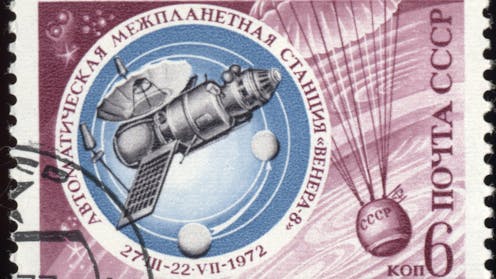
During the height of the Cold War in the 1960s and 1970s, the USSR launched 29 spacecraft towards Venus, the planet scientists call Earth’s “twin sister”.
Three flew past Venus, and went into orbit around the Sun. Sixteen orbited or landed on Venus, where they experienced a climate often described as “hellish”.
Ten got stuck in Earth orbit. All of them re-entered Earth’s atmosphere the same year they were launched – except Kosmos 482, which has stayed aloft for 53 more years. As the last remnant of the Soviet Venus program left in Earth orbit, it’s not your average piece of space junk.
Because it was designed to withstand Venusian conditions, many think the lander may make planetfall on Earth instead of incinerating in the atmosphere. And that is expected to happen this week.
Destination Morning Star
Venus was a target of interest because its thick clouds might be hiding life on the surface. But the spacecraft were also Cold War weapons aimed at demonstrating the superiority of socialist science.
Venera 1 was launched in 1961, only four years after Sputnik 1, the first satellite. Venera 7, in 1970, was the first spacecraft to successfully soft-land instead of crashing on a planet. Vega 2 was the last USSR Venus mission in 1984.
The Venera probes were launched in pairs, a few days apart. If one failed, the other might succeed. Venera 8 was launched on March 27 1972 and reached Venus 117 days later. On March 31, its twin left Earth but failed to escape Earth orbit, earning the designation Kosmos 482.

The spacecraft comprised a delivery “bus” about 3.5 metres tall, with a propulsion system, solar panels and a mesh dish antenna at one end, and the spherical landing craft at the other end. The landers had their own refrigeration system to cool them down and a heat shield to protect them. If all went to plan, the buses would eject the landers from orbit. The landers would hit the upper cloud decks at a speed of nearly 12km per second.
At 60km altitude, the main parachute was released to float the lander down to the surface. A range of instruments would then measure the temperature, pressure, wind speed, visibility, atmospheric gases and rock composition, and radio the results back to Earth. Each lander carried a USSR medallion inside.
But all didn’t go to plan. Venera 8 sped on its way to Venus, sending its lander down on July 22.
Fate had something different in store for Kosmos 482.
How to be space junk in one easy step
The upper rocket stage that was meant to propel the Kosmos 482 bus out of Earth orbit shut off too early because the timer wasn’t set correctly. The rocket stage fell back to Earth and burnt up, while titanium pressure vessels from its fuel system fell onto fields in Aotearoa New Zealand.
The bus and landing craft came apart in mid-June and the bus fell back into the atmosphere in 1981. The 465kg lander continued its orbit alone.
At its farthest, the lander was 9,000km away, coming as close as 210km in its highly elliptical orbit around Earth. Over 50 years, that orbit has lowered to only 2,000km at its farthest point. Now the atmosphere is dragging it back towards Earth with a predicted re-entry of May 10. You can get updates on Kosmos 482’s position here.
Venera 9 took the first images of the surface in 1975. The Venera 13 and 14 missions took the first colour photos.Will the lander fall on Earth?
The lander had a titanium body designed to withstand Venus surface conditions of 90 times the atmospheric pressure of Earth and 470°C. After more than 50 years it won’t have the refrigeration, the capacity to aerobrake or a working parachute to slow it down and keep it cool. Its reentry will be uncontrolled.
Typically, space junk reenters at around seven kilometres per second and can reach temperatures of 1,600°C as it tears through the atmosphere. Titanium alloys have a melting point of around 1,700°C. This is why the so-called “space balls” that landed in New Zealand in April 1972 survived reentry. If they did, then the lander could as well.
Six of the nine other failed Kosmos reentries had landers or impactors, but we don’t know where they are – either they did not survive, fell into the ocean, or have not yet been found on land. This may also be the fate of the Kosmos 482 lander.
The Kosmos 482 lander filmed from Leiden in 2020 by space tracking expert Marco Langbroek (Delft Technical University)Danger from Venus
Venus might be the planet of love, but in popular culture, it has been associated with danger.
In the 1960 East German film The Silent Star (later dubbed into English as First Spaceship on Venus), the Venusians plan to bombard Earth with radiation so they can conquer it.
In the 1968 film Night of the Living Dead, an American Venus probe returns bringing a deadly radiation which turns the dead into zombies.
An episode of the hit 1970s TV series The Six Million Dollar Man characterised a Russian Venus spacecraft as a “death probe” when it accidentally returned to Earth.
These representations reflect Cold War fears of nuclear war and war waged from space.
In the 21st century, we have a new source of anxiety: the environmental impacts of space junk. But spacecraft such as Kosmos 482 are not the junk people should be worried about.
In the past five years, there’s been a massive increase in the number of rocket launches and the number of spacecraft in low Earth orbit. More and more space junk is reentering the atmosphere. For example, it’s estimated that a Starlink satellite reenters almost every day. When it burns up, it leaves behind damaging chemicals and soot particles.
In the meantime, Venera 8 is still waiting silently on the surface of Venus for its twin to arrive.
Authors: Alice Gorman, Associate Professor in Archaeology and Space Studies, Flinders University


















