

For 100 years, we have marvelled at planetariums. Here’s a brief history of how humans brought the stars indoors
- Written by: Martin Bush, Senior Lecturer in History and Philosophy of Science, The University of Melbourne
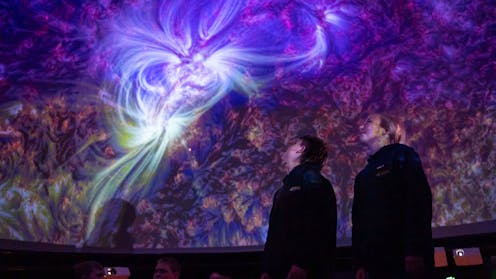
Picture this: a small audience is quietly ushered into a darkened room. They gasp in awe, as a brilliant night sky shines above. They wonder – as many after them will do – what trickery has made the roof above their heads disappear?
But this is a performance; the stars above an ingenious projection. For the first time a public audience has experienced the spectacle of the opto-mechanical planetarium. The location is the newly opened Deutsches Museum in Munich, built to celebrate science and technology. The date is May 7 1925.
Visualising the heavens
Throughout time, cultures around the world have used the stars to help make sense of the world, to understand where we come from and determine our place in the cosmos.
People have tried to recreate the movements of the stars and planets since antiquity. In the 1700s, the orrery, a clockwork model of the Solar System, was developed. The word “planetarium” was invented to describe orreries that featured the planets.
One room-sized orrery example was built by the self-taught Frisian astronomer Eise Eisinga. It’s still operational today in Franeker, Netherlands.
No human has ever been to the edge of the Solar System to see this view. Orreries, and other mechanical models of the universe like celestial globes, present views from impossible, external perspectives.

The first planetariums
The desire for a realistic view of the stars and planets, created from a perspective we actually see, gathered pace in the early 20th century as light pollution from growing cities diminished the view of the night sky.
People like Oskar von Miller, first director of the Deutsches Museum in Munich, Germany, wanted to return this vision of the stars and planets to everyone. (Ironically, von Miller’s earlier career was as an electrical engineer, rolling out the city lighting that contributed to light pollution.)
One early attempt to create this view of the night sky was the Atwood Sphere, installed in Chicago in 1913.
Approximately five metres across, it was made of sheet metal perforated with a star map. When viewed from the inside, the light shining through 692 pinholes replicated the Chicago night sky. The whole structure could even be rotated to simulate the motion of the stars.
A realistic display of the stars is one thing. Representing the planets, whose positions in the sky change from night to night, is a different one. Von Miller and others at the Deutsches Museum knew that fixed holes could not represent the complexity of a moving planet.
What if the planets were displayed by projection? If so, couldn’t the stars be projected, as well? With this realisation, a new kind of planetarium was born, borrowing the name from earlier orreries but working in a completely different way.
The task of building such a device was given to the German optical company Carl Zeiss AG. After many setbacks, their first planetarium projector was completed in 1923, with the first performance at the Deutsches Museum a century ago today.

Planetariums were a hit with the public. Within decades, they had spread around the world – the first planetarium in the United States opened in Chicago in 1930, while the first one in Asia opened in Osaka, Japan in 1937. The popularity of planetariums particularly accelerated in the US during the space race of the 1960s.
Australia’s oldest operating planetarium is the Melbourne Planetarium, managed by Museums Victoria since 1965. In Aotearoa New Zealand, Auckland’s Stardome Observatory has been in operation since 1997. The current longest-running planetarium in the southern hemisphere is in Montevideo, Uruguay, operational since 1955.
Changing pace of technology
The opto-mechanical planetarium projector remains a technological wonder of the modern world. Individual plates, perforated with pinholes, are illuminated by a bright central light. Separate lenses focus each projection from one of these star maps to fill the entire dome with about 5,000 stars.
The Sun, Moon and planets have separate projectors driven by gears and rods that mechanically calculate the object’s position in the sky for any time or place.
 The Zeiss ZKP-1 star projector was installed at Adelaide Planetarium in 1972.
Adelaide Planetarium
The Zeiss ZKP-1 star projector was installed at Adelaide Planetarium in 1972.
Adelaide Planetarium
By the 1990s, a digital revolution had begun. With the advent of computers, the positions of the planets could now be calculated digitally. The Melbourne Planetarium became the first digital planetarium in the southern hemisphere when it installed the Digistar II in 1999.
This system, developed by computer graphics company Evans and Sutherland, replaced the multiple lenses of earlier projectors with a fisheye lens. A single beam of light swept across the whole dome so rapidly that it seemed to create a single image – albeit in a bizarre green colour, rendering a starfield of fuzzy green blobs.
The first accurate fly-through of a star field was created by Evans and Sutherland and used as the opening credits of Star Trek II: Wrath of Khan (1982).The trade-off for a less crisp starfield was a 3D database with more than 9,000 stars. For the first time, planetarium audiences could fly through space, far beyond the edge of the Solar System.
Planetarium technology continues to develop. Today, most planetariums operate through video projection. Known as fulldome, the output from multiple projectors is blended together to create a seamless video, transforming the planetarium into a sophisticated 360-degree theatre.
 A still fulldome frame from Melbourne Planetarium’s production Moonbase One, released in 2018.
Museums Victoria
A still fulldome frame from Melbourne Planetarium’s production Moonbase One, released in 2018.
Museums Victoria
A gateway to the stars
Astronomy has also changed over the last century. Just as Zeiss was completing its first projector, astronomer Edwin Hubble discovered that other galaxies exist beyond our Milky Way galaxy.
The stars shown on the dome in Munich in 1925 turned out to be just a tiny part of the universe that we know today.
Planetariums’ digital systems now incorporate data from telescopes and space agencies around the world. Audiences can fly off Earth, orbit the planets and moons of the Solar System, and explore the billions of known galaxies.
 In the planetarium, data from the GAIA spacecraft shows the little Sagittarius Dwarf Galaxy dropping stars like breadcrumbs as it orbits the Milky Way.
Museums Victoria, CC BY-SA
In the planetarium, data from the GAIA spacecraft shows the little Sagittarius Dwarf Galaxy dropping stars like breadcrumbs as it orbits the Milky Way.
Museums Victoria, CC BY-SA
Yet some things have not changed. From orreries and lantern slides to opto-mechanical and digital planetariums, the communication of astronomy has always been about more than just the latest results of science.
The power of the planetarium over the last 100 years has been its ability to evoke wonder and awe. It taps into our enduring fascination with the vast mystery of the night sky.
Authors: Martin Bush, Senior Lecturer in History and Philosophy of Science, The University of Melbourne


















