

a potted history of Hollywood’s long relationship with Australia
- Written by: Andrew James Couzens, Lecturer in Digital Media, CQUniversity Australia
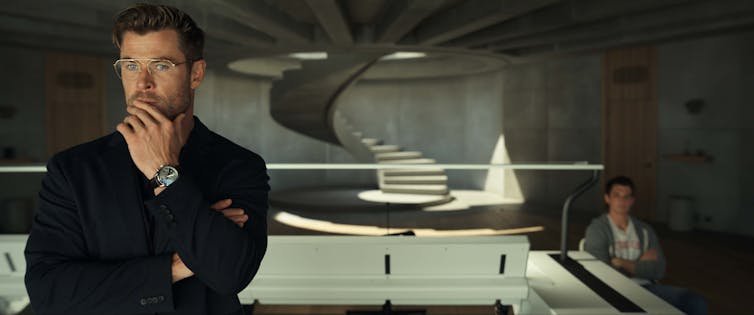
Donald Trump has said the United States should be applying tariffs to movies “produced in foreign lands”. This has the potential to deeply impact the Australian film industry.
Local crews are currently celebrating a boom in big budget production at studios on the Gold Coast, Sydney and Melbourne. Over the last five years, foreign production has represented almost half of all drama production expenditure in Australia.
But the history of Hollywood making movies in Australia warns us not to get complacent.
When times are good for Australian film crews they can be very good indeed. But global events can leave studios empty and film crew without work.
Read more: How do you put a tariff on movies? Here's what Trump's plan could mean for Australia
How Hollywood influenced Australian cinema
Hollywood’s influence was felt in Australian production from the silent era.
For its 1927 adaptation of Marcus Clarke’s literary classic For the Term of His Natural Life, local production and distribution company Australasian Films hired Hollywood director Norman Dawn. They felt this was necessary to appeal to American audiences.
For most of the 20th century, Hollywood production used Australia for its exotic setting. Films like On the Beach (1959), Kangaroo (1952) and The Sundowners (1960) brought their crews from America, rather than using Australians.
By the late 1960s, Hollywood’s cultural dominance was seen as a serious problem.
The Australian federal government established new grant and investment schemes for local films, intended to establish Australian culture in response to American influence.
The local industry’s independence was fervently protected, and we saw the release of films like Picnic at Hanging Rock (1975) and Newsfront (1978), aimed at establishing a distinct Australian film culture.
The international box office success of George Miller’s 1979 film Mad Max motivated a shift to more commercial, Hollywood-aligned filmmaking in Australia. Many in the industry argued the film illustrated the value of pursuing a popular cinema modelled on American production practices.
This laid the groundwork for Hollywood to become even more integrated with the local production industry.
Studios and infrastructure
The 1988 opening of Village Roadshow Studios and the filming of the 1988 Mission Impossible television series on the Gold Coast ignited the relationship between the Australian film industry and Hollywood that exists today.
These studios were followed by Fox Studios Australia (now Disney Studios Australia) in Sydney, home to productions including The Matrix and Star Wars: Episodes I–III.
These studios acquired international investment from Hollywood studios and received significant state government support. They supported new collaborations between Hollywood and the Australian film industry, though some criticised this direction for Australian cinema.
Throughout the 1990s, there was a rapid increase in the quantity of footloose production – a term referring to films originating from Hollywood but shooting elsewhere to reduce costs.
The comparatively weak Australian dollar, low labour and construction costs, and strong state government incentives meant that blockbusters like The Matrix could cut their budgets by as much as a third by shooting in Australia rather than Hollywood.
The local industry grew as big budget Hollywood films created jobs for Australian production crews. These crews depended on a steady supply of foreign production, because local productions were not big enough to support local crews.
Bust
The Australian film production industry was thrust into crisis in the second half of the 2000s, when a strong Australian dollar coupled with the global financial crisis wiped out the supply of footloose productions.
In 2008–09, foreign production brought just A$31 million into the country, from a high in 2003–04 of $519 million, adjusted for inflation.
This saw screen employment drop and some production facilities close.

Industry lobbying encouraged the federal government to introduce a 16.5% location tax offset for foreign films shooting in Australia, and a 30% tax offset for post, digital and visual effects.
Combined with the weakening Australian dollar, this brought Hollywood production back with a vengeance by 2014–15.
But the impact that a dry spell of blockbuster production could have on the Australian industry gave Hollywood producers significant negotiating power. In response, state and federal governments offered heavy hitters like Disney’s Pirates of the Caribbean: Dead Men Tell No Tales (2017) and Thor: Ragnarok (2017) tens of millions of dollars on top of existing offsets.
Boom
In 2020–21, the expenditure of foreign films shooting in Australia more than doubled compared to previous years. This was due to Australia, and especially Queensland, being one of the few places in the world where production could take place during COVID lockdowns.
Foreign production, especially on the Gold Coast, exploded.
Studio infrastructure was stretched to breaking point, with some films using makeshift studio spaces like the Gold Coast Convention and Exhibition Centre.

Growing capacity became a policy priority, and significant investment was directed towards training crew and expanding studio facilities.
The boom in Hollywood expenditure in Australia has resulted in an expansion of local production capability through crew training and investment in facilities.
But, as the global financial crisis bust shows, growth can be a double edged sword. It requires a consistent supply of footloose production to sustain itself.
The anxiety around Trump’s recently proposed tariffs demonstrates the Australian film industry remains dependent on footloose production.
Policy must now address how to exploit boom periods to support sustainability during the inevitable bust.
Authors: Andrew James Couzens, Lecturer in Digital Media, CQUniversity Australia


















