

The space race is being reshaped by geopolitics, offering opportunities for countries such as New Zealand
- Written by: Peter Zámborský, Senior Lecturer, Management & International Business, University of Auckland, Waipapa Taumata Rau
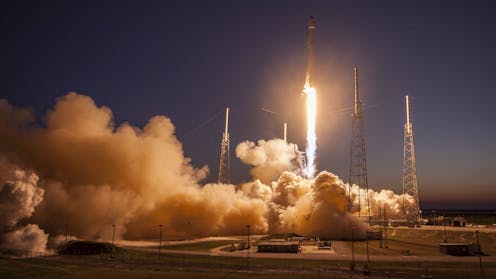
The space economy is being reshaped — not just by innovation, but by geopolitics. What was once dominated by state space agencies, and more recently by private ventures, is evolving into a hybrid model in which government priorities and commercial capabilities are intertwined.
The rise of protectionist policies, tariff wars, export controls and national security concerns is forcing space firms to adapt their strategies – and in many cases, to rethink where and how they operate.
This offers countries such as New Zealand the opportunity to stand out in the new space race – becoming neutral ground with fewer trade and other regulatory barriers for the growth of the emerging hybrid space economy.
Looking to space
The New Zealand government plans to double the size of the space and advanced aviation sectors by 2030. Already, about 20,000 workers are employed in these sectors, generating US$1.8 billion in revenue.
New Zealand’s flagship player in the space sector is Rocket Lab. Founded in 2006, the integrated space firm was listed on NASDAQ in 2021. By the end of 2024, the company was worth around US$8 billion.
While its headquarters are in the United States, Rocket Lab also operates in Canada and keeps around 700 of its 2,000 global staff and its key launch site in New Zealand. Recently, it also announced the acquisition of a German optical communications supplier, Mynaric.
Opportunities in US trade war
Rocket Lab’s decision to engage in substantial foreign investment and diversify its operations across the US, New Zealand, Canada and Europe gives it flexibility in responding to the US-initiated trade war.
The current and possible future US tariffs have created uncertainty for investors. Along with retaliatory measures by China and other nations, these developments have significant consequences for space firms.
Companies in this field rely on globally sourced components (for example, semiconductors and electronic components) and materials such as steel and specialised fuel for their operations.
Firms based in just one location can suffer from tariffs or retaliatory restrictions. But those with operations in several countries — especially in more neutral countries such as New Zealand and some Southeast Asian nations — may benefit from geopolitical tensions. Geostrategic diversification gives them more options, including less risky locations for operations, trade and investments in the space sector.
A recent Deloitte report noted that companies in the space ecosystem may prefer to look for launch sites and satellite providers on neutral ground.
Initiatives are already emerging in Indonesia and Malaysia to construct commercial spaceports and attract investment in satellite manufacturing.
The benefits of being neutral
The rising geopolitical tensions mean new space firms from relatively neutral countries such as New Zealand are increasingly aligning with national defence priorities. The emerging hybrid space economy is, in some ways, a response to this global power realignment.
New Zealand has historically sought to balance strong trade ties with China, its largest trading partner, with security cooperation with the US as part of the Five Eyes intelligence alliance. But recent developments have prompted a reassessment.
Notably, the presence of Chinese warships in the Tasman Sea and upheavals in the global security climate after Russia’s invasion of Ukraine has led to a review of New Zealand’s defence posture.
The government is now aiming to double defence spending to 2% of GDP. The US military has held talks with New Zealand about launching more satellites from this country.
Earlier this year, Rocket Lab also declared it was “ready to serve the Pentagon”. For example, it secured contracts worth about US$500 million to launch a satellite from New Zealand for BlackSky, a US-based space-based intelligence provider.
Rocket Lab also became one of five launch companies invited to compete for missions under the US National Security Space Launch program. This program puts the most valuable military and spy satellites into orbit, worth up to US$6 billion of Pentagon contracts in the next few years.
Tapping into foreign investment
Nations’ increased needs for domestic space defence capabilities also create foreign investment opportunities. For example, Airbus will design and build a new military satellite system costing about US$170 million in the United Kingdom to improve real-time military imagery.
Ongoing economic strife and possible military conflicts have important implications for the strategies of new space firms and the policies of nations seeking space investment.
New space firms may redirect their investment to countries where their main customers are located (for example, the US or European Union) or to neutral countries less affected by geopolitical tensions (for example, New Zealand). This allows them to diversify and reduce exposure to tariffs and other restrictions.
In New Zealand, this may mean more government investment not only by Rocket Lab, but also involvement by other industry players from the US, Japan or Europe.
Commercial opportunities in the new space sector will remain. But the shape of the sector may move towards a more hybrid space, recognising both commercial and national security interests in times of economic war.
Authors: Peter Zámborský, Senior Lecturer, Management & International Business, University of Auckland, Waipapa Taumata Rau


















