

Modern Australian
Times Advertising

Australian researchers use a quantum computer to simulate how real molecules behave

  • Written by Ivan Kassal, Professor of Chemical Physics, University of Sydney
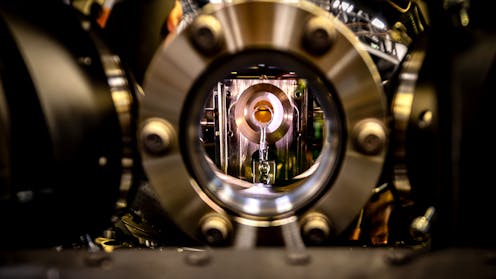
Australian researchers use a quantum computer to simulate how real molecules behave

When a molecule absorbs light, it undergoes a whirlwind of quantum-mechanical transformations. Electrons jump between energy levels, atoms vibrate, and chemical bonds shift — all within millionths of a billionth of a second.

These processes underpin everything from photosynthesis in plants and DNA damage from sunlight, to the operation of solar cells and light-powered cancer therapies.

Yet despite their importance, chemical processes driven by light are difficult to simulate accurately. Traditional computers struggle, because it takes vast computational power to simulate this quantum behaviour.

Quantum computers, by contrast, are themselves quantum systems — so quantum behaviour comes naturally. This makes quantum computers natural candidates for simulating chemistry.

Until now, quantum devices have only been able to calculate unchanging things, such as the energies of molecules. Our study, published this week in the Journal of the American Chemical Society, demonstrates we can also model how those molecules change over time.

We experimentally simulated how specific real molecules behave after absorbing light.

Simulating reality with a single ion

We used what is called a trapped-ion quantum computer. This works by manipulating individual atoms in a vacuum chamber, held in place with electromagnetic fields.

Normally, quantum computers store information using quantum bits, or qubits. However, to simulate the behaviour of the molecules, we also used vibrations of the atoms in the computer called “bosonic modes”.

This technique is called mixed qudit-boson simulation. It dramatically reduces how big a quantum computer you need to simulate a molecule.
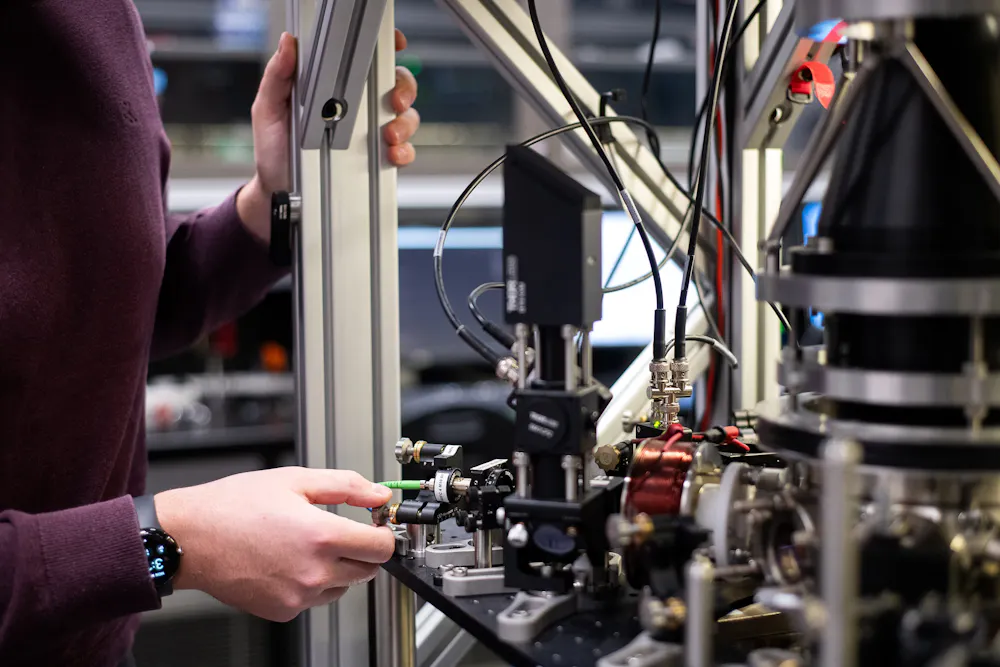
Photo of a person adjusting a complex device.
Using a new technique allows realistic simulations to be carried out with small quantum computers. Nicola Bailey

We simulated the behaviour of three molecules absorbing light: allene, butatriene, and pyrazine. Each molecule features complex electronic and vibrational interactions after absorbing light, making them ideal test cases.

Our simulation, which used a laser and a single atom in the quantum computer, slowed these processes down by a factor of 100 billion. In the real world, the interactions take femtoseconds, but our simulation of them played out in milliseconds – slow enough for us to see what happened.

A million times more efficient

What makes our experiment particularly significant is the size of the quantum computer we used.

Performing the same simulation with a traditional quantum computer (without using bosonic modes) would require 11 qubits, and to carry out roughly 300,000 “entangling” operations without errors. This is well beyond the reach of current technology.

By contrast, our approach accomplished the task by zapping a single trapped ion with a single laser pulse. We estimate our method is at least a million times more resource-efficient than standard quantum approaches.

We also simulated “open-system” dynamics, where the molecule interacts with its environment. This is typically a much harder problem for classical computers.

By injecting controlled noise into the ion’s environment, we replicated how real molecules lose energy. This showed environmental complexity can also be captured by quantum simulation.

What’s next?

This work is an important step forward for quantum chemistry. Even though current quantum computers are still limited in scale, our methods show that small, well-designed experiments can already tackle problems of real scientific interest.

Simulating the real-world behaviour of atoms and molecules is a key goal of quantum chemistry. It will make it easier to understand the properties of different materials, and may accelerate breakthroughs in medicine, materials and energy.

We believe that with a modest increase in scale — to perhaps 20 or 30 ions — quantum simulations could tackle chemical systems too complex for any classical supercomputer. That would open the door to rapid advances in drug development, clean energy, and our fundamental understanding of chemical processes that drive life itself.

Authors: Ivan Kassal, Professor of Chemical Physics, University of Sydney

Read more https://theconversation.com/australian-researchers-use-a-quantum-computer-to-simulate-how-real-molecules-behave-256870

What People Mean by “Alternative Doctor” And Why Expectations Around Care Are Changing

When people search for an “alternative doctor,” they’re usually looking for something specific, even if they haven’t fully defined it yet. I...

Why Does My Power Keep Tripping? Common Causes Explained by Electricians Sydney

The electrical system is the lifeblood of your home, powering everything from your phones to cooking utensils and more. But from time to time, your po...

Interstate Car Transporter Urges Buyers to Book Early

As the conflict in the Middle East continues to put increasing pressure on local fuel supply, Australian transport companies are experiencing increasi...

Digital Minimalism for Business Owners: Fewer Tools, Better Systems

Be honest. How many apps are open right now? One for scheduling, another for invoices, a third for customer notes, plus a spreadsheet someone email...

The Importance Of Proactive NDIS Renewal Preparation For Sustaining Your Provider Business

Your NDIS renewal notice is not a signal to start preparing. By the time it arrives, preparation should already be well underway. For new providers, s...

Why Fire Extinguisher Testing in Sydney Is Becoming a Records Game, Not Only a Maintenance Job

A fire extinguisher used to feel like one of the simpler parts of building safety. It hung on the wall, wore a service tag, and sat there quietly unle...

The Switchboard Upgrade Question Every Melbourne Renovator Should Ask Before the Walls Close Up

Renovations have a funny way of making people think on surfaces first. Splashback, stone, joinery, tapware, paint. Fair enough too. That is the exciti...

Winter Sanitation Gaps in Parramatta Kitchens: A Hidden Pest Risk

Winter brings a host of changes to our homes, from the chill in the air to the cozy warmth indoors. However, this season also introduces sanitation ch...

When to Seek Advice from Employment Lawyers in Melbourne

Australian employment law is detailed and, at times, complex, with rights and obligations that aren't always obvious to employees or employers witho...

7 Benefits of Professional Gutter Cleaning for Australian Homeowners

Gutters aren't exactly glamorous. They sit up there on the edge of your roof, doing their job quietly - until they stop working. Clogged, overflowing ...

Pipe Floats Strengthening Pipeline Performance In Demanding Environments

Pipelines often travel through environments that are anything but predictable, water currents shift, terrain changes, and materials keep moving unde...

Why Ceiling Fans Are Essential For Comfort, Efficiency, And Modern Living

Creating a comfortable indoor environment is not just about temperature; it is about how air moves, how a room feels, and how efficiently energy is ...

Why Duct Cleaning In Melbourne Is A Smart Investment For Healthier Living Spaces

Behind your walls, ceilings, and vents lies a network quietly working every day to keep your home comfortable. Yet over time, this system can become...

Disability Service Providers Supporting Inclusive And Independent Living

Finding the right support system can feel like assembling a puzzle where every piece must fit just right. For individuals and families navigating di...

A Beginner's Guide to Owning a Caravan in Australia

Owning a caravan opens up a style of travel that's hard to match for freedom and flexibility. However, for those just starting out, the process of c...

Preparing Your Air Conditioner for Summer: What Most Homeowners Overlook

As temperatures rise, many homeowners switch on their air conditioning for the first time in months — only to find it’s not performing the way i...

What Actually Adds Value to Properties in Newcastle

Newcastle has seen steady growth over the past few years, with more buyers looking beyond Sydney for lifestyle, space, and long-term value. As dema...

What is Design and Build in Construction?

Imagine you’re about to start a new construction project, maybe it’s a custom home or a commercial building. You’ve got the idea, the land, an...

















