

Why is southern Australia in drought – and when will it end?
- Written by: Chiara Holgate, Senior Research Fellow, ARC Centre of Excellence for Weather of the 21st Century, Australian National University
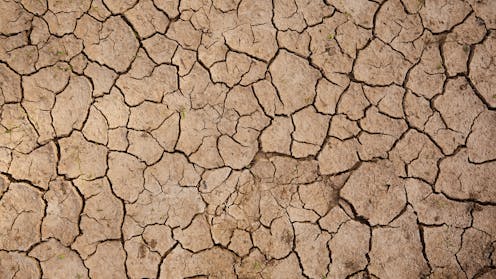
Swathes of South Australia, Victoria, Tasmania and Western Australia are in the grip of drought as they experience some of the lowest rainfall totals on record.
Farmers are spending eye-watering amounts of money buying feed, or selling stock to stay afloat.
Some towns are already on water restrictions. Those not connected to the mains water system are in a perilous situation. In the Adelaide Hills, water is being trucked in to fill empty rainwater tanks and dams.
The story playing out across southern Australia could be a glimpse of what’s to come. Our recent research suggests southern Australia may experience longer and more intense droughts in the future, as the climate changes.
How bad is this drought?
Parts of southern Australia have been experiencing drier than normal conditions for well over a year.
Conditions on the ground are worsening as the drought continues.
In Adelaide, the desalination plant has ramped up to maintain water supply. Similarly, Victoria’s desal plant has fired up for the first time since 2022 as dam levels fall.
Farmers are facing some of the driest conditions in decades, and financial pressures are mounting.
Nature, too, is struggling. Waterways, wetlands and deep pools have dried up, leading to fears for endangered fish, insects and many other species.

Where has the rain gone?
In a drought-prone country such as Australia, there’s an age-old question: why do the rains sometimes disappear?
Our recent research shows Australian scientists are getting closer to answering this question.
We now know Australian droughts develop when weather systems that lift and carry moisture from the ocean – to fall as heavy rain on land – disappear. When these weather systems return, the droughts break.
These kinds of weather systems have been notably absent from southern Australia in recent months. Instead, slow-moving high-pressure systems, which typically bring warm and dry conditions, have been the standout feature across southern Australia.
For Australia, the driest inhabited continent, heavy rains are what keep drought at bay. Last spring and summer, drought conditions were building in parts of Queensland and northern New South Wales. But then Tropical Cyclone Alfred brought heavy rains, dumping up to four times as much rain as these areas usually get in February and March.
Similarly, heavy rains at the end of last year helped parts of northern and central WA avoid drought conditions.
Unfortunately, western Victoria and southern SA have had no such luck.

How long will the drought last?
If farmers, water authorities and policymakers knew how much longer this drought would last, they could make clear plans. Keep or sell livestock? Impose water restrictions or wait?
Unfortunately, drought timing is very hard to predict. As our research shows, the climate processes that bring weather systems laden with heavy rain are complex.
But we do know heavy and persistent rain is needed to break the drought. And the current forecast shows there’s a decent chance of that as we head towards spring. Though forecasts can change, and those with skin in the game will have their eyes glued to next month’s update to the Bureau of Meteorology’s rainfall outlook.
It also helps that we’re heading into what’s usually the rainier time of year. This means the odds of receiving decent rain are higher at this time of year than if we were heading into summer.
Climate and water long-range forecast, issued 15 May 2025 (Bureau of Meteorology)Dry and drier
Over the past few decades, southern Australia has become drier. Drying has been most pronounced during the cooler months, between April and October. Some parts of southern Australia have also become more drought-prone, with the number of months spent in drought increasing over this time.
Maps of the current dry conditions across southern Australia closely follow the regions projected to experience longer and more frequent drought conditions in future.
It’s too early to draw a clear line between climate change and this particular drought. But the weight of evidence shows southern droughts are likely to strike more often in the future. The Tinderbox Drought from 2017–19, for instance, was the first Australian drought to show a possible worsening from climate change.
The good news? We now know more about how Australian droughts work. This means we can now be more confident in the direction of Australia’s water future than in past decades.
We must urgently use this new knowledge to develop innovative solutions that will allow Australia to thrive in a climate of increasingly variable water availability. Solutions will involve setting sustainable limits on water use, introducing water recycling and improving efficiency, among other measures.
Though solutions may look different in different parts of Australia, one thing rings true everywhere: we all need to make every drop count.
Authors: Chiara Holgate, Senior Research Fellow, ARC Centre of Excellence for Weather of the 21st Century, Australian National University
Read more https://theconversation.com/why-is-southern-australia-in-drought-and-when-will-it-end-256443


















