

Australia to attend climate summit empty-handed despite UN pleas to ‘come with a plan'
- Written by: Frank Jotzo, Director, Centre for Climate and Energy Policy, Crawford School of Public Policy, Australian National University
This story is part of Covering Climate Now, a global collaboration of more than 250 news outlets to strengthen coverage of the climate story.
Climate action will be on the world stage again at a meeting of world leaders in New York on September 23. The United Nations has convened the event and urged countries to “come with a plan” for ambitious emissions reduction.
UN Secretary-General António Guterres called the meeting because he says global efforts to tackle climate change are running off-track. He wants leaders to present concrete, realistic pathways to strengthen their existing national emissions pledges and move towards net zero emissions by 2050.
Australia is not expected to propose any significant new actions or goals. Prime Minister Scott Morrison - in the US at the time to visit President Donald Trump - will not attend the summit. Foreign Minister Marise Payne will attend, and is likely to have to fend off heavy criticism over Australia’s slow progress on climate action.
Australia: procrastinator or paragon?
Australia has gained an international reputation as a climate action laggard - plagued by political acrimony over climate change, offering few policies to reduce emissions and embroiled in diplomatic rifts with our Pacific neighbours over, among other things, support for coal.
For many afar, it is difficult to understand the policy vacuum in a country so vulnerable to climate change.
In turn, the federal government points out that Australia is one of the few countries that has fully met its emissions reductions targets under the Kyoto protocol period to 2020, and says that it expects to meet the 2030 Paris emissions targets.
 An island in the low-lying Pacific nation of Tuvalu, which is threatened by inundation from rising seas.
Mick Tsikas/AAP
An island in the low-lying Pacific nation of Tuvalu, which is threatened by inundation from rising seas.
Mick Tsikas/AAP
Come with a plan, and make it good
The landmark Paris agreement includes a global goal to hold average temperature increase to well below 2°C and pursue efforts to keep warming below 1.5°C above pre-industrial levels.
Countries set so-called “nationally determined contributions” (NDCs) outlining an emissions reduction target and how they will get there.
Read more: Why declaring a national climate emergency would neither be realistic or effective
Australia set a target to reduce emissions by 26-28% below 2005 levels by 2030. Under the Paris treaty, the national pledges should be reviewed and strengthened every five years.
The UN convened the summit to ensure countries are developing concrete, realistic pathways to enhance their NDCs. The new pledges should be in line with a 45% cut to global greenhouse gas emissions over the next decade, and net-zero emissions by 2050.
Australia’s annual greenhouse gas emissions are about 12% lower than in 2005, the base year for the Paris target. But since 2013 they have steadily risen, and are continuing to rise.
In the electricity sector, recent declines in coal-fired power and increases in renewables are reducing carbon output. But those savings are being negated by rises in the gas industry and from transport.
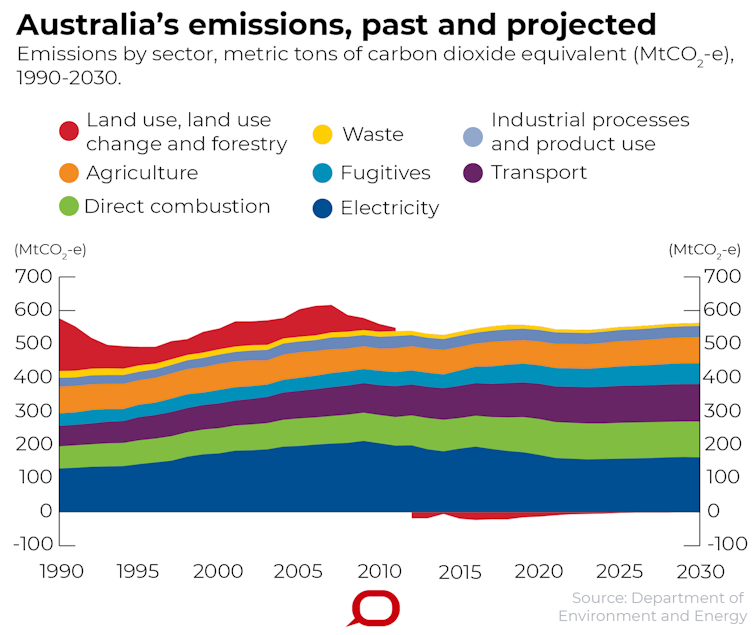 Australia’s greenhouse gas emissions, past and projected. Data drawn from Department of the Environment and Energy report titled ‘Australia’s emissions projections 2018’
Department of the Environment and Energy
Australia’s greenhouse gas emissions, past and projected. Data drawn from Department of the Environment and Energy report titled ‘Australia’s emissions projections 2018’
Department of the Environment and Energy
Nevertheless, the Australian government is loudly confident of reaching the Paris target - including by using a large amount of accumulated credits from the Kyoto Protocol period. On average, Australia stayed below the Kyoto emissions budgets from 2008 to 2020, and the plan is to count this “carry-over” against an expected overshoot in the period to 2030.
This may be compatible with the Paris Agreement rule book. But it would receive scorn from countries that care about climate commitments. The Kyoto targets were not in line with the ambition now spelled out in the Paris agreement, and Australia’s Kyoto targets are seen by many countries as lax.
With meaningful policy effort, Australia could meet the Paris target without resorting to Kyoto credits, and possibly meet a much more ambitious target. This would set us up better for deeper cuts down the road.
Rapid and large emissions reductions could be made in the electricity sector - especially if the investment boom in renewables of the last two years were to continue. However the latest indications are that renewables investment is tailing off.
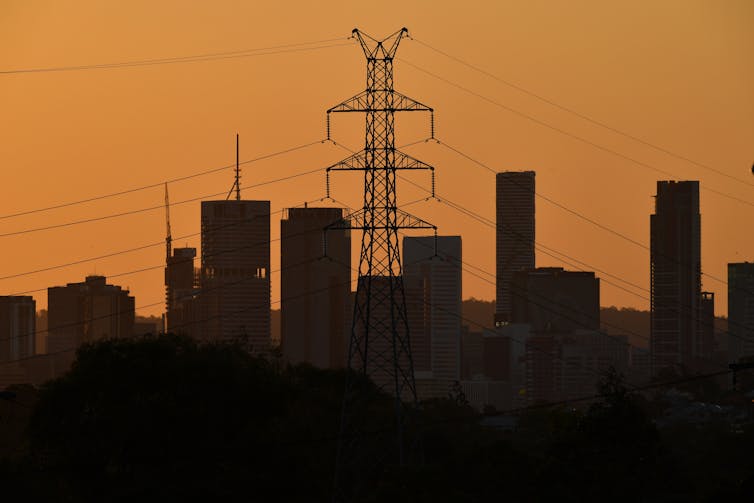 The transition to renewables is transforming the electricity sector. Pictured: a high voltage electricity transmission tower in central Brisbane.
Darren England/AAP
The transition to renewables is transforming the electricity sector. Pictured: a high voltage electricity transmission tower in central Brisbane.
Darren England/AAP
Large improvements can readily be made in transport by shifting to electric vehicles and improving the rather dismal fuel efficiency of conventional cars still sold in Australia. Gas and coal use in industry can be cut by improving efficiency and shifting to electricity, and by phasing out some old energy-hungry and often uneconomic plants like aluminium smelters.
The gas industry can do better through improved management of leaks and reduced venting of methane; we can also improve agricultural practices and land management.
Read more: Why carbon dioxide has such outsized influence on Earth's climate
The transition in the energy sector will definitely happen, based on the cost advantage of renewables, unless governments actively stand in the way. The question is how quickly and smoothly it will happen.
The advantages of the renewables transition extend beyond our shores. Solar and wind energy could be converted to carbon-free hydrogen and other zero-emissions fuels at massive scale and then exported. Electricity could also be sent through undersea cables to Asia.
This is shaping up as a real possibility, depending on technology costs and whether the world kicks the fossil fuel habit.
Outside electricity generation, policy measures are needed to achieve, or at least encourage, these changes. A price on carbon like many countries now have, would do a very good job, combined with the right regulation and public investment.
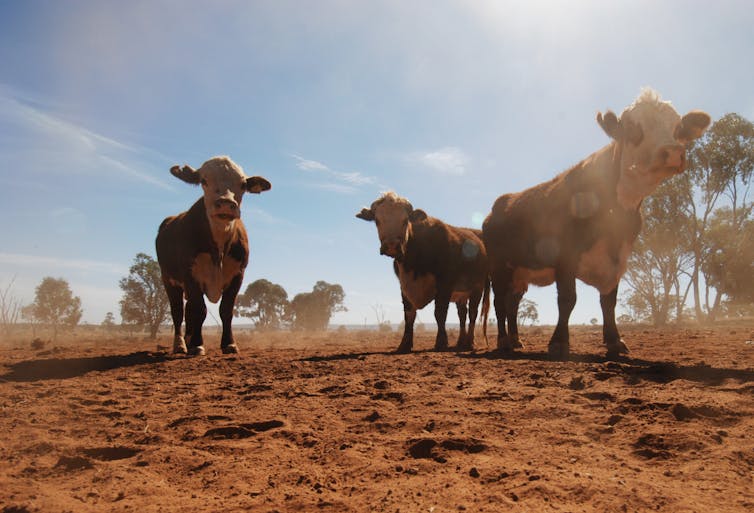 Cattle stir up dust on a property outside Condobolin in NSW’s central west. Most of the nation is currently gripped by drought.
Dean Lewins/AAP
Cattle stir up dust on a property outside Condobolin in NSW’s central west. Most of the nation is currently gripped by drought.
Dean Lewins/AAP
Limiting the risk of catastrophic climate change demands that global emissions fall rapidly in coming decades. Keeping temperature rise to 2°C or less means reducing emissions to net-zero.
Australia will be expected to table strategies to get to net-zero by 2050 next year, at the UN’s climate COP, or “conference of the parties”.. That process should be a chance for Australian governments, industry and civil society to put heads together about how this could work.
Read more: Nuclear power should be allowed in Australia – but only with a carbon price
The year 2050 is beyond the horizon of most corporate interests vested in existing assets, and it allows greater emphasis on long term opportunities than on short term adjustments. This should encourage a more open discussion than the often acrimonious debates about 2030 emissions targets and short-term policies.
Australia should show the world it can imagine a zero-emissions future, and hatch the beginnings of a plan for it. It would help position the nation’s resources industries for the future and help with our international reputation.
Authors: Frank Jotzo, Director, Centre for Climate and Energy Policy, Crawford School of Public Policy, Australian National University


















