

Australia’s native bees struggled after the Black Summer fires – but a world-first solution brought them buzzing back
- Written by: Kit Prendergast, Postdoctoral Researcher, Pollination Ecology, University of Southern Queensland
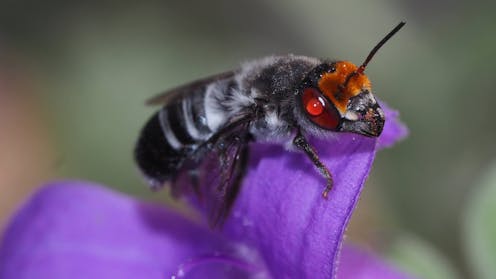
After a devastating bushfire, efforts to help nature recover typically focus on vertebrates and plants. Yet extreme fires can threaten insects, too.
After the Black Summer fires of 2019–20, I embarked on world-first research into whether “bee hotels” – a type of artificial nesting structure – could help native bees recolonise an area.
I installed 1,000 bee hotels in the Jarrah forests of Western Australia, parts of which burned during the Black Summer fires.
After months of monitoring, I concluded – with great excitement and relief – that the project was a success. Native bees were using the structures to lay eggs and raise young. The work shows pollinators such as bees can be aided after fires, to help bring damaged landscapes back to life.
Vital wild pollinators
Australia has more than 2,000 species of native bees. They help keep our ecosystems healthy, and play a crucial role in pollinating wildflowers.
Native bees typically nest in holes in trees that occur naturally when beetles bore through wood. When fire destroys trees, bees can be left without a place to nest and reproduce. This prevents them from recolonising habitats after fire.
Under climate change, bushfires in Australia are becoming more frequent and severe. Wood-nesting bees are especially vulnerable to bushfires. For example, fires are recognised as a major threat to the glittering green carpenter bee (Xylocopa aerata), which creates its own holes in wood to nest in.
The worsening fires take place at a time when global populations of wild pollinators, such as bees, are in steady decline. This problem has been well-publicised, although the plight of Australia’s native bees has received less attention.
My research tested whether bee hotels could help our native bees bounce back after fire.
What the research found
The Jarrah Forest of southwest Western Australia is a biodiversity hotspot. The 1,000 bee hotels were installed across five sites in the northern part of the forest, where bushfires burned during the summer of 2019–20.
Bee hotels replicate the holes in wood that native bees nest in. In August 2021, I installed bee hotels of two types: wooden blocks with 15 holes drilled in them, and bunches of about 50 bamboo stems bundled together. I monitored them from September 2021 to March 2022.
At the end of the period I concluded – with great excitement and relief – that the project was a success. Across all bee hotels at the five sites, 832 cavities were occupied by native bees.
Assuming four cells per cavity for each offspring, this meant more than 3,300 native bees would likely emerge in the next generation.
Uptake by bees was initially slow. This was to be expected, because the main group of species that used bee hotels – from the Megachile genus – tend to not be active in the region until late spring.
I found the nests were also used by bees of the genus Hylaeus, as well as tiny Exoneura bees. Other inhabitants included wasps, spiders, ants and crickets.
I also surveyed three burnt sites where bee hotels were not installed. There, I recorded the numbers of native bees foraging on flowers, and compared it to the sites with bee hotels. More native bees were present at the latter sites, which reinforced my findings.
Importantly, the research allowed natural recolonisation. It did not involve installing bee hotels at unburnt sites, then moving them to burnt areas once they were occupied. This could have been disastrous.
Aside from depleting one population, it may have meant native bees were moved to an area where there were not enough flowers, or were forced to compete with existing bee populations.
The research also showed European honey bees could pose a problem for native bees in fire-damaged landscapes. At sites with a higher density of honey bees, fewer native bees were foraging and fewer nests were occupied in the bee hotels.
This supports previous findings by myself and others that honey bees can negatively affect native bees. It adds further evidence that honey bees should not be permitted in sensitive habitats, such as bushland following fire or in national parks.
Empowering bee-saving efforts
My research provides proof that bee hotels can aid in the recovery of cavity-nesting native bees after fires.
This work fills a major gap. While there has been much attention on the recovery of furry animals and plants after fires, there has been far less investment into the recovery of plant pollinators.
Leaving insects to languish after fires isn’t just bad for those species. It also hampers the ability of ecosystems to recover from fire and other damage. This is especially true for pollinators such as native bees, which are vital for plant reproduction.
This work empowers us to help native bees after fires, by providing nesting resources to promote populations.
Authors: Kit Prendergast, Postdoctoral Researcher, Pollination Ecology, University of Southern Queensland


















