

why proposed changes to forestry rules won’t solve the ‘slash’ problem
- Written by: Mark Bloomberg, Adjunct Senior Fellow, Te Kura Ngahere-New Zealand School of Forestry, University of Canterbury
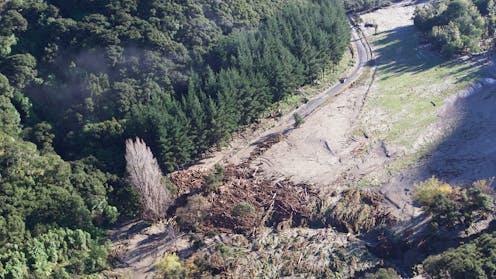
The biggest environmental problems for commercial plantation forestry in New Zealand’s steep hill country are discharges of slash (woody debris left behind after logging) and sediment from clear-fell harvests.
During the past 15 years, there have been 15 convictions of forestry companies for slash and sediment discharges into rivers, on land and along the coastline.
Such discharges are meant to be controlled by the National Environmental Standards for Commercial Forestry, which set environmental rules for forestry activities such as logging roads and clear-fell harvesting. The standards are part of the Resource Management Act (RMA), which the government is reforming.
The government revised the standards’ slash-management rules in 2023 after Cyclone Gabrielle. But it it is now consulting on a proposal to further amend the standards because of cost, uncertainty and compliance issues.
We believe the proposed changes fail to address the core reasons for slash and sediment discharges.
We recently analysed five convictions of forestry companies under the RMA for illegal discharges. Based on this analysis, which has been accepted for publication in the New Zealand Journal of Forestry, we argue that the standards should set limits to the size and location of clear-felling areas on erosion-susceptible land.
Why the courts convicted 5 forestry companies
In the aftermath of destructive storms in the Gisborne district during June 2018, five forestry companies were convicted for breaches of the RMA for discharges of slash and sediment from their clear-fell harvesting operations. These discharges resulted from landslides and collapsed earthworks (including roads).
There has been a lot of criticism of forestry’s performance during these storms and subsequent events such as Cyclone Gabrielle. However, little attention has been given to why the courts decided to convict the forestry companies for breaches of the RMA.
The courts’ decisions clearly explain why the sediment and slash discharges happened, why the forestry companies were at fault, and what can be done to prevent these discharges in future on erosion-prone land.
New Zealand’s plantation forest land is ranked for its susceptibility to erosion using a four-colour scale, from green (low) to red (very high). Because of the high erosion susceptibility, additional RMA permissions (consents) for earthworks and harvesting are required on red-ranked areas.

New Zealand-wide, only 7% of plantation forests are on red land. A further 17% are on orange (high susceptibility) land. But in the Gisborne district, 55% of commercial forests are on red land. This is why trying to manage erosion is such a problem in Gisborne’s forests.
Key findings from the forestry cases
In all five cases, the convicted companies had consents from the Gisborne District Council to build logging roads and clear-fell large areas covering hundreds or even thousands of hectares.
A significant part of the sediment and slash discharges originated from landslides that were primed to occur after the large-scale clear-fell harvests. But since the harvests were lawful, these landslides were not relevant to the decision to convict.
Instead, all convictions were for compliance failures where logging roads and log storage areas collapsed or slash was not properly disposed of, even though these only partly contributed to the collective sediment and slash discharges downstream.
The court concluded that:
Clear-fell harvesting on land highly susceptible to erosion required absolute compliance with resource consent conditions. Failures to correctly build roads or manage slash contributed to slash and sediment discharges downstream.
Even with absolute compliance, clear-felling on such land was still risky. This was because a significant portion of the discharges were due to the lawful activity of cutting down trees and removing them, leaving the land vulnerable to landslides and other erosion.
The second conclusion is critical. It means that even if forestry companies are fully compliant with the standards and consents, slash and sediment discharges can still happen after clear-felling. And if this happens, councils can require companies to clean up these discharges and prevent them from happening again.
This is not a hypothetical scenario. Recently, the Gisborne District Council successfully applied to the Environment Court for enforcement orders requiring clean-up of slash deposits and remediation of harvesting sites. If the forestry companies fail to comply, they can be held in contempt of court.
Regulations are not just red tape
This illustrates a major problem with the standards that applies to erosion-susceptible forest land everywhere in New Zealand, not just in the Gisborne district. Regulations are not just “red tape”. They provide certainty to businesses that as long as they are compliant, their activities should be free from legal prosecution and enforcement.
The courts’ decisions and council enforcement actions show that forestry companies can face considerable legal risk, even if compliant with regulatory requirements for earthworks and harvesting.
Clear-felled forests on erosion-prone land are one bad rainstorm away from disaster. But with well planned, careful harvesting of small forest areas, this risk can be kept at a tolerable level.
However, the standards and the proposed amendments do not require small clear-fell areas on erosion-prone land. If this shortcoming is not fixed, communities and ecosystems will continue to bear the brunt of the discharges from large-scale clear-fell harvests.
To solve this problem, the standards must proactively limit the size and location of clear-felling areas on erosion-prone land. This will address the main cause of catastrophic slash and sediment discharges from forests, protecting communities and ecosystems. And it will enable forestry companies to plan their harvests with greater confidence that they will not be subject to legal action.
Authors: Mark Bloomberg, Adjunct Senior Fellow, Te Kura Ngahere-New Zealand School of Forestry, University of Canterbury


















