

The drought in southern Australia is not over – it just looks that way
- Written by: Andrew B. Watkins, Associate research scientist, School of Earth, Atmopshere & Environment, Monash University
How often do you mow your lawn in winter? That may seem like an odd way to start a conversation about drought. But the answer helps explain why our current drought has not broken, despite recent rain – and why spring lamb may be more expensive this year.
Southern Australia has been short of rain for 16 months. Western Victoria, the agricultural regions of South Australia (including Adelaide) and even parts of western Tasmania are suffering record dry conditions. Those rainfall measurements began in 1900 (126 years ago).

Fewer and less intense rain-bearing weather systems have been crossing the southern coastline since February 2024, compared to normal. Put simply, the land has not received enough big dumps of rain.
But June has finally brought rain to some drought-affected regions. There’s even an emerald green tinge to the fields in certain agricultural areas. But it’s now too cold for plants to really grow fast, meaning farmers will be carting hay and buying extra feed for livestock until the weather warms in spring.

Too little, too late
This month, some areas received good rainfall – including places near Melbourne and, to a lesser degree, Adelaide. City people may be forgiven for thinking the drought has broken and farmers are rejoicing. But drought is not that simple.
Unfortunately, the rainfall was inconsistent, especially further inland. The coastal deluge in parts of southern Australia in early June didn’t extend far north. Traditionally, the start of the winter crop-growing season is marked by 25mm of rain over three days – a so-called “autumn break”. But many areas didn’t receive the break this year.
The lack of rain (meteorological drought) compounded the lack of water in the soil for crops and pasture (agricultural drought). Parts of Western Australia, SA, Victoria, Tasmania and southern New South Wales had little moisture left in their soils. So some rain is quickly soaked up as it drains into deeper soils.
To make matters worse, autumn was the warmest on record for southern Australia, following its second-warmest summer on record. This can increase the “thirst” of the atmosphere, meaning any water on the surface is more likely to evaporate. Recent thirsty droughts, such as the 2017–19 Tinderbox Drought in NSW, were particularly hard-hitting.
Some areas may have experienced “flash drought”, which is when the landscape and vegetation dry up far quicker than you would expect from the lack of rain alone. By May, areas of significantly elevated evaporative stress were present in southeastern SA, Victoria, southern NSW and northern Tasmania.
In late May and early June, and again this week, there have been winter dust storms in SA. Such dust storms are a bad sign of how dry the ground has become.
Some regions no longer have enough water to fill rivers and dams (hydrological drought). Water restrictions have been introduced in parts of southwest Victoria and Tasmania. The bureau’s streamflow forecast does not look promising.
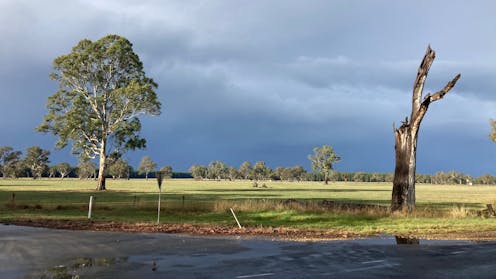
 The landscape near Mortlake in western Victoria was still dry in late May. Typically the autumn break (first post-summer rain event of more than 25 mm) occurs here by early May.
Andrew Watkins
The landscape near Mortlake in western Victoria was still dry in late May. Typically the autumn break (first post-summer rain event of more than 25 mm) occurs here by early May.
Andrew Watkins
A green drought
Remember that lawn mowing analogy? The winter chill has already set in across the south. This means it’s simply too cold for any vigorous new grass growth, and why you are not mowing your lawn very often at the moment.
Cool temperatures, rather than just low rainfall, also limit pasture growth. While from a distance the rain has added an emerald sheen to some of the landscape, it’s often just a green tinge. Up close, it’s clear there is very limited new growth.
Rather than abundant and vigorous new shoots, there’s just a little bit of green returning to surviving grasses. This means there’s very limited feed for livestock. To make matters worse, sometimes the green comes from better-adapted winter weeds.
There will be a lot of hay carting, regardless of rainfall, until spring when the soils start to warm up once again and new growth returns. This all adds up to fewer stock kept in paddocks or a big extra cost in time and money for farmers – and ultimately, a more expensive spring lamb barbecue.
 Farmers are being forced to choose between sending sheep to market or buying in feed.
AAP Image/Supplied by Cassie Oster
Farmers are being forced to choose between sending sheep to market or buying in feed.
AAP Image/Supplied by Cassie Oster
Is this climate change?
Southern Australia (southern WA, SA, Tasmania, Victoria and southern NSW) used to experience almost weekly rain events in autumn and early winter. Cold fronts and deep low-pressure systems rolling in from the west brought the bulk of the rainfall.
Now there is a far more sporadic pattern in these regions. Rainfall in the April to October crop and pasture growing season has declined by around 10–20% since the middle of last century. The strongest drying trend is evident during the crucial months between April and July.
Further reductions in southern growing season rainfall are expected by the end of this century, especially in southwestern Australia. Southeastern regions, including southern Victoria, parts of SA and northern Tasmania, also show a consistent drying trend, with a greater time spent in drought every decade.
 A drying trend is evident across southern Australia from April to October when the 30 years from 1994 to 2023 are compared to the long-term average. The decile map shows where rainfall is above average, average, or below average for this period compared to all years from 1900 (when reliable national rainfall records began) to 1993.
State of the Climate 2024, Bureau of Meteorology
A drying trend is evident across southern Australia from April to October when the 30 years from 1994 to 2023 are compared to the long-term average. The decile map shows where rainfall is above average, average, or below average for this period compared to all years from 1900 (when reliable national rainfall records began) to 1993.
State of the Climate 2024, Bureau of Meteorology
Drought is complex. Just because it’s raining doesn’t always mean it has rained enough, or at the right time, or in the right place. To make matters worse, a green drought can even deceive us into thinking everything is fine.
Breaking the meteorological drought will require consistent rainfall over several months. Breaking the agricultural drought will also require more warmth in the soils. Outlooks suggest we may have to wait for spring.
This article includes scientific contributions from David Jones and Pandora Hope from the Australian Bureau of Meteorology.
Read more: Why is southern Australia in drought – and when will it end?
Authors: Andrew B. Watkins, Associate research scientist, School of Earth, Atmopshere & Environment, Monash University


















