

how less structured city spaces can nurture children’s creativity and independence
- Written by: Jose Antonio Lara-Hernandez, Senior Researcher in Architecture, Auckland University of Technology
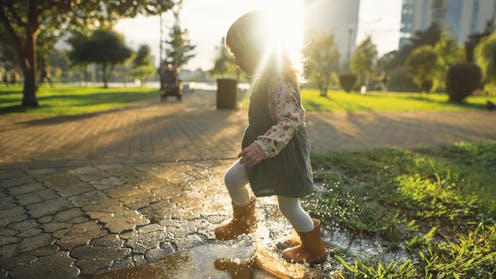
Children’s play is essential for their cognitive, physical and social development. But in cities, spaces to play are usually separated, often literally fenced off, from the rest of urban life.
In our new study, we compare children’s use of such spaces in Auckland, New Zealand, and Venice, Italy. Our findings present a paradox: playgrounds built for safety can stifle creativity and mobility, while self-organising open spaces offer rich opportunities to explore and belong.
In Auckland, places such as Taumata Reserve are a testimony to contemporary playground design – grassy, shaded, equipped with slides and swings, and buffered from traffic. Such places are an oasis cherished by caregivers for the sense of perceived safety they provide.
Yet during our observations, we noted how these spaces function not necessarily as an oasis or a point for social encounter, but rather as isolated refuge islands, disconnected from the city’s everyday life. Children’s independent mobility and opportunities for diverse play activities remained limited and predefined.
Contrast this with Venice’s Santa Croce neighbourhood. Car-free streets and piazzas, such as Campo San Giacomo dell’Orio above, pulsate with life. We saw children play ball, draw on pavements, chase each other and even water plants. These spaces are shared inter-generational stages.
To compare children’s experience, we measured the diversity of activities (a proxy for creativity). Auckland’s Taumata Reserve scored just 1.46. In contrast, Venice scored 2.33, with more than 2,600 spontaneous acts in the streets, reflecting a child-led play culture.
Why this matters
Play is not a luxury. It is a fundamental necessity of life to understand, navigate and adapt to the complexities of the world.
From a deterministic perspective, contemporary Western cultures (such as in Europe and New Zealand) prescribe diverse benefits of play. This includes learning and developing resilience, spatial awareness and social skills.
In Auckland, safety is the focus. While inclusion for children with special needs is understandable, it may inadvertently limit the collective capacity for vital and formative developmental experiences at the neighbourhood scale.
Global research shows declining children’s mobility, linked to car dependency and adult-controlled routines. This reduces children’s activity radius, constrains confidence and diminishes connection to place. For one of us, a father of two, watching his daughters navigate parks underscores this: children need to be able to learn risk competency.
Venice is a cultural model we can draw lessons from. Its pedestrian streets let children roam, climb statues and play hide-and-seek on bridges. This exposure to risks builds judgement, adaptability and agency. It also makes children co-creators of urban life.
Our study uses what we call “temporary appropriation” – when children use spaces in unplanned, creative ways – and a design framework called SPIRAL, which draws from individual experiences and cultural narratives to build public spaces.
Auckland’s rules and fences curb this; Venice’s human-scale design invites it. Venice’s conditions foster risk competency in children and caregivers, strengthening community bonds through a culture of care. Auckland’s spaces for play are spatially fragmented, limiting social encounters and the risk-taking skills vital for development.
From a New Zealand perspective, it is also essential to recognise the significance of place-based belonging from a Māori worldview. Concepts such as whakapapa (genealogy), whenua (land) and whanaungatanga (relational ties) emphasise deep, inter-generational connections to place.
In this view, play is not merely recreation but a cultural expression; a way for children to experience turangawaewae (a place to stand).
What other cities can learn
From our research, we can draw lessons for how urban spaces might be reimagined to better support children’s wellbeing and autonomy. This includes:
Designing public spaces with natural elements, “risky art”, loose parts and creative equipment for open-ended play that balances safety without compromising opportunities for discovery and risk-taking
reducing the number of cars and slowing speeds to achieve better outcomes for children
reclaiming streets so that all people and animals can have positive adventures
prioritising policies for car-free or traffic-calmed areas across neighbourhoods and in proximity to social places (schools, libraries, shops, parks) to contribute to a culture where safety is a collective responsibility and a commitment towards a stronger social cohesion
proactively involving children in urban design through place-making and temporary appropriation; it is their right to be heard and listened to through the UN Convention on the Rights of the Child
encouraging participatory co-design workshops and action-focused initiatives to harness children’s insights to design spaces that meet needs
considering nuanced and emotional indicators for success such as belonging, curiosity, joy and inter-generational exchange rather than just efficiency or maintenance cost
and collaboratively modifying the environment over time.
We envision cities where children roam freely, invent and experience deeper and authentic belonging. Venice proves that shared public spaces help children enrich and shape cities, as much as the rest of the population does.
Safe playgrounds are only a starting point. For healthy, regenerative and vibrant cities to work, we need to realise that children should have agency to shape the complex assemblage that cities really are. Let’s build urban futures where children don’t just play, but can have positive adventures.
The choices we make today matter. We can either feed the fear or meet the cultural challenge together by embracing the positive adventures of life, with a sense of collective wellbeing, care and stewardship.
Authors: Jose Antonio Lara-Hernandez, Senior Researcher in Architecture, Auckland University of Technology

















