

why men in tinnies aren’t the only heroes during a flood disaster
- Written by: Rebecca McNaught, Research Fellow, Rural and Remote Health, University of Sydney
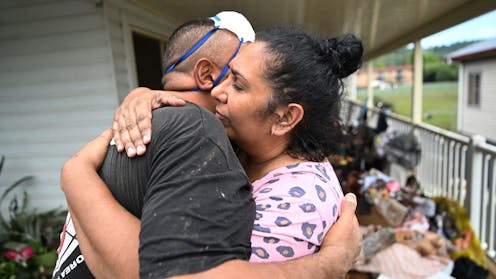
When flooding strikes, our screens fill with scenes of devastated victims, and men performing heroic dinghy rescues in swollen rivers. But another story often goes untold: how women step in, and step up, to hold their stricken communities together.
Unprecedented floods in the Northern Rivers of New South Wales in 2022 are a case in point. Our research shows female leadership was the hidden backbone of community recovery in the aftermath of the emergency. Women rose to leadership roles, filling crucial gaps left by formal disaster responses. As one woman told us:
I mean there’s some blokes around, I’ve got to give them some credit, but, yeah, I’m amazed … it was always the women saying, what do you need? What can I help with?
And long after the disaster had passed and the media had moved on, women were still there, quietly leading sustained recovery efforts from their homes, community halls and online networks.
But while the labour of men was generally supported and recognised, the complex and difficult work of women was largely overlooked.
The invisible labour of disaster recovery
The NSW Northern Rivers region is a rural area highly prone to climate disaster.
In February and March 2022, the region experienced catastrophic flooding and landslips. About 11,000 homes were inundated. Health care facilities were damaged and disrupted. Emergency services were overwhelmed and many communities were cut off, some for weeks.
In response, the community stepped up in extraordinary ways. Our research explored the particular contribution of women to this effort.
‘No one else was going to do it’
The research involved interviews with people involved in the flood response and recovery. We also examined notes from public events and transcripts from a NSW government inquiry into the floods.
We found that, despite facing immense challenges, women played an essential role in sustaining their communities during and after the crisis.
For example, they coordinated food relief, managed donation hubs, organised volunteers and provided emotional support to neighbours and strangers. As one female interviewee told us:
It was more than about food … people would just come and then we’d just hug them and they’d just cry … the food relief turned into something deeper.
Emergency-management environments are often dominated by men. As a result, female community organisers often felt excluded from formal decision-making. As one woman told us:
every face in the meeting was a white middle-aged guy with a buzz cut. And, and I was like, there is no women. There is no diversity. There was no sense of community or that whole recovery space.
One woman cited the example of a local council celebrating “men in their dinghies” who took part in a flood rescue, while failing to recognise women who collectively contributed many thousands of unpaid hours towards the recovery effort:
here we are with just simply a trillion women doing all of the childcare, all of the cooking, all of the soft labour, literally everything plus being on dinghies … and there’s just nothing for us.
Some women took unpaid leave from work to coordinate recovery activities in their communities, because, as one woman told us, “no one else was going to do it”.
Women’s roles were not limited to unskilled tasks and care work. Women also brought professional skills to the recovery effort, such as event management, IT, nursing, communications, clinical psychology, trauma healing, business management, social work and public health.
Women: there for the long term
We found while men’s involvement in disaster recovery tended to be concentrated on specific short-term rescue and response, women tended to remain active for months or even years.
For example, two years after the flooding disaster, at a gathering of grassroots community-disaster organisers, 87% of names on the contact list were female.
Some women continued to volunteer their labour, while others managed to obtain short-term funding. Whether paid or unpaid, the women experienced overwhelm and felt exhausted by the long-term effort, and some experienced vicarious trauma. However, their sense of community responsibility prevented them from stepping back.
Rethinking who we see as leaders
The research confirms women’s contributions are consistently overlooked during and after a disaster. It reflects a broader trend in Australia, where women’s labour is historically undervalued.
Women’s disaster work – coordinating volunteers, providing emotional care and advocating for their communities – was often unsupported by government and continued long after official agencies left.
Yet, these contributions remained largely invisible.
Three years after the floods, many women in the Northern Rivers are preparing for the next emergency, and women comprise the majority of community resilience groups in the region.
Women must be recognised and supported to ensure the health and wellbeing of disaster-affected communities. The health and wellbeing of these women themselves must also be paramount.
More government and private funding is vital. Where possible, philanthropic community grants should also be expanded.
The recently formed Northern Rivers Community Resilience Alliance involves 50 grassroots groups combining to provide peer support, advocate together, seek joint funding and provide training. Such networks can provide ongoing support to community organisers.
As Earth’s climate becomes more hostile and extreme weather events become more likely, there is an urgent need to support community efforts – and to rethink who we see as leaders in times of disaster. Building resilient communities starts with recognising and resourcing the people doing the work – including local women.
The authors acknowledge Emma Pittaway, Loriana Bethune and Dominica Meade who co-authored the research upon which this article is based.
Authors: Rebecca McNaught, Research Fellow, Rural and Remote Health, University of Sydney


















