

where do phobias come from?
- Written by: Lara Farrell, Associate Professor and Clinical Psychologist, Griffith University
 If you have a question you’d like an expert to answer, send it to curiouskids@theconversation.edu.au.
Where do phobias come from? – Olivia, age 12, Strathfield, Sydney.
Phobias are an intense fear of very specific things like objects, places, situations or animals. The most common phobias for children and teens are phobias of specific animals such as dogs, cats or insects.
When someone suffers from a phobia, they tend to avoid these places or things at all costs. That can be very hard to do and often leads to a lot of other problems.
There are many different factors that might make it more likely for someone to develop a phobia.
However, research tells us that to some degree specific phobias are learned. In addition, factors such as life experiences, your personality, and even how the people around you cope all contribute to developing a phobia or not.
Read more:
Curious Kids: should I be scared of lightning?
How people may develop phobias
Specific phobias are very common, especially among children and adolescents. Research tells us that approximately 10% of children will experience a specific phobia, making this type of anxiety one of the most common anxiety disorders affecting young people.
Here are three main learning scenarios that may influence whether or not you develop a phobia.
Seeing other people (such as parents or friends) get really scared in a specific situation, or around a particular object or animal. This is called “modelling”. When you see someone else “model” a fear reaction to certain things, you may learn to be afraid of the same thing.
Hearing or reading scary stories about a situation, object or animal. For example, a parent who always tells you, “dogs are dangerous”, “never approach a dog”, “beware of dogs”, teaches you that ALL dogs are dangerous, ALL of the time, which may contribute to you developing a fear or phobia of dogs.
Having a frightening experience with a particular object, animal or situation. We call this “direct conditioning”. For example, you may have been growled at or even bitten by a dog; or be swept up in a rip in the ocean; or have had a tree fall on your house in a bad storm. These experiences are often very scary, and some children may then feel afraid whenever they are in that situation again.
It is important to remember, however, that not all children who see, hear or experience bad things develop a specific phobia. There are other things that might contribute. Research suggests phobias often run in families, so there may be a genetic link. Personality (or what doctors call “temperament”) may even play a role.
If you have a question you’d like an expert to answer, send it to curiouskids@theconversation.edu.au.
Where do phobias come from? – Olivia, age 12, Strathfield, Sydney.
Phobias are an intense fear of very specific things like objects, places, situations or animals. The most common phobias for children and teens are phobias of specific animals such as dogs, cats or insects.
When someone suffers from a phobia, they tend to avoid these places or things at all costs. That can be very hard to do and often leads to a lot of other problems.
There are many different factors that might make it more likely for someone to develop a phobia.
However, research tells us that to some degree specific phobias are learned. In addition, factors such as life experiences, your personality, and even how the people around you cope all contribute to developing a phobia or not.
Read more:
Curious Kids: should I be scared of lightning?
How people may develop phobias
Specific phobias are very common, especially among children and adolescents. Research tells us that approximately 10% of children will experience a specific phobia, making this type of anxiety one of the most common anxiety disorders affecting young people.
Here are three main learning scenarios that may influence whether or not you develop a phobia.
Seeing other people (such as parents or friends) get really scared in a specific situation, or around a particular object or animal. This is called “modelling”. When you see someone else “model” a fear reaction to certain things, you may learn to be afraid of the same thing.
Hearing or reading scary stories about a situation, object or animal. For example, a parent who always tells you, “dogs are dangerous”, “never approach a dog”, “beware of dogs”, teaches you that ALL dogs are dangerous, ALL of the time, which may contribute to you developing a fear or phobia of dogs.
Having a frightening experience with a particular object, animal or situation. We call this “direct conditioning”. For example, you may have been growled at or even bitten by a dog; or be swept up in a rip in the ocean; or have had a tree fall on your house in a bad storm. These experiences are often very scary, and some children may then feel afraid whenever they are in that situation again.
It is important to remember, however, that not all children who see, hear or experience bad things develop a specific phobia. There are other things that might contribute. Research suggests phobias often run in families, so there may be a genetic link. Personality (or what doctors call “temperament”) may even play a role.
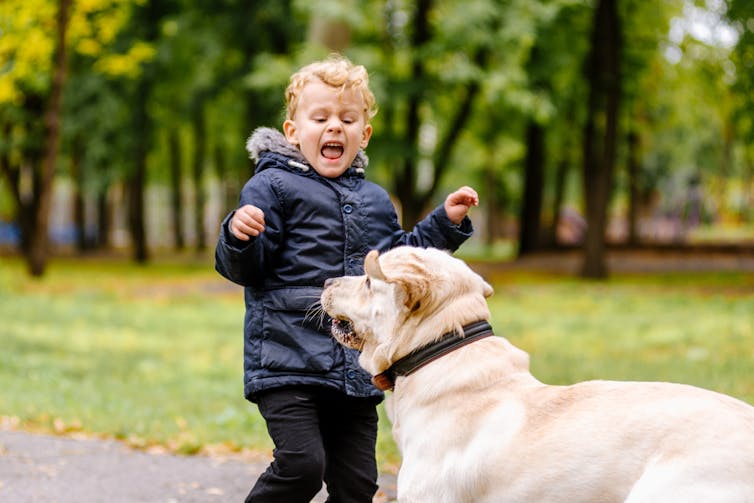 A bad experience can make you develop a fear or phobia.
Shutterstock
The good news
The good news is that there are many other factors that might help to protect children or adolescents from developing a phobia, even if you have had a very bad experience. For example, support from family and friends can help and comfort you when something scary happens.
Some research suggests that being optimistic can protect you from fear. Being someone who thinks about the world and themselves in a really positive way – seeing the glass half full instead of half empty – may reduce the impact of or development of anxiety and fears.
And finally, the most powerful way to stop a fear turning into a phobia is to face your fears – even when you feel nervous or scared. For example, you might feel really scared about giving a speech. But if you practise and do some public speaking, you might realise it’s not as bad as you imagined!
You may learn you are braver and stronger than you know.
Read more:
Curious Kids: why are some people affected by sleep paralysis?
Hello, curious kids! Have you got a question you’d like an expert to answer? Ask an adult to send your question to curiouskids@theconversation.edu.au
A bad experience can make you develop a fear or phobia.
Shutterstock
The good news
The good news is that there are many other factors that might help to protect children or adolescents from developing a phobia, even if you have had a very bad experience. For example, support from family and friends can help and comfort you when something scary happens.
Some research suggests that being optimistic can protect you from fear. Being someone who thinks about the world and themselves in a really positive way – seeing the glass half full instead of half empty – may reduce the impact of or development of anxiety and fears.
And finally, the most powerful way to stop a fear turning into a phobia is to face your fears – even when you feel nervous or scared. For example, you might feel really scared about giving a speech. But if you practise and do some public speaking, you might realise it’s not as bad as you imagined!
You may learn you are braver and stronger than you know.
Read more:
Curious Kids: why are some people affected by sleep paralysis?
Hello, curious kids! Have you got a question you’d like an expert to answer? Ask an adult to send your question to curiouskids@theconversation.edu.au
Authors: Lara Farrell, Associate Professor and Clinical Psychologist, Griffith University
Read more http://theconversation.com/curious-kids-where-do-phobias-come-from-121738


















