

The biggest hurdle for the Coalition's religious discrimination bill: how to define 'religion'
- Written by: Erin Wilson, Associate Professor of Politics and Religion, University of Groningen
The Coalition government’s proposed religious discrimination bill has been criticised for the potential problems it poses for women, the LGBTQI+ community, people with disabilities and people from diverse ethnic and cultural backgrounds.
Yet, there is another group who may also be adversely affected if the bill becomes law – religious people themselves, especially minorities.
In a recent submission to the attorney-general’s office, I highlighted a key problem of the bill and one that could impact religious minorities in particular – that it does not explain what is meant by the terms “religion” and “religious”.
What is religion?
Though “religion” is not defined in the bill, “religious belief or activity” is. It is characterised in one of four ways:
holding a religious belief
engaging in lawful religious activity
not holding religious belief
not engaging in, or refusing to engage in, lawful religious activity.
Underlying the bill is the implicit assumption that “religion” has a clear definition – everyone knows what it is.
But this assumption is flawed. Scholars of religion have long debated this question, with no agreement. Many conclude that, in fact, it is impossible to have a clear, universal definition of religion.
Attempts to carve out a definition encounter a wide variety of exceptions:
Is “religion” defined by “belief in God”? If so, does that mean Buddhism is not a religion?
Is “religion” a set of precepts and guidelines for how to live a moral life? If so, does that make veganism a religion?
Is “religion” an institution or community brought together around shared belief in something greater than oneself? If so, couldn’t communism or nationalism be considered a religion?
Does “religion” require a group of people meeting in a church or other place of worship? Does that mean that ancestor or nature worship, or Indigenous spirituality do not count as religion?
Because of complexities like this, the Australian Human Rights Commission has noted that the concepts of “belief” and “religion” should be interpreted broadly in Australian law.
And using a specific concept of religion as the basis for making new laws can have serious repercussions.
Read more: Politics with Michelle Grattan: Father Frank Brennan on Israel Folau and religious freedom
Even people within the same religion can have very different values and belief systems. Two people who identify as Christian, for example, may hold opposing views on abortion,climate change, gender equality, marriage equality, to name a few. The same is true for people who identify as Muslim, Jewish, Buddhist and every other tradition.
Two cases from the European Court of Human Rights highlight this problem. In one case, the court ruled that a Swiss Muslim teacher could not wear her headscarf while teaching because it was an “active” religious symbol that violated the principle of neutrality in the classroom.
In another case brought by an atheist parent, the court ruled that a crucifix on the wall of an Italian state-run school was a “passive” religious symbol and did not violate the principle of classroom neutrality.
Two cases involving religious symbols, two people claiming violation of their religious rights, two very different outcomes.
Australia’s Christian past
What makes this ambiguity particularly troubling in European and post-colonial societies such as Australia is that understandings of “religion” are broadly informed by Christian historical experiences and influences.
Thus, what counts as “religious belief or activity” is often determined according to models inherited from Christianity, which may not align with belief structures and practices in other traditions.
And because of the lack of clarity over what is or isn’t considered “religious” in the Coalition’s bill, it may be left to the discretion of individual judges – relying on their personal views of “religion” – to determine whether discrimination has indeed occurred.
Read more: Why Australia needs a Religious Discrimination Act
There are two important contextual factors that further aggravate this concern.
First, the impetus for the bill came from two key events that have galvanised Christians: the Religious Freedom Review, undertaken following the marriage equality plebiscite, and the sacking of Israel Folau by Rugby Australia over his anti-gay social media posts.
Second, contemporary Australian politics and society are characterised by heightened suspicion of non-Christian religions, especially Islam.
This raises important questions about how the bill’s implementation could affect religious minorities.
What counts as “discrimination”?
The definition of “religion” is not the only problem. Another difficulty concerns how the bill determines whether or not “discrimination” has occurred.
For example, statements of religious belief would not be protected by the bill if they are deemed “malicious” to another person.
Yet, as the Australian Federation of Islamic Councils noted in its submission to the attorney-general’s office, the bill does not clearly define what kind of speech constitutes a “malicious” statement. There is, however, a suggestion that this may be determined on the basis of whether a statement will cause “harm”.
Research on free speech and religious discrimination notes there is often a line that can be drawn between “offensive” and “harmful” speech. But where and how do you draw that line?
Read more: In long-awaited response to Ruddock review, the government pushes hard on religious freedom
Let’s take Folau’s comments as an example. Under the bill, it could be argued that Folau’s comments about LGBTQI people (amongst others) were merely offensive, not “malicious” or likely to cause “harm”.
Yet LGBTQI people have experienced intense stigma, abuse and exclusion throughout Australia’s history. This context matters. It makes it more likely that statements like Folau’s could be harmful, inciting abuse against the community or causing psychological harm to those who were offended.
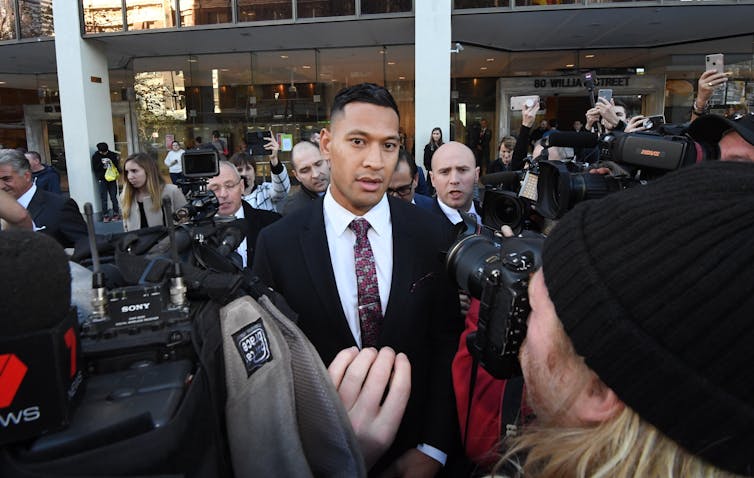 Rugby Australia sacked Folau after deeming his Instagram post ‘unacceptable’.
Peter Rae/AAP
Rugby Australia sacked Folau after deeming his Instagram post ‘unacceptable’.
Peter Rae/AAP
Could the law work in practice?
One way to address these concerns would be to provide accompanying advice to judges and lawyers who are interpreting the religious discrimination law in future cases.
Consider a case in which a Muslim woman is denied employment at a Muslim school because she refuses to wear a headscarf. How should such a case be decided? Is the Muslim woman experiencing religious discrimination because she is denied employment based on her choice to not wear a headscarf? Or would forcing the Muslim school to hire a woman who chooses not to veil constitute religious discrimination?
In such a case, lawyers could consult with Muslim religious leaders and scholars from a wide variety of traditions and perspectives as expert witnesses. These experts could examine the context of the case and offer advice regarding who is or isn’t experiencing religious discrimination.
Yet because the challenge of deciding what counts as “religion” in a just and equitable way is so fraught, there is a case to be made for not implementing the legislation at all.
Instead, existing legislation protecting freedom of speechand freedom of thought and conscience could be revised and strengthened, paying particular attention to the views and experiences of marginalised religious groups and minority traditions.
Authors: Erin Wilson, Associate Professor of Politics and Religion, University of Groningen


















