

We can’t drought-proof Australia, and trying is a fool's errand
- Written by: Emma Kathryn White, PhD Candidate, Infrastructure Engineering, University of Melbourne
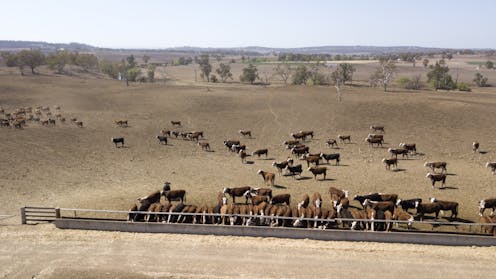
There is a phrase in the novel East of Eden that springs to mind every time politicians speak of “drought-proofing” Australia:
And it never failed that during the dry years the people forgot about the rich years, and during the wet years they lost all memory of the dry years. It was always that way.
While author John Steinbeck was referring to California’s Salinas Valley, the phrase is particularly pertinent to Australia where the El Niño-Southern Oscillation exerts a profound influence. Water availability varies greatly across the country, both in space and time. El Niño conditions bring droughts and devastating bushfires, while La Niña is accompanied by violent rainfall, floods and cyclones.
Read more: Recent Australian droughts may be the worst in 800 years
This variability is innate to the Australian environment. And now, climate change means that in some regions, the dry years are becoming drier and the wet years are becoming less frequent. Managing water resources under a changing climate and burgeoning population requires innovative and realistic solutions that are different to those that have worked in the past.
Drought-proofing is impossible
Planning for the dry years involves setting sustainable usage limits, using more than one source of water, efficiency improvements, managed aquifer recharge, water recycling and evaluation of the best usage of water resources. It does not involve misleading claims of drought-proofing that infer we can somehow tame the unruly nature of our arid environment instead of planning and preparing for reality.
Unlike managing for the wet and dry periods, drought-proofing seeks to negate dry periods through infrastructure schemes such as large dams (subject to huge evaporative losses) and dubious river diversions. It fails to acknowledge the intrinsic variability of water availability in Australia, and modify our behaviour accordingly.
The reality is that in many parts of the country, groundwater is the sole source of water and the climate is very dry. A cornerstone of the recently launched $100 million National Water Grid Authority is the construction of more dams. But dams need rain to fill them, because without rain, all we have is empty dams. And we have enough of those already.
A history of denial
Just because Dorothea Mackellar wrote of “droughts and flooding rains” over 100 years ago, it doesn’t mean water management should proceed in the same vein it always has.
Australia has always had a variable climate, which changes significantly from year to year and also decade to decade. This not the same as a long-term climatic trend, better known as climate change.
Read more: "Weather" and "climate" are used interchangeably. They shouldn't be
Climate change is making parts of Australia even drier. Rainfall in the south-eastern part of Australia is projected to keep declining. We cannot rely on blind faith that rains will fill dams once more because they have in the past.
Yet inevitably, during the dry years, claims that Australia can be “drought-proofed” are renewed. Deputy Prime Minister Michael McCormack recently praised the Bradfield scheme, an 80 year old infrastructure project intending to divert northern river flows inland. It has been so thoroughly debunked on all scales, it is better described as a pipe-dream than piping scheme. It has no place in reasonable water management discourse.
The concept of drought-proofing harks back to the days of European settlement. Early water management techniques were more appropriate for verdant English fields than the arid plains of Australia.
In the early twentieth century, water resources were vigorously developed, with government-sponsored irrigation schemes and large dams constructed. During this time, little thought was given to sustainability. Instead, the goal was to stimulate inland settlement, agriculture and industry. Development was pursued despite the cost and ill-advised nature of irrigation in particular areas.
Shifting long entrenched perceptions of water management
All this said, irrigation certainly has its place: it supports a quarter of Australia’s agricultural output. And there are substantial efforts underway to rebalance water usage between irrigation and the environment.
However, acknowledgement of the relative scarcity of water in certain parts of Australia has only really occurred in the last 30 years or so.
Widespread droughts in the late 1970s and early 1980s highlighted the importance of effective water management and shifted long-entrenched perceptions of irrigation and development. Water reforms were passed, mandating future water development be environmentally sustainable development, which meant, for the first time, water resource management sought a balance between economic, social and environmental needs.
Antiquated ideas about drought-proofing, pushed by politicians, promise much yet deliver little. They distract attention and siphon funds from realistic solutions, or actually re-evaluating where and how we use our limited water resources.
Read more: The air above Antarctica is suddenly getting warmer – here's what it means for Australia
We need practical, effective and well-considered management such as water recycling, efficiency measures and source-divestment that accounts for both shorter term climatic variability and long term changes in temperature and rainfall due to climate change. A big part of this is managing expectations through education.
Attempting to drought-proof Australia is not “managing for the dry periods”, as advocates claim. It is sticking our heads in the dry, salty sand and pretending the land is cool and green and wet.
Authors: Emma Kathryn White, PhD Candidate, Infrastructure Engineering, University of Melbourne
Read more http://theconversation.com/we-cant-drought-proof-australia-and-trying-is-a-fools-errand-124504


















