

how new tourism opportunities can empower the traditional owners of Uluru
- Written by: Barry Judd, Professor, Indigenous Social Research, Charles Darwin University
Last weekend marked 34 years since the land title to Uluru was handed back to the local Yankunytjatjara-Pitjantjatjara peoples. It was also when joint management of the Uluru-Katja-Tjuta National Park began between the traditional owners (Anangu people) and Parks Australia.
The arrangement recognised Anangu title to the land and ensured the direct involvement of Anangu in the development of tourism in the area.
The agreement also coincided with the relocation of tourism facilities from the southeast base of Uluru to the purpose-built resort town of Yulara. The old hotels and other tourist sites were discarded and became the base for the Anangu community of Mutitjulu.
However, if joint management aimed to deliver improved economic and social outcomes for Anangu residents, it has proven to be a spectacular failure.
Read more: Closing Uluru to climbers is better for tourism in the long run
Today, Yulara and Mutitjulu stand in stark contrast. Yulara is filled with cashed-up, bucket-list travellers from all over the world, while Mutitjulu is an outpost of lingering disadvantage where overcrowding, underemployment, poverty, high rates of suicide and preventable diseases remain pervasive problems.
Mutitjulu was also the epicentre of the controversial Northern Territory National Emergency Response in 2007, commonly referred to as the intervention, when the federal government took control over more than 70 Indigenous communities in response to allegations of child sexual abuse.
Over a decade later, the intervention has done little to close the gap in these communities.
Mutitjulu is emblematic of what academic Jon Altman refers to as the persistent need to reestablish trust between Indigenous Australians and the institutions that for so long failed to ensure their basic human rights were protected.
An end to climbing brings new opportunities
The end of climbing at Uluru provides an opportunity to reset the relationship between the traditional owners and the tourism sector, and look for new ways for Anangu to be integrated into the industry.
Central to this is how the Anangu can meaningfully develop their cultural assets within the park to ensure the long-term benefit of their people, particularly through direct employment.
Read more: Why we are banning tourists from climbing Uluru
There would appear to be ample opportunities for the people in Mutitjulu to take advantage of the 1,000-plus tourism jobs in Yulara, which are currently staffed largely by Indigenous and non-Indigenous people from outside the community.
The closure of Uluru to climbing also necessitates the development of alternate visitor experiences, particularly more educational and immersive experiences that would entail learning from and interacting respectfully with traditional owners.
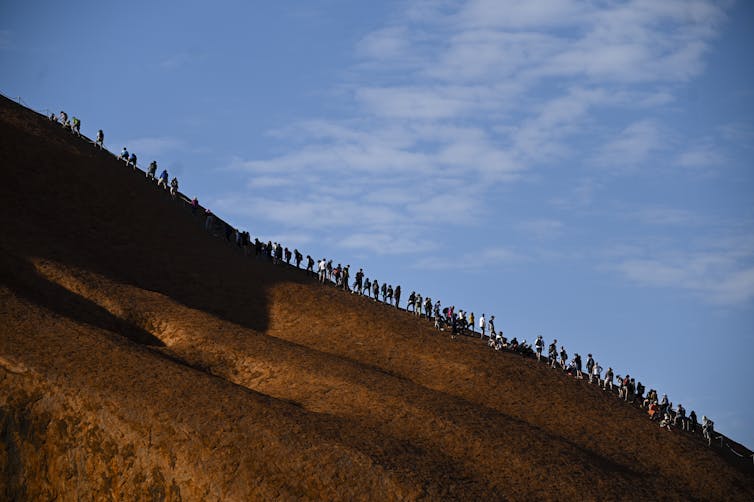 The decision to end climbing at Uluru has been a cause for celebration by Indigenous communities.
Lukas Coch/AAP
The decision to end climbing at Uluru has been a cause for celebration by Indigenous communities.
Lukas Coch/AAP
Obstacles to developing an Indigenous tourism economy
Yet, structural impediments prevent this from becoming a reality at Uluru, as well as other remote parts of Australia.
These obstacles include a lack of education and training options specific to Indigenous needs to help them set up and run their own businesses. Another issue is that land rights and native title claims have tended to benefit a few legally recognised landowners and haven’t been conducive to whole-of-community development.
Both the Anangu and key tourism stakeholders in central Australia, including Voyages Indigenous Tourism and Tourism NT, are keenly aware of the need to reform the local tourism industry.
Read more: How Indigenous tourism can help bring about reconciliation in Australia
Enabling greater access to commercial bank loans is critical to Indigenous business development, as is collaborative planning between Indigenous groups and the government. Likewise, scientific and traditional Indigenous knowledge could be combined in new ways to drive tourism growth in areas like land and wildlife management.
The Anangu must also be empowered to start micro-enterprises grounded in Knowledge of Country that would strengthen their community, culture and language. One example of this is the Indigenous Ranger and Protected Area program, which involves Indigenous rangers managing their own lands based on traditional cultural practice.
Read more: Indigenous rangers don’t receive the funding they deserve – here's why
Another approach that has shown promise is embracing Indigenous knowledge systems as part of the tourist educational experience. This is gaining currency in the NT as remote community arts centres seek to become visitor destinations in their own right.
These approaches to bottom-up initiatives have the greatest potential for growth and long-term empowerment in Uluru.
A model for other Indigenous communities
A major tourism rethink also requires addressing the structural impediments that prevent Indigenous peoples from starting businesses.
For example, new incentives could be built into the Australian tax code for those who invest in businesses on Aboriginal-owned land. However, such measures will only succeed if they are supported by bespoke educational and training programs for Anangu wanting to work in tourism.
The closure of Uluru to climbing should not simply focus on the limits the Anangu have imposed on visitors, but rather on the new possibilities this presents to leverage tourism for a more sustainable and resilient future.
This could also provide a model for traditional owners elsewhere who want to reclaim decision-making authority over tourism and other cultural activities on their lands.
And it signals to the broader Australian public that a greater respect for the rights of Indigenous people might just be the catalyst that helps drive a brighter Indigenous future.
Authors: Barry Judd, Professor, Indigenous Social Research, Charles Darwin University


















