

Playing with old phones teaches children good habits, and reflects our bad ones back at us
- Written by: Jo Bird, Lecturer, University of New England
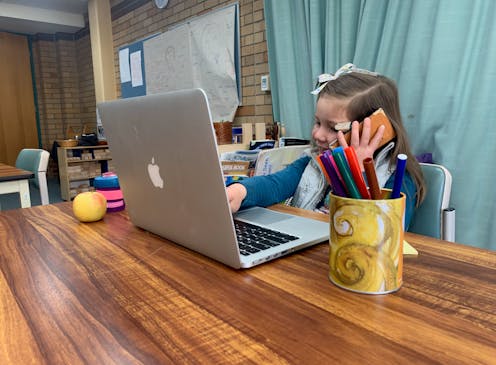
Screens are everywhere, including in the palms of our hands. Children see how much time we adults spend on our smartphones, and therefore how much we seem to value these devices – and they want to be a part of it.
Children see us constantly looking up information we need to know, and being continuously connected. It’s only natural that they should want to copy this behaviour in their play, and “practise being an adult”.
Read more: Imitation and imagination: child's play is central to human success
Most people have an opinion about children and technology, and the media regularly present stories of their potential for learning, or horror stories of the damage they can cause. My research takes a slightly different tack.
Rather than studying children’s screen use per se, I looked at how they play with old and discarded devices, such as a hand-me-down phone handset or an old and defunct laptop that has otherwise outlived its usefulness.
Many early childhood education centres contain play spaces set up to mimic situations in everyday adult life. Examples include “home corner” containing kitchen equipment, of other situations such as offices, hairdressing salons, doctors’ surgeries, and restaurants. These spaces might also let children play at using mobile phones, computers, iPads, EFTPOS machines, or other electronic devices.
I observed classes of 4 and 5-year-olds at two early education centres as they played imaginatively using technologies, to find out how they use devices in their play.
Facebook aficionados
Some of the children’s behaviours were fascinating and eye-opening.
Four-year-old Maddie, for example, “videoed” her educator dancing, and then said she was going to post it to Facebook. She knew the process involved, even though she had only ever watched her mother post, and had never done it herself.
Four-year-old Jack made a “video camera” from cardboard boxes and pretended to film other children. It even had a screen where you could watch the footage he had shot.
Another educator told me her two-year-old child knows the difference between her work phone and her personal phone, and uses a different voice while pretending to talk on each.
In my research, children put phones in pockets or handbags before they went off and played, one child stated “I can’t go out without my phone!”
Practise and pretend
During pretend play, children are often acting at a higher level to practise new skills.
The children in my study had seen grown-ups doing “grown-up” things with their devices, and wanted to recreate them in their play situations.
Early childhood educators can use this kind of play to help children understand complex concepts and situations. For example, I have observed preschool children acting out tsunamis in the sandpit, discussing X-rays and broken bones, and showing a child how to care for a doll to practise interacting with a new sibling.
Technologies are no different. Parents and educators can use pretend play with technologies to teach children useful life lessons, such as how to behave appropriately with mobile phones, and when it is appropriate to use them.
Read more: One man's trash: how using everyday items for play benefits kids
In the Facebook example above, the educator could have had a conversation with Maddie about asking permission before taking a video of someone else and posting it to Facebook. They could ask questions like “how would you feel if someone took a video of you dancing and then posted it to Facebook?”
When the children were playing restaurants, one child declared: “no screens at the table!” The children then negotiated that it was okay when the call was very important, or if they needed to look something up to help with whatever the group was discussing. In this way, the children displayed their understanding of the importance of social interactions.
Read more: Play-based learning can set your child up for success at school and beyond
Not only can educators teach children through play, they can also model appropriate behaviour with technologies. By asking children if it is alright to take a photo or video of them, showing the child their image before it is shared with others, and being present and not looking at a screen when a child is speaking, we can show children we respect them and behave ethically towards them.
So before you throw away your broken laptop or your old mobile, consider donating it to your local early childhood centre or, if you have children in your own home, give it to them to use as a toy. You might be surprised at what they will teach you.
Authors: Jo Bird, Lecturer, University of New England


















