

how ecology and mental health go together in our cities
- Written by: Zoe Myers, Lecturer, Australian Urban Design Research Centre, University of Western Australia
Mental health in our cities is an increasingly urgent issue. Rates of disorders such as anxiety and depression are high. Urban design and planning can promote mental health by refocusing on spaces we use in our everyday lives in light of what research tells us about the benefits of exposure to nature and biodiversity.
Mental health issues have many causes. However, the changing and unpredictable elements of our physical and sensory environments have a profound impact on risk, experiences and recovery.
Read more: Green for wellbeing – science tells us how to design urban spaces that heal us
Physical activity is still the mainstay of urban planning efforts to enable healthy behaviours. Mental well-being is then a hoped-for byproduct of opportunities for exercise and social interaction.
Neuroscientific research and tools now allow us to examine more deeply some of the ways in which individuals experience spaces and natural elements. This knowledge can greatly add to, and shift, the priorities and direction of urban design and planning.
What do we mean by ‘nature’?
A large body of research has compellingly shown that “nature” in its many forms and contexts can have direct benefits on mental health. Unfortunately, the extent and diversity of natural habitats in our cities are decreasing rapidly.
Too often “nature” – by way of green space and “POS” (Public Open Space) – is still seen as something separate from other parts of our urban neighbourhoods. Regeneration efforts often focus on large green corridors. But even small patches of genuinely biodiverse nature can re-invite and sustain multitudes of plant and animal species, as urban ecologists have shown.
Read more: The small patch of bush over your back fence might be key to a species’ survival
 An urban orchard in Perth.
Zoe Myers
An urban orchard in Perth.
Zoe Myers
It has also been widely demonstrated that nature does not effect us in uniform or universal ways. Sometimes it can be confronting or dangerous. That is particularly true if nature is isolated or uninviting, or has unwritten rules around who should be there or what activities are appropriate.
These factors complicate the desire for a “nature pill” to treat urban ills.
We need to be far more specific about what “nature” we are talking about in design and planning to assist with mental health.
Read more: Increasing tree cover may be like a 'superfood' for community mental health
Why does biodiversity matter?
The exponential accessibility and affordability of lab and mobile technologies, such as fMRI and EEG measuring brain activity, have vastly widened the scope of studies of mental health and nature. Researchers are able, for example, to analyse responses to images of urban streetscapes versus forests. They can also track people’s perceptions “on the move”.
Research shows us biodiverse nature has particular positive benefit for mental well-being. Multi-sensory elements such as bird or frog sounds or wildflower smells have well-documented beneficial effects on mental restoration, calm and creativity.
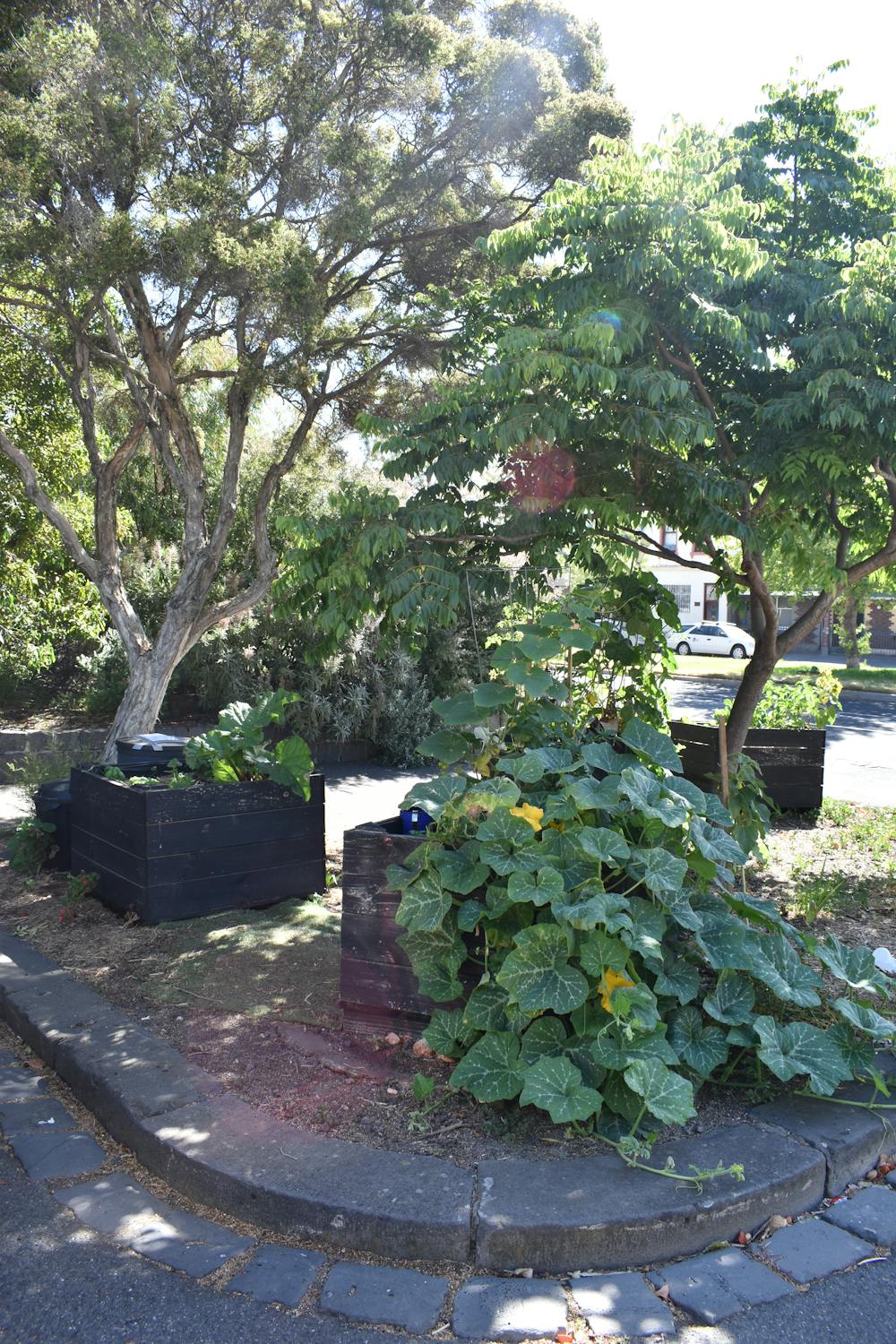 Planters bring life to a roadside in Carlton, Melbourne.
Melanie Thomson, Author provided (No reuse)
Planters bring life to a roadside in Carlton, Melbourne.
Melanie Thomson, Author provided (No reuse)
Other senses – such as our sense of ourselves in space, our balance and equilibrium and temperature – can also contribute to us feeling restored by nature.
Acknowledging the crucial role all these senses play shifts the focus of urban design and planning from visual aesthetics and functional activity to how we experience natural spaces. This is particularly important in ensuring we create places for people of all abilities, mobilities and neurodiversities.
Neuroscientific research also shows an “enriched” environment – one with multiple diverse elements of interest – can prompt movement and engagement. This helps keep our brains cognitively healthy, and us happier.
Read more: Reducing stress at work is a walk in the park
Beyond brain imaging of experiences in nature, there is growing and compelling evidence that contact with diverse microbiomes in the soil and air has a profound effect on depression and anxiety. Increasing our interaction with natural elements through touch – literally getting dirt under our nails – is both psychologically therapeutic and neurologically nourishing.
We also have increasing evidence that air, noise and soil pollution increase risk of mental health disorders in cities.
What does this mean for urban neighbourhoods?
These converging illustrations suggest biodiverse urban nature is a priority for promoting mental health. Our job as designers and planners is therefore to multiply opportunities to interact with these areas in tangible ways.
 A residential street in Perth.
Zoe Myers
A residential street in Perth.
Zoe Myers
The concept of “biophilia” isn’t new. But a focus on incidental and authentic biodiversity helps us apply this very broad, at times unwieldy and non-contextual, concept to the local environment. This grounds efforts in real-time, achievable interventions.
Using novel technologies and interdisciplinary research expands our understanding of the ways our environments affect our mental well-being. This knowledge challenges the standardised planning of nature spaces and monocultured plantings in our cities. Neuroscience can therefore support urban designers and planners in allowing for more flexibility and authenticity of nature in urban areas.
Neuroscientific evidence of our sensory encounters with biodiverse nature points us towards the ultimate win-win (-win) for ecology, mental health and cities.
Dr Zoe Myers is the author of Wildness and Wellbeing: Nature, Neuroscience, and Urban Designn (Palgrave Macmillan, 2020).
Authors: Zoe Myers, Lecturer, Australian Urban Design Research Centre, University of Western Australia


















