

Bushfire smoke is everywhere in our cities. Here's exactly what you are inhaling
- Written by: Gabriel da Silva, Senior Lecturer in Chemical Engineering, University of Melbourne
As bushfire smoke blankets large parts of Australia, it’s time to examine what this complex chemical mixture is made of, to better understand what it’s doing to both our bodies and the planet.
I research the chemical processes that create pollutants in flames, and what happens when they are released into the air we breathe.
Bushfires are not the only source of smoke we are exposed to in our everyday lives. We breathe smoke from cigarettes, wood-fired heaters, coal-fired power stations and vehicles.
But smoke stemming from the bushfires is accumulating over cities in concentrations rarely seen before in Australia, badly affecting cities including Sydney, Melbourne and Canberra. This poses risks to public health and the environment. Read on to find out exactly what you’re breathing in.
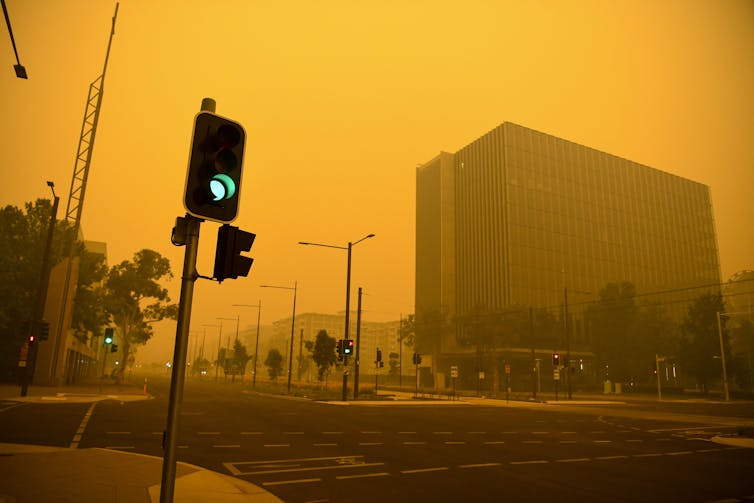 A smoke-filled Canberra street on January 5 this year.
Lukas Coch/AAP
A smoke-filled Canberra street on January 5 this year.
Lukas Coch/AAP
It’s largely water
First, there is a lot of water in bushfire smoke. When fire rips through a forest it burns off the water held in the trees, sending rolling clouds of steam up into the atmosphere.
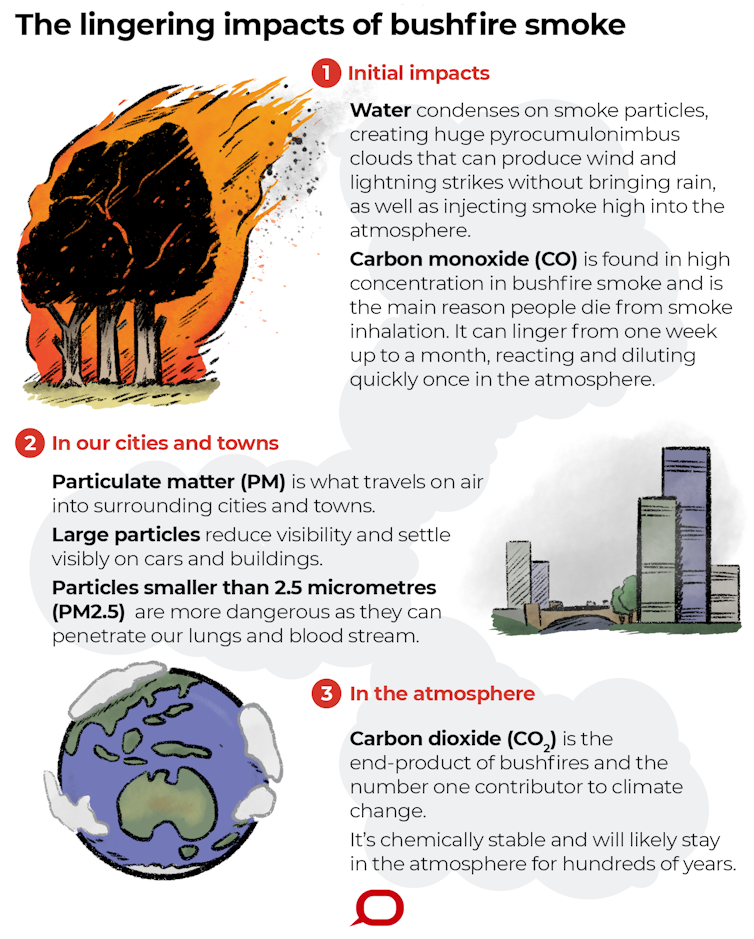
Water might seem harmless, but it actually enables bushfires to form their own weather. Water vapour condenses on smoke particles and forms huge pyrocumulonimbus clouds. We saw these storms in the current fire crisis. They can complicate firefighting efforts by producing wind and lightning strikes but unfortunately rarely bring rain.
Read more: Even for an air pollution historian like me, these past weeks have been a shock
These clouds also inject smoke high into the atmosphere from where it can circle the globe. We recently saw this when smoke from bushfires in Australia’s south-east drifted to New Zealand and then on to South America. Smoke lofted into the stratosphere influences the climate by blocking the movement of light and heat, and can even interfere with chemistry in the ozone layer.
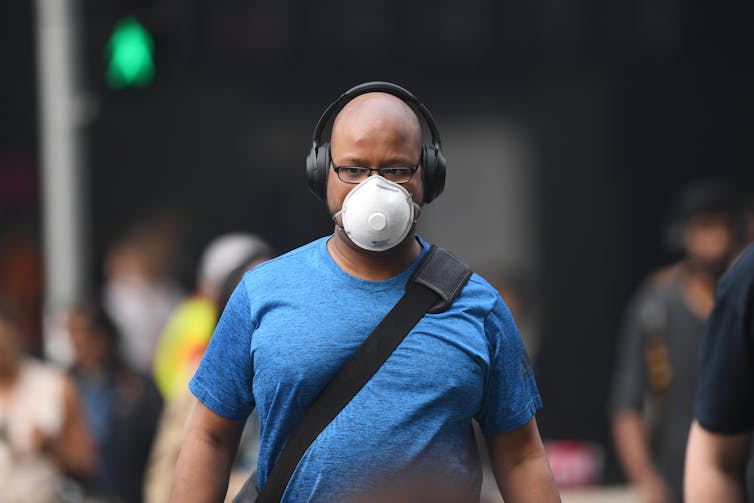 A man wears a face mask to protect himself from bushfire smoke in Melbourne on Tuesday this week.
AAP/Erik Anderson
A man wears a face mask to protect himself from bushfire smoke in Melbourne on Tuesday this week.
AAP/Erik Anderson
The climate effect
Smoke also contains gases, most notably carbon monoxide (CO) and carbon dioxide (CO₂). Carbon dioxide is the end-product of combustion and is the most significant contributor to man-made global warming.
Forests sequester massive amounts of carbon as wood and other organic matter and much of this is released back into the atmosphere as carbon dioxide when burned.
Within about a year, these molecules could be anywhere in Earth’s atmosphere. CO₂ is so long-lived that many of these same molecules will remain circling the globe for hundreds of years.
Read more: We know bushfire smoke affects our health, but the long-term consequences are hazy
This bushfire season, more than 10 million hectares of land has already burned. Estimates based on satellite data put the subsequent CO₂ release at 400 million tonnes. This is close to Australia’s total annual greenhouse gas emissions of around 500 million tonnes of CO₂ equivalent.
Our planet’s climate emergency is already making Australia hotter and drier, with more frequent extreme weather events. The ensuing fires are in turn releasing carbon back into the atmosphere, forming a dangerous positive feedback loop.
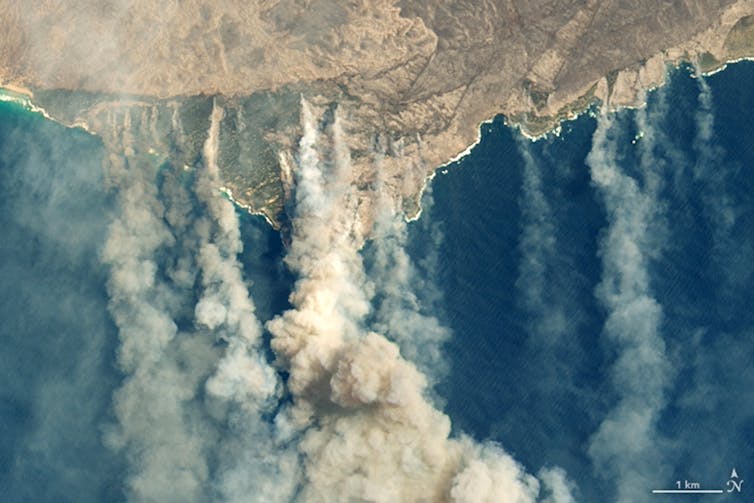 A satellite image showing burned land and thick smoke over Kangaroo Island on January 9.
NASA Earth Observatory
A satellite image showing burned land and thick smoke over Kangaroo Island on January 9.
NASA Earth Observatory
The poisonous sibling
Whereas CO₂ presents a long-term threat to us all, its poisonous sibling carbon monoxide (CO) is a more immediate concern to those directly exposed to smoke. Carbon monoxide forms when combustion is interrupted on its way to make carbon dioxide.
At the high concentrations found in smoke, carbon monoxide can be deadly. It binds strongly to our haemoglobin – the molecule in red blood cells that carries oxygen around the body. At around 100 parts per million in air it can starve the human body of oxygen, asphyxiating its victims.
Carbon monoxide poisoning through smoke inhalation is a direct concern to firefighters and those sheltering from flames. Those fighting bushfires often work long shifts, sometimes over several weeks, with face masks that offer limited protection.
 Wes Mountain/The Conversation, CC BY-ND
But that’s not all
In addition to these two gases, smoke contains trace levels of many other pollutants such as sulfur dioxide (SO₂) and nitrogen dioxide (NO₂). In a bushfire, these are produced through the burning of sulfur and nitrogen in plants.
(These gases are also produced through burning fossil fuels. Over eons, ancient trees fossilise into oil and coal but retain some sulfur and nitrogen).
Read more:
In this new world of bushfire terror, I question whether I want to have kids
Both SO₂ and NO₂ irritate our respiratory system. Atmospheric SO₂ is also problematic because over time it gets converted in air into sulfuric acid, forming acid rain. NO₂, on the other hand, breaks down in sunlight causing harmful ground-level ozone to form.
We are still learning about other dangerous trace gases in smoke. For instance, in the last decade we have come to realise that highly toxic isocyanic acid from smoke can be present in urban air at concentrations approaching those which are known to impact our health. Unfortunately, little research is available for Australian conditions.
Don’t forget the tiny particles
The final component of smoke we need to consider are the solid particles, or particulate matter (PM). This is both soot that builds up during combustion, and ash that breaks down from the remnants of burnt fuel.
What we see following a bushfire are mostly the larger particles, which reduce visibility and settle on cars and buildings. But the most dangerous component to our health are microscopic particles around one millionth of a metre in size.
These particles can penetrate deep into our lungs and make their way into our bloodstream, potentially impacting almost every bodily system.
Moreover, because of their size they are more likely to stay aloft in air and be transported away from their source.
Particles smaller than 2.5 micrometres, known as PM2.5, settled on Canberra in recent weeks – a problem so severe on some days the city could lay claim to having the most polluted air in the world.
Wes Mountain/The Conversation, CC BY-ND
But that’s not all
In addition to these two gases, smoke contains trace levels of many other pollutants such as sulfur dioxide (SO₂) and nitrogen dioxide (NO₂). In a bushfire, these are produced through the burning of sulfur and nitrogen in plants.
(These gases are also produced through burning fossil fuels. Over eons, ancient trees fossilise into oil and coal but retain some sulfur and nitrogen).
Read more:
In this new world of bushfire terror, I question whether I want to have kids
Both SO₂ and NO₂ irritate our respiratory system. Atmospheric SO₂ is also problematic because over time it gets converted in air into sulfuric acid, forming acid rain. NO₂, on the other hand, breaks down in sunlight causing harmful ground-level ozone to form.
We are still learning about other dangerous trace gases in smoke. For instance, in the last decade we have come to realise that highly toxic isocyanic acid from smoke can be present in urban air at concentrations approaching those which are known to impact our health. Unfortunately, little research is available for Australian conditions.
Don’t forget the tiny particles
The final component of smoke we need to consider are the solid particles, or particulate matter (PM). This is both soot that builds up during combustion, and ash that breaks down from the remnants of burnt fuel.
What we see following a bushfire are mostly the larger particles, which reduce visibility and settle on cars and buildings. But the most dangerous component to our health are microscopic particles around one millionth of a metre in size.
These particles can penetrate deep into our lungs and make their way into our bloodstream, potentially impacting almost every bodily system.
Moreover, because of their size they are more likely to stay aloft in air and be transported away from their source.
Particles smaller than 2.5 micrometres, known as PM2.5, settled on Canberra in recent weeks – a problem so severe on some days the city could lay claim to having the most polluted air in the world.
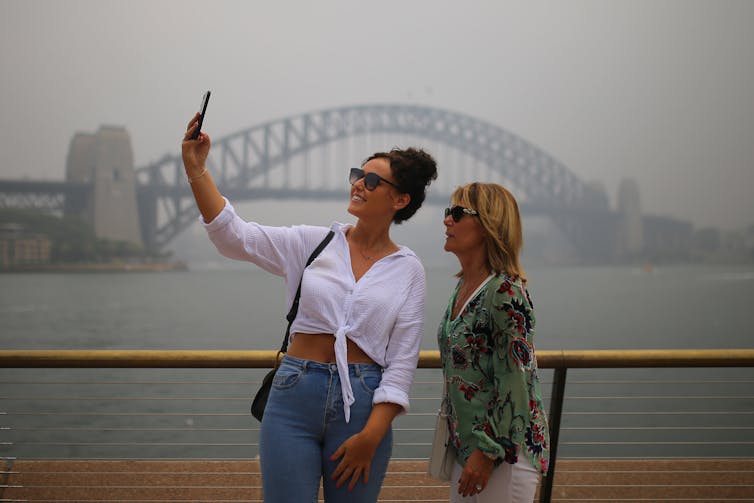 Tourists take selfies against a smoke-filled Sydney Harbour this month.
STEVEN SAPHORE/AAP
Be prepared
Bushfire smoke is a complex chemical mixture that can affect humans in many ways. As fires become increasingly common across our continent, we must become more familiar with what we are breathing in.
Australia’s unique vulnerability to climate change, as has been evident this bushfire season, means we should also lead the world in reducing greenhouse gas emissions.
At the same time, Australians need to adapt. This means equipping our buildings with sensors and purifiers to respond to air pollution and educating the public on how to stay safe during an air quality emergency. It’s clear we must prepare for many smoke-filled summers to come.
Read more:
Bushfires won't change climate policy overnight. But Morrison can shift the Coalition without losing face
Tourists take selfies against a smoke-filled Sydney Harbour this month.
STEVEN SAPHORE/AAP
Be prepared
Bushfire smoke is a complex chemical mixture that can affect humans in many ways. As fires become increasingly common across our continent, we must become more familiar with what we are breathing in.
Australia’s unique vulnerability to climate change, as has been evident this bushfire season, means we should also lead the world in reducing greenhouse gas emissions.
At the same time, Australians need to adapt. This means equipping our buildings with sensors and purifiers to respond to air pollution and educating the public on how to stay safe during an air quality emergency. It’s clear we must prepare for many smoke-filled summers to come.
Read more:
Bushfires won't change climate policy overnight. But Morrison can shift the Coalition without losing face
Authors: Gabriel da Silva, Senior Lecturer in Chemical Engineering, University of Melbourne


















