

Babies learn a lot in their first year. But their behaviour doesn’t always tell the full story
- Written by Eylem Altuntas, Researcher, Speech & Language Development, The MARCS Institute for Brain, Behaviour and Development, Western Sydney University
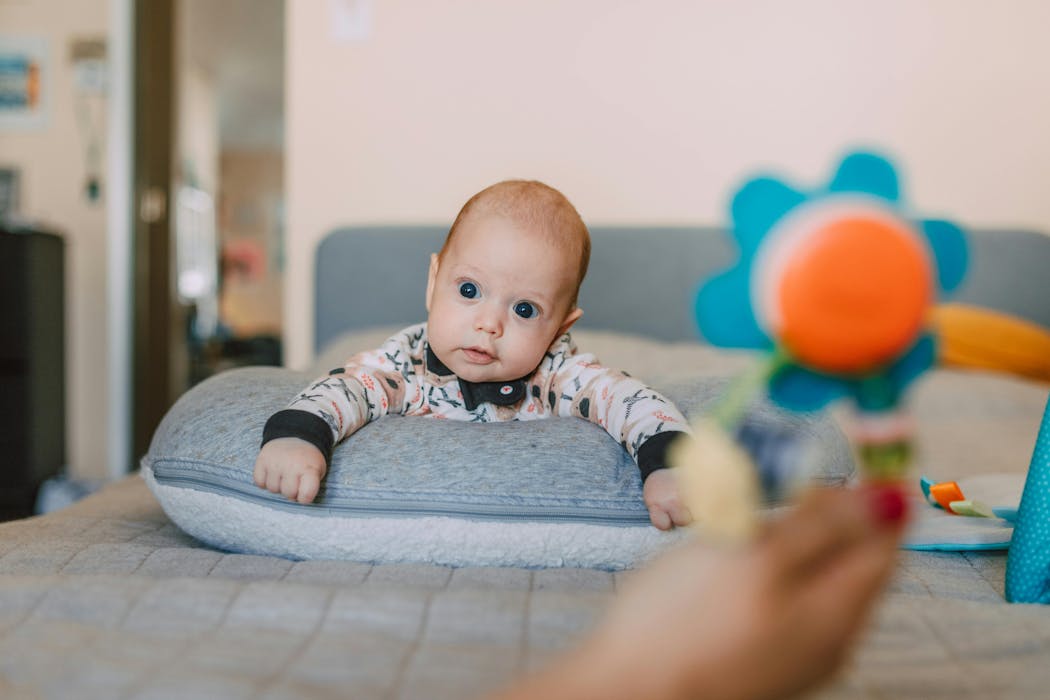
Anyone who has spent time with a baby knows how unpredictable the first year can feel. One week a baby suddenly seems to “get” something new. The next week, that same response may disappear.
Parents often describe this as progress coming in bursts rather than in a straight line. These changes can be exciting to watch, but they can also raise questions. Did my baby forget? Did something go wrong?
Our new research, published in Language Learning and Development, suggests early language learning unfolds in much the same way. We found babies can pick up how speech sounds are made as early as four months old.
But this early ability does not simply grow stronger month by month. Instead, as babies move through the first year, the way they show what they know can change, even while learning continues quietly in the background.
Learning about speech
In earlier research, we showed babies as young as four months can learn patterns about how speech sounds are made.
After a short game involving two made-up “mini-languages”, four-month-olds could link what they had heard with what they later saw, even when the test was completely silent.
This told us babies were not just remembering individual sounds. They were picking up something more general about speech, such as whether sounds were made with the lips or with the tongue tip.
For many researchers, and for parents following this work, that raised a natural question: if babies can do this so early, what happens next?
Watching learning change over time
To find out, we followed the same babies over time and tested them again at seven and ten months. We also tested a separate group of ten-month-olds who had never seen the task before.
This allowed us to watch how learning changed within the same children, while also seeing how babies at the same age responded when everything was new.
The task itself was designed to be simple and engaging. Babies first learned links between made-up words and cartoon animals. For example, a word like “buviwa”, made using the lips, might always appear with a kangaroo, while a word like “dazolu”, made using the tongue tip, appeared with a kookaburra. Each “language” followed a clear pattern based on how its sounds were made.
Later, babies watched silent videos of a person speaking new words and then saw an animal image. Because the videos were silent, babies had to rely on what they had learned earlier, rather than matching sound and sight in the moment.
At four months, babies showed a clear response, paying closer attention when the talking face matched the animal they had learned. At seven months, this clear response was no longer there, which at first surprised us.
But at ten months, a different pattern emerged. Babies paid more attention when something did not match what they had learned. This response was especially clear in babies who were seeing the task for the first time, and became stronger when results from both ten-month-old groups were considered together.
Reorganising language systems
When we look at these findings together, the pattern starts to make sense.
Younger babies often prefer what feels familiar, while older babies tend to focus more on what is new or unexpected. Seven months appears to be a transitional period. Learning is still happening, but it is not expressed as a clear preference in either direction. Rather than signalling a loss of ability, the shift we see reflects a change in how babies respond as they mature.
This period of change fits with what is happening more broadly in babies’ lives. Between about seven and ten months, babies are becoming increasingly tuned to the sounds of the language they hear every day. They are also beginning to recognise common words and link sounds to meaning.
During this time, their language system is not just growing, it is reorganising. When that happens, learning can look uneven from the outside.
Many parents notice similar moments at home. A baby who once turned immediately toward a familiar voice may suddenly seem less responsive, only to show new signs of understanding weeks later.
These moments can be worrying, especially when progress is expected to be steady. Our findings suggest some of these changes may reflect learning in motion rather than learning lost.
Behaviour doesn’t always tell the full story
For parents, this work is a reminder that behaviour does not always tell the full story. If a baby doesn’t show a clear response at a particular age, it does not necessarily mean they have stopped learning or missed an important step.
For researchers and clinicians, the findings highlight the limits of relying on single tests at single ages. Early language learning is flexible and changing. To understand it properly, we need to look at how babies develop over time, not just how they perform at one moment.
Importantly, the results show babies don’t learn in a straight line, and quiet moments are not empty ones. Even when progress is hard to see, learning may still be unfolding, preparing the ground for what comes next.
Authors: Eylem Altuntas, Researcher, Speech & Language Development, The MARCS Institute for Brain, Behaviour and Development, Western Sydney University

















