

Remote communities are more vulnerable to fuel price shocks – could microgrids help?
- Written by Saman Gorji, Associate Professor, Renewable Energy and Electrical Engineering, Deakin University
When diesel prices jump, most Australians notice it at the bowser.
But in parts of remote Australia, diesel is what keeps the lights on. That makes it indispensable.
That’s why the federal government’s decisions to temporarily relax fuel standards and release some of Australia’s domestic reserves matters beyond transport.
And these measures raise a broader question: how can we protect diesel-dependent communities from future fuel price shocks?
Beyond the bowser
Tighter global oil markets don’t only affect petrol stations. Instead, they impact every link in Australia’s complex fuel supply chain. And people in regional and remote communities are often the first to be hit by fuel shortages and delayed deliveries.
In many remote communities, these global pressures directly impact the electricity supply. About 500,000 people, or 2% of Australians, live off-grid. This means they are not connected to the main electricity grid.
In the Northern Territory, about 25 million litres of diesel are pumped into generators that supply electricity to remote Aboriginal communities. Some of these communities are not protected by consumer laws that aim to keep residents informed about disruptions to the energy supply, such as when electricity is disconnected. Given power is an essential service, that’s simply not good enough.
Fuelling regional communities
However, it’s not just remote communities that rely on diesel. Higher diesel prices have significant ramifications for regional economies more broadly.
In March, the federal government modified Australia’s fuel quality standards. This was primarily to get more fuel to farmers, fishers and regional residents. Agriculture is particularly reliant on diesel, with the National Farmers’ Federation warning of major disruptions to harvest and planting schedules. Diesel also powers key farm machinery including tractors and irrigation pumps. So as diesel prices surge, farmers are paying more to produce food and fibre.
Rising fuel prices also expose the weaknesses in regional electricity systems. This was shown by a government report examining the effects of a catastrophic storm event that swept across Victoria in 2024. It found at the peak of the event, more than 530,000 homes and businesses lost power after six transmission towers collapsed. That outage was not caused by a fuel shortage. But it reinforces the fact we cannot rely on complex electricity systems built on long supply chains.
The good news is Australia is already moving towards a more reliable, and local, energy system.
According to the Australian Energy Market Operator’s 2024 Integrated System Plan, the cheapest way to create a net-zero electricity system is to use renewable energy in combination with gas and battery storage. Under this plan, consumer energy resources such as rooftop solar, batteries and electric vehicles will become a crucial part of how we distribute electricity.
Embracing microgrids
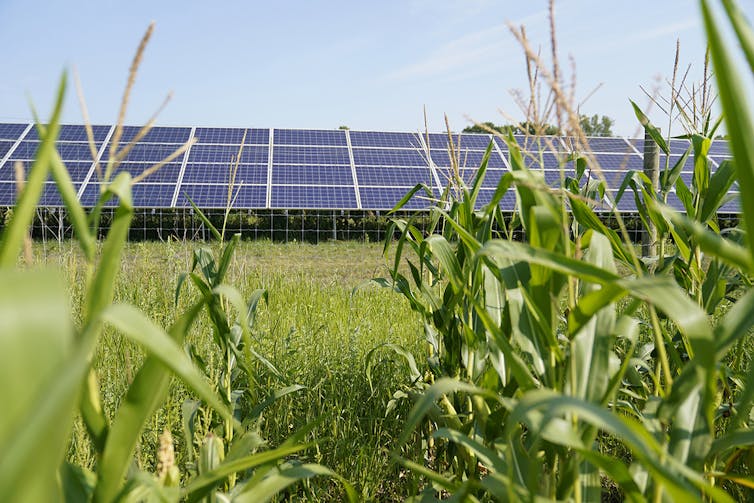
Microgrids could be another promising option. A microgrid is a small local power system that often combines solar, batteries and smart devices that help monitor energy use. In some cases, microgrids can keep generating power when the main grid is damaged or offline.
Some Australian communities are already experimenting with microgrids. On King Island, off Tasmania’s northeast coast, the local renewable integration project supplies more than 65% of the town’s annual electricity needs. As part of the First Nations Community Microgrids Program, South Australia is installing hybrid systems that combine solar, battery and diesel elements in remote Aboriginal communities. Both projects aim to generate renewable energy in a more affordable and reliable way.
Microgrids have multiple benefits. One is they are modular, meaning they are made of different parts that can be combined in different ways to meet each community’s specific needs. Microgrids are also relatively portable. This means we can put them in communities with the greatest energy needs, such as towns that rely on diesel or are located at the edge of large networks.
However, microgrids are not a silver bullet. Communities should consider several factors before installing a microgrid, including whether they have a suitable place to put it. Each community must also make sure it can afford the upfront costs of installing a microgrid. In some places, it may be more feasible to strengthen existing energy infrastructure.
Overall, microgrids could help us more effectively generate, store and distribute energy. They may be particularly suited to remote communities that rely on finite fuel supplies.
Unfortunately, we are living through a period of international conflict and fuel price shocks. So it’s time we prioritise making and storing power closer to the people who need it most.
Authors: Saman Gorji, Associate Professor, Renewable Energy and Electrical Engineering, Deakin University

















