

telehealth may limit coronavirus spread, but there's more we can do to protect health workers
- Written by: Matt Mason, Lecturer and Program Co-ordinator: Nursing, University of the Sunshine Coast
The Australian government today announced new telehealth consultations will be covered under the Medicare Benefits Schedule.
This will mean people who are isolated due to the coronavirus can access medical services from home by audio or video, an important step to protect other patients and health-care workers from being infected.
Health-care workers are perhaps our most valuable asset in an outbreak situation, but can be at high risk when coming into contact with patients who have COVID-19.
So how do health-care workers protect themselves – and patients – from transmission? And what more could we do?
The challenges
Regardless of COVID-19, doctors and other health-care staff often feel some level of expectation to turn up to work even when ill. They’re often worried about placing strain on co-workers and affecting patient care.
The practice of quarantining health-care workers who may have been exposed to the virus puts additional pressure on health services and is expected to increase as the outbreak continues.
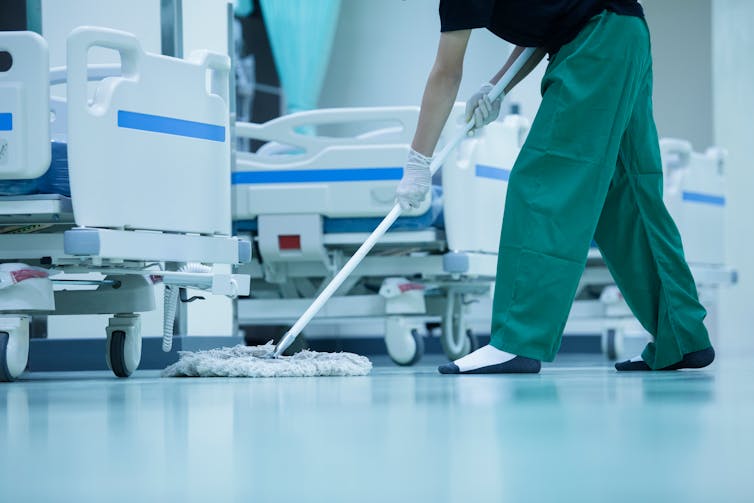 Infection control measures are in place all the time in health-care settings. But during outbreaks like the coronavirus, they’re stepped up.
Shutterstock
Infection control measures are in place all the time in health-care settings. But during outbreaks like the coronavirus, they’re stepped up.
Shutterstock
Over the weekend, we saw tension between medical practitioners and state health departments when a Melbourne GP saw patients while unwell and subsequently tested positive to coronavirus.
The Victorian health minister called for the health professional regulatory agency AHPRA to investigate the doctor, despite the fact he followed state guidelines current at the time.
Where multiple jurisdictions and authorities are providing differing information, this complicates the decision health-care workers face when they’re unwell or may have been exposed to the coronavirus.
As much as possible, health-care workers should follow guidelines issued by their place of work or health department.
Health-care workers take precautions all year round
Australia has a robust, evidence-based infection prevention and control system supported through accreditation bodies like the Australian Commission on Safety and Quality in Healthcare.
Standard precautions used in most health-care encounters include hand hygiene, the use of appropriate personal protective equipment, the safe use and disposal of sharps, and routine cleaning. These are to be followed even if there’s no evidence of an infection.
Read more: How do we detect if coronavirus is spreading in the community?
Extra measures
We use what we call transmission-based precautions in conjunction with standard precautions when we know of or suspect an increased risk of transmission for a particular disease.
Because we know coronavirus spreads through large droplets, health workers are using two classes of transmission-based precautions: droplet and contact precautions.
Contact precautions involve putting on gloves and a gown upon entry to the patient care area, to ensure clothing and skin do not make contact with surfaces that have potentially been contaminated with the infectious droplets. Droplet precautions involve wearing a surgical mask so infectious droplets don’t get in the mouth and nose.
Normally coronavirus is spread only via droplets but some medical procedures such as inserting a breathing tube can aerosolise the virus, meaning it can stay in the air longer.
Health-care workers may take additional airborne precautions when they’re undertaking aerosol generating procedures such as intubating a critically unwell patient. These precautions include wearing a properly fitting P2/N95 respirator and caring for the patient in a special isolation room.
Studies overseas have shown these procedures, when followed, do protect health-care workers from contracting infectious diseases.
But there’s often a gap between the recommended practices and their application in health-care settings. Studies have indicated reasons for this include staff attitudes, insufficient knowledge of procedures, inadequate supplies, time pressures and staffing levels.
Education and training around these procedures must be routine so that in the face of an outbreak like coronavirus, health-care workers are supported and prepared to implement these critical protocols.
Telehealth consultations are a good step
As well as enabling people who are sick or isolated to see a doctor from home, telehealth will allow doctors who may be isolated due to infection, or quarantined because they’ve had contact with an infection, to continue to practise.
The measure could also ease the strain on resources. Numerous health-care practices have reported scarcity of personal protective equipment (like masks) and hand hygiene consumables (such as soap and paper towels), potentially placing health-care workers and patients at risk.
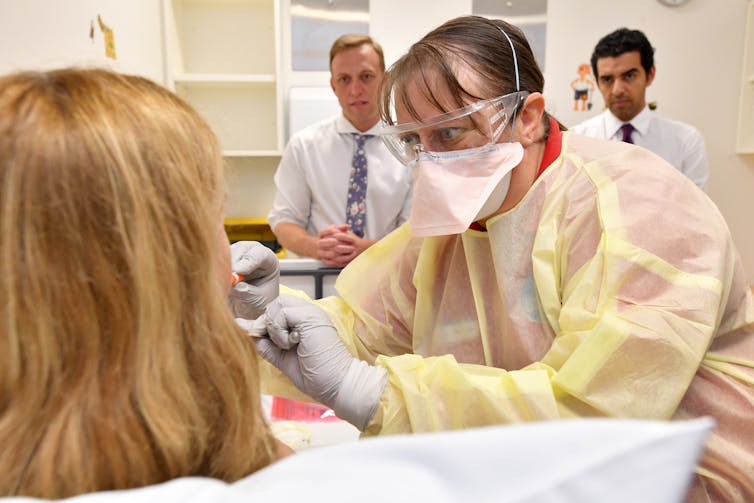 It’s critical health-care workers have access to appropriate protective equipment.
Darren England/AAP
It’s critical health-care workers have access to appropriate protective equipment.
Darren England/AAP
While telehealth is useful to a degree, when someone needs a test or treatment, this will likely need to happen face-to-face.
It’s critical health-care workers can access the appropriate supplies so they can follow the proper infection prevention and control protocols.
We also need consistent messaging for the public and health-care workers on when to contact a health-care professional, how that should be done and what to do to minimise coronavirus risk.
Read more: Worried about your child getting coronavirus? Here's what you need to know
In the 2003 SARS outbreak, one fifth of reported infections were in health-care workers. We don’t want to see that again.
Existing health systems are already stretched beyond their limits. We don’t have the capacity to respond to a surge in required services – let alone to absorb health-care workers who are unwell.
Authors: Matt Mason, Lecturer and Program Co-ordinator: Nursing, University of the Sunshine Coast


















