

What is homeschooling? And should I be doing that with my kid during the coronavirus lockdown?
- Written by: Rebecca English, Lecturer in Education, Queensland University of Technology
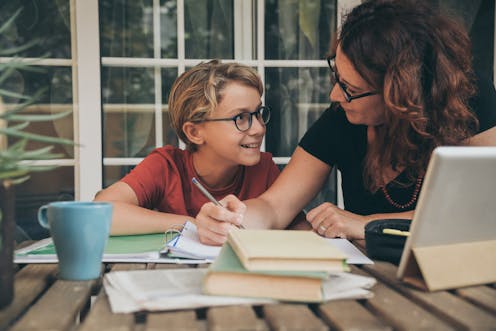
“How to home school” has been trending on Google for the past few weeks as more and more children stay home from school because of COVID-19.
So, what is homeschooling and is this what parents whose children are learning from home are now doing?
What is home education?
Home education is one of the world’s fastest growing educational movements.
In its broadest sense, home education can be understood as any form of education that occurs outside of a physical school. It includes the 20,000 or so students registered for home education in Australia, as well as distance education students – who are enrolled in a school but learn remotely.
There are a wide variety of home education approaches and they lie on a spectrum. Highly structured approaches that mirror school, with a detailed curriculum and lots of book work, lie at one end. Most people can imagine what that looks like because it’s not that different from traditional schooling.
At the other end is unschooling, where children choose the direction of their learning. In this approach, there may be no formal written work.
Read more: Homeschooling is on the rise in Australia. Who is doing it and why?
With unschooling, the choice is as much of a lifestyle as an education. Parents act as facilitators of their child’s learning, sourcing and providing access to resources and then getting out of the way. Research suggests unschoolers are more likely to be satisfied with their education and have an intrinsic motivation to learn.
Most home educating families’ approaches fall somewhere in between and use a mix of parent-directed and child-directed learning.
What are the legal requirements of home educators?
Each state and territory in Australia has its own laws and requirements around home education. In essence, parents need to apply to register their children. Some states such as the Northern Territory require you to follow any Australian approved curriculum (such as the Australian Curriculum, Montessori or Steiner).
Others, including Queensland, Tasmania, Victoria and the ACT, stipulate you just need to cover key learning areas such as English, Maths, Science, Arts, Technology, Health, Humanities or Languages.
In New South Wales, parents need to follow the NSW Syllabus, which is based on, but not the same as, the Australian Curriculum.
Regardless of where they are located, parents indicate their intention to home educate by completing a form from their state’s education department. They then need to develop a plan of their approach, and to show their plan will meet the child’s individual learning needs.
Age levels and year levels are less important in home education – children’s work is targeted to where they are up to not their age.
Parents can buy a pre-packaged curriculum and resources or they can develop their own. They can use tutors and group classes, as well as activities like scouts and sporting teams, and everyday hands-on activities as a part of their learning. If they need to, parents can adapt to better meet their child’s needs.
At the end of the registration period, most states and territories require parents to report on their child’s progress.
Are we all homeschoolers now?
To some extent, when it comes to educating your child at home, this situation is unique – in other respects it’s not.
Many homeschooling families have brought their child home to learn because of a crisis, such as related to bullying, health, or a disability.
But families in this new wave of accidental home educators don’t have to register their children with their state or territory education department. The child’s enrolment is maintained with their school.
Read more: Trying to homeschool because of coronavirus? Here are 5 tips to help your child learn
And, in most cases, the schools are sending work home. Reports on the ground suggest this is working well for many families.
But some parents are reporting difficulties implementing what they’re being asked to do at home. This is particularly so when they’re balancing their child’s education with their own work requirements, or where the schoolwork is worksheet heavy.
If this is your situation, you are not alone and schools are trying their best to make this work. Hopefully, with more time, things will run more smoothly.
What new homeschoolers can learn from the old
Many long established home education families work from home as well, so they empathise with parents’ new found juggle of work and schooling. There’s some things schools and parents can learn from how home educators manage things.
Think about other ways of learning apart from book work. Some children thrive on book work, but others need more hands on tasks. If your child is struggling, talk their teacher and see if he or she is open to you covering the content in a different way.
For example, an alternative to doing fractions through worksheets might be cooking a meal. Cooking allows you to introduce other concepts such as addition and mass (mathematics), following a procedural text (literacy), discussing your experience of learning to cook (humanities and social science), nutrition (health), and even the science of molecular gastronomy. And everyone gets fed.
That’s something else to keep in mind – kids can sometimes help their parents with the things they need to do. Whether that’s cooking or helping you set up the technology for an online work meeting. Home educating families are used to seeing the learning happening in everyday activities, and doing so can help parents feel less stressed about what their child is missing out on.
If you’re struggling with working out how to do this, there’s support in home education social media groups, where experienced home educators are providing support to parents (and teachers).
Keep in mind, much of this situation is new to home educators too. They’re not used to being at home so much either – much of their learning is normally in the community.
But organisations and groups are doing what they can to link families to the outside world. People are providing online storytime, and zoos, wildlife parks, museums and galleries are freely available online.
Authors: Rebecca English, Lecturer in Education, Queensland University of Technology


















