
Does nicotine protect us against coronavirus?
- Written by: Adrian Bauman, Sesquicentenary Professor, Public Health, University of Sydney
If you noticed headlines recently suggesting smoking could protect against COVID-19, you might have been surprised.
After all, we know smoking is bad for our health. It’s a leading risk factor for heart disease, lung disease and many cancers. Smoking also reduces our immunity, and makes us more susceptible to respiratory infections including pneumonia.
And smokers touch their mouth and face more, a risk for COVID-19 infection.
Initial observational findings suggested a history of smoking increased the risk of poor outcomes in COVID-19 patients, as the World Health Organisation and other bodies have identified.
But a recent paper which examined smoking rates among COVID-19 patients in a French hospital hypothesised smoking might make people less susceptible to COVID-19 infection.
So what can we make of this?
Read more: Smoking increases your coronavirus risk. There's never been a better time to quit
What the study did
This study was a cross-sectional survey where the researchers assessed the exposure (smoking) and the outcome (COVID-19) at the same time. This type of research design can’t prove the exposure causes the outcome – only that there may be an association.
There were two groups included in the study – 343 inpatients treated for COVID-19 from February 28 to March 30, and 139 outpatients treated from March 23 to April 9. Among other data collected, participants were asked whether they were current smokers.
The researchers compared smoking rates in both groups with smoking rates in the general French population.
The results
The study found 4.4% of inpatients and 5.3% of outpatients with COVID-19 were smokers, after adjusting for differences in age and sex.
This was only a fraction of the prevalence seen in the general French population. Some 25.4% reportedly smoked daily in 2018.
The authors asserted:
current smokers have a very much lower probability of developing symptomatic or severe SARS-CoV-2 infection as compared to the general population.
The finding of lower rates of smokers among COVID-19 cases has been more recently described elsewhere, in a rapid review of 28 studies on smoking in COVID-19 patients from various countries.
Read more: Why do more men die from coronavirus than women?
The authors of the French study suggest the mechanism behind the protective effects of smoking could be found in nicotine.
SARS-CoV-2, the virus that causes COVID-19, gains entry into human cells by latching onto protein receptors called ACE2, which are found on certain cells’ surfaces.
The researchers have proposed nicotine attaches to the ACE2 receptors, thereby preventing the virus from attaching and potentially reducing the amount of virus that can get into a person’s lung cells.
The researchers are now planning to test their hypothesis in a randomised trial involving nicotine patches; though the trial is still awaiting approval from French health authorities.
So how should we interpret the results?
These counterintuitive results may be due to several biases, so let’s explore some alternative explanations.
First is what we call “selection bias”. The hospital patients may be less likely to be daily smokers than the general population. For example, health-care workers and those with existing chronic conditions were disproportionately represented in the inpatient sample – both of these groups usually show lower prevalence of current smoking.
Further, around 60% of the hospitalised patients in the study were ex-smokers (similar to the national prevalence). Some may have given up smoking very recently in response to the WHO declaring smoking as a risk factor for COVID-19. But they were classified as non-daily smokers in the study.
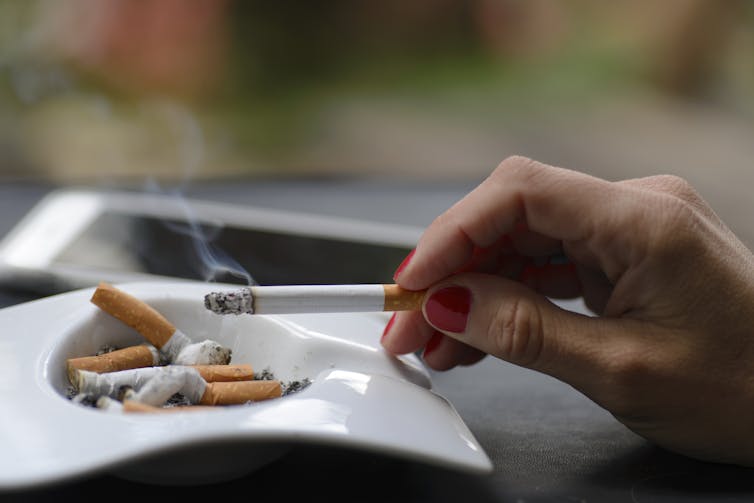 We can identify several biases in the study.
Shutterstock
We can identify several biases in the study.
Shutterstock
Second is what we call “social desirability bias”. COVID-19 patients may be more likely to deny smoking when asked about their smoking status in hospital, wanting to be seen by medical professionals as doing the right thing.
And data collection may have been incomplete for behavioural questions in busy hospitals overwhelmed by COVID-19 cases.
Finally, it’s important to note this paper has not yet been peer-reviewed.
Taken together, although there appears to be an association between smoking and COVID-19 in these hospital-based samples, there’s no evidence of a causal relationship – that is, that smoking prevents COVID-19.
Read more: Drug use may increase the risk of coronavirus. Here's how to reduce the harms
Lots of research at pandemic speed
We must acknowledge this research has been conducted at “pandemic speed”, much faster than usual research time frames.
Normally it would be months between submission and publication – but in this case the researchers completed their observations and had the research published online within the same month.
An unintended consequence of the early release of research is that it may provoke undue community hope or belief in unproven treatments.
French authorities had to limit sales of nicotine treatments to avoid stockpiling after this study was published.
Read more: The smoke from autumn burn-offs could make coronavirus symptoms worse. It’s not worth the risk
We saw a similar phenomenon recently with the drug hydroxychloroquine, where supplies ran out for those who needed them after politicians proclaimed it as a cure for COVID-19.
So right now we need to put in extra effort to make sure early evidence is not misinterpreted or overstated.
As for the role of smoking in COVID-19 – this link requires substantially more research and critical appraisal. Because overall, smoking still kills. – Adrian Bauman, Melody Ding and Leah Shepherd
Blind peer review
On the whole, this Research Check represents a fair and balanced account of the study. The alternative explanations for the observation of low smoking status prevalence among the French hospital sample provided are possible.
One plausible explanation is error in recording smoking status. There is evidence of under-reporting and inaccurate reporting of smoking status within hospital samples, in general.
It’s unclear from the study what method was used to collect smoking status data. The authors simply state patients were “asked” and “data were collected in the context of care”. It’s important to know who asked the smoking status questions, what questions were asked, when they were asked, and what record keeping system was used.
Given clinical smoking status record keeping may not capture all smokers accurately, a better comparison would be to compare the 2020 data with pre-COVID-19 hospital patient data, rather than general population data which may have asked different questions. – Billie Bonevski
Research Checks interrogate newly published studies and how they’re reported in the media. The analysis is undertaken by one or more academics not involved with the study, and reviewed by another, to make sure it’s accurate.
Authors: Adrian Bauman, Sesquicentenary Professor, Public Health, University of Sydney
Read more https://theconversation.com/does-nicotine-protect-us-against-coronavirus-137488


















