

Coronavirus shows housing costs leave many insecure. Tackling that can help solve an even bigger crisis
- Written by: Samuel Alexander, Research fellow, Melbourne Sustainable Society Institute, University of Melbourne
The massive economic disruption brought by COVID-19 has revealed that for many, economic security is an illusion. And our biggest vulnerability is housing costs - the biggest expense for most households.
This fact is pertinent when we consider the crucial task of how to create a more resilient and sustainable economy after the crisis.
We mustn’t forget COVID-19 is actually a crisis within a much bigger and more complex crisis – climate change and environmental degradation.
But housing costs make many of us utterly dependent on a return to business-as-usual, despite the catastrophic environmental consequences.
Prime Minister Scott Morrison on Friday flagged the first stage in loosened coronavirus restrictions, expected to boost Australia’s economy by more than A$3 billion a month.
But we believe bouncing back to a path of untrammelled economic growth is no solution at all.
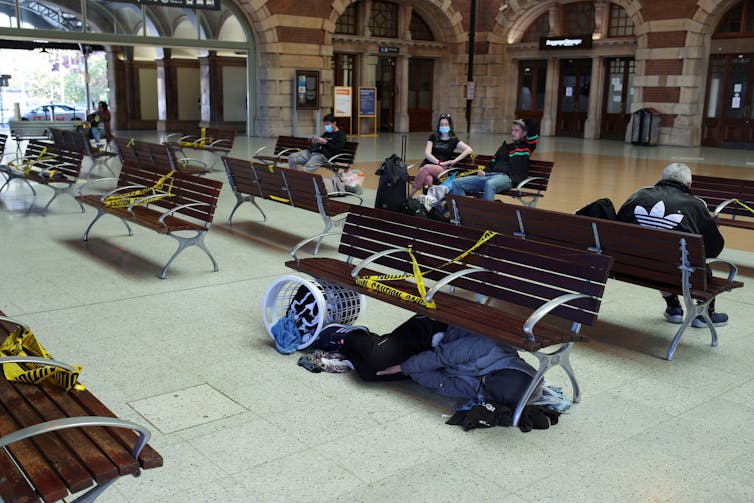 The coronavirus has highlighted the economic insecurity of many.
Loren Elliott/Reuters
The coronavirus has highlighted the economic insecurity of many.
Loren Elliott/Reuters
A tragic paradox
Rich nations such as Australia must permanently reduce and stabilise economic growth – and with it, resource and energy demands – to maintain a liveable planet.
But here lies the tragic paradox. How can we deliberately orchestrate an economic slowdown, when the COVID-19 experience has caused so much personal pain and left many unable to pay rent and bills?
Read more: Want an economic tonic, Mr Morrison? Use that stimulus money to turbocharge renewables
Treasury forecasts suggest unemployment in Australia will jump from around 700,000 to 1.4 million as a result of COVID-19. Casuals, many of whom are not eligible for the JobKeeper payments, are already at serious risk of becoming homeless.
Governments and banks have taken immediate steps to keep people afloat, such as stimulus spending on unemployment benefits, a six-month freeze on mortgage repayments and a ban on certain rental evictions.
These stopgap measures show the emerging housing crisis is unprecedented and serious – but they are merely band-aid solutions to personal economic insecurity.
What’s more, they ignore the obvious environmental devastation wrought by a growing economy. It’s clear we must look for other solutions.
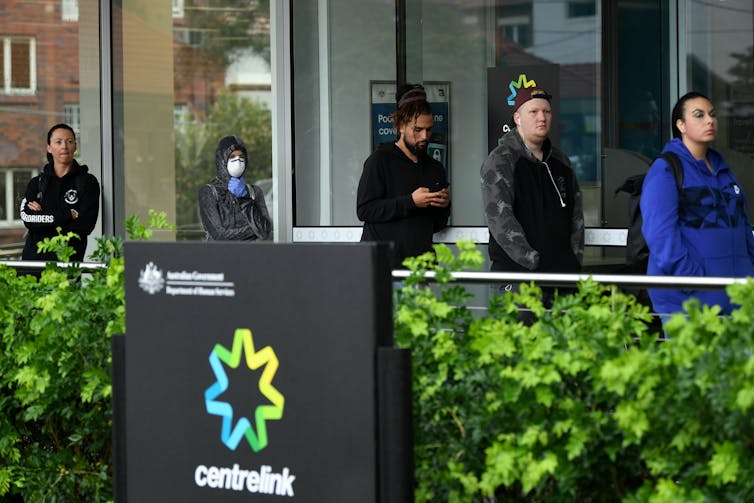 The coronavirus left thousands of people unemployed.
Joel Carrett/AAP
The coronavirus left thousands of people unemployed.
Joel Carrett/AAP
Public housing offers a new way
We propose that federal and state authorities offer unemployed people the opportunity to access public housing and a “participation income”.
The voluntary program would first be offered to eligible people either living in public housing, or at the top of the waiting list. If a pilot proved successful, and as public housing investment increased, the program could be offered more widely.
Participants would be paid a modest living wage in exchange for about 15 hours of local community service each week. This work could include growing food, maintaining the neighbourhood, helping to run sharing schemes such as a community tool bank, or even building new homes under expert guidance.
Read more: Why it doesn't make economic sense to ignore climate change in our recovery from the pandemic
The payment and associated activities would replace a person’s unemployment benefits and job-seeking obligations.
Such a program would provide a secure home and livelihood to the poorest members of society. It would also provide real-world examples of alternative ways of meeting basic human needs, and governing access to land.
This proposal is built on the basic premise that land (just like air and water) was not created by the market and so should not be a commodity. Access to land for housing should be a human right granted to all, not just to those who can afford it.
 Tending to community gardens is one way citizens can become more self-sufficient.
TASS/Sipa USA
Tending to community gardens is one way citizens can become more self-sufficient.
TASS/Sipa USA
New grounds for idealism
A scheme such as ours could show how people are liberated from their reliance on economic growth when land is not commodified.
Urban commons, such as the R-Urban project in Paris, demonstrate how everyday citizens can create an alternative economy. There, several hundred people co-manage land that includes a small farm for collective use, a recycling plant and cooperative eco-housing.
Read more: Using lots of plastic packaging during the coronavirus crisis? You're not alone
This is not a new concept. Local collaboration on common land is humanity’s oldest and most widespread mode of economic operation. For First Australians, it underpinned their way of life for tens of thousands of years.
And in Britain, people lived and locally collaborated on common land for many thousands of years before it became privatised.
Our proposal is about creating new futures based on common land, not a return to the past. It would initially involve the unemployed in public housing. But it could be expanded to include others alienated from the market: victims of the automation of jobs, the globalisation of labour – such as manufactured goods being increasingly produced in developing nations – or the decline in polluting industries such as fossil fuels.
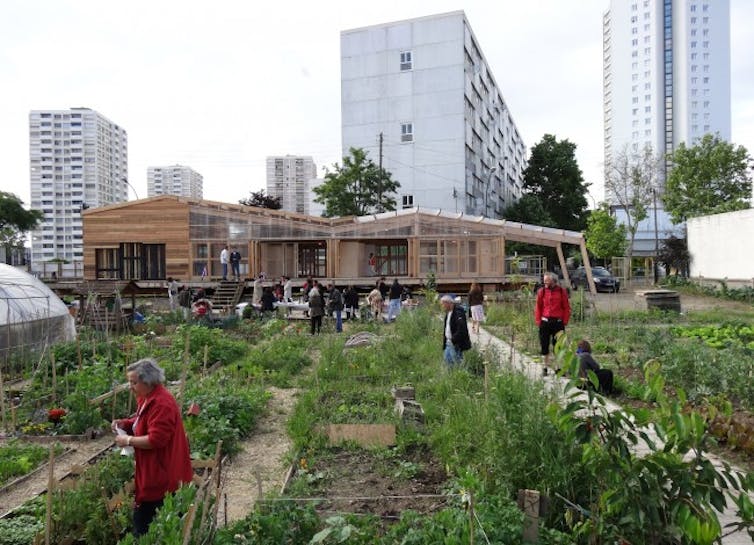 The R-Urban project in Paris, which includes a small farm.
Flickr
The R-Urban project in Paris, which includes a small farm.
Flickr
We need a new ‘golden age’ for public housing
Scaling up new land governance arrangements to the point where they influence the broader economy would require a huge expansion in public housing.
COVID-19 has highlighted Australia’s public housing shortage. Social welfare advocates, unions and the building industry have recognised the problem.
Reserve Bank governor Phillip Lowe says Australia must exploit low interest rates to invest in infrastructure. The stimulus following the Great Depression and the end of World War II offers a precedent: it led to the “golden age” of Australian public housing.
We call on governments to be innovative and ambitious. Building a more resilient and sustainable future requires the courage to experiment with new housing and living arrangements. Now is the time to act.
Authors: Samuel Alexander, Research fellow, Melbourne Sustainable Society Institute, University of Melbourne


















