

Morrison government dangles new carrots for industry but fails to fix bigger climate policy problem
- Written by: Frank Jotzo, Director, Centre for Climate and Energy Policy, Australian National University
The intricacies of climate change policy have not been front of mind for the Australian government this last half year, but the issue is now back on the agenda. Yesterday a review chaired by energy industry executive Grant King into new low-cost sources of emissions reduction was released. The government has accepted many of its recommendations.
Federal energy minister Angus Taylor says the changes create new ways to reduce emissions across the industrial, manufacturing, transport and agriculture sectors.
The package spells a broadening of existing mechanisms and may open the door to some better outcomes. But the existing climate policy patchwork remains deeply inadequate, and in practice the changes may do little more than channel government funding to industry.
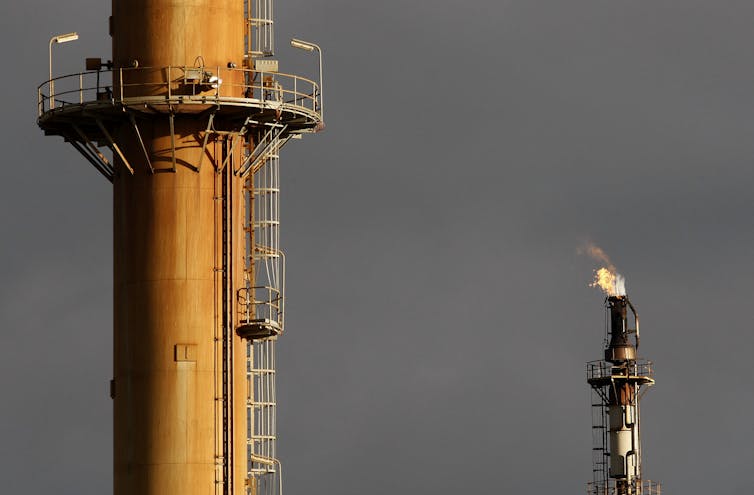 Climate policy changes will funnel public money to private industry.
Mick Tsikas/AAP
Climate policy changes will funnel public money to private industry.
Mick Tsikas/AAP
The role of carbon capture and storage and storage
In line with the review’s recommendation, the government’s emissions reduction fund will be extended to projects using carbon capture and storage (CCS) technology.
CCS involves capturing carbon dioxide from sources such as power stations, gas plants or cement plants and pumping it underground. It tends to be technically difficult and costly per unit of tonne of emissions saved, and usually does not capture all of the emissions.
The Emissions Reduction Fund (ERF) has been the government’s primary climate policy mechanism. It gives subsidies to projects that are deemed to reduce carbon emissions – to date, mainly in agriculture and forestry. The policy is vastly less effective and efficient than the carbon pricing mechanism it replaced in 2014.
The obvious criticism is that extending government support to CCS locks in some fossil fuel use, when Australia has great opportunities to put our energy system on a zero-emissions footing using cheap renewable energy.
Read more: Yes, carbon emissions fell during COVID-19. But it's the shift away from coal that really matters
However, in the path to decarbonising Australia’s economy, the technology may well have a role in some industrial applications such as cement production and natural gas processing. In principle it makes sense to include any technology in a policy mechanism, as long as it is cost-competitive.
The emissions reduction fund currently pays companies about A$16 for every tonne of carbon dioxide presumed to be reduced.
In practice, carbon capture and storage projects in Australia would require far more to be economically feasible. This is because the additional cost per tonne of carbon dioxide removed is usually far higher than in typical agriculture and forestry projects. Replacing fossil fuels with renewable energy, or saving energy through better efficiency, is typically also far cheaper than cutting emissions through CCS.
So on present settings, where all project types receive the same rate of subsidy, including CCS might be mostly just a nod to the relevant interest groups. Methodologies for establishing and monitoring projects would be established by the bureaucracy but it seems unlikely that many projects would happen.
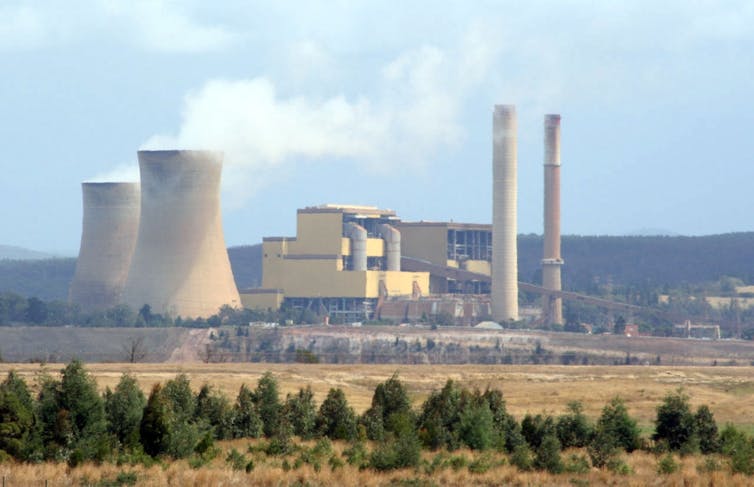 CCS traps carbon from sources such as coal stations.
Wikimedia
CCS traps carbon from sources such as coal stations.
Wikimedia
Energy technology support
The King review also calls for expanding the remit of the Australian Renewable Energy Agency (ARENA) and the Clean Energy Finance Corporation (CEFC) to make them “technology neutral”, so the agencies could support technologies across all sectors of the economy.
This implies expanding ARENA’s research and development activities, and the CEFC’s project finance, to the transport and industry sectors. These are the next big areas for decarbonisation after electricity, and it makes sense to channel resources into them.
A “technology neutral” approach could include carbon capture and storage. ARENA and CEFC make their own decisions about their investments within a broad mandate by government. It is important this remains so, allowing the most promising technologies to be supported, irrespective of the apparent preferences by government for fossil fuel-based technologies.
Broadening the ERF
The review recommends other changes to broaden the ERF, including to make it easier for smaller projects in agriculture and forestry to participate. This may have been prompted by the fact that the last two ERF auctions resulted in only a small number of projects and small volume of contracted emissions reductions.
This change may get extra projects over the line. But it does not fix the fundamental problem with the ERF, or its successor the Climate Solutions Fund.
The scheme pays businesses, in the form of credits, when they take steps to reduce emissions relative to a hypothetical baseline. Since it is generally impossible to know whether a company’s action to reduce emissions would have happened anyway, we can’t know to what extent claimed reductions are real. Despite elaborate estimation methodologies, the fundamental problem remains.
Under an effective and efficient climate policy framework, the ERF would either not exist or have a relatively minor role. But Australia is a long way from effective and efficient climate policy.
 Australia is a long way from an effective climate policy.
Sergio Perez/Reuters
Australia is a long way from an effective climate policy.
Sergio Perez/Reuters
Softly, softly towards carbon trading?
Under the government’s Safeguard Mechanism, a company emitting carbon emissions beyond its baseline is required to buy emissions reductions credits to cover the excess.
But in practice, the baselines are set so high that projects rarely reach them, and those that do receive exemptions.
The new recommendation, accepted by the government, is to give emissions credits to companies that stay below their baselines, if it was the result of investment in “transformative” emissions-saving measures. This would create an incentive to do better, rather than just the existing, muted incentive not to do worse than a very unambitious standard.
The question is, who would buy these credits? The review suggests the government, or companies that exceed their baselines, might buy them. The former would expand the subsidy approach to emissions cuts even further. This is quite unnecessary: private money in industry is available for relevant investments if the right incentives or regulations are in place.
But what holds promise is if companies emitting over their baselines have to buy credits from companies that operate below the baseline.
Read more: Want an economic tonic, Mr Morrison? Use that stimulus money to turbocharge renewables
That would create a form of carbon trading. There would be a market price for emissions in industry, and companies would move towards establishing cost-effective measures to curb emissions. There would be no money flowing to or from government, as trades would be only between companies.
The safeguard mechanism was originally designed with this possibility in mind, and perhaps now the door is opening a fraction.
But to create real demand for emissions credits, and a meaningful price on emissions in industry, emissions baselines would have to be drastically lowered and no more exemptions granted. Companies running old, inefficient equipment, of which there are many in Australia, would be put on the spot.
Given the government’s deep aversion to carbon pricing, and the likely opposition by some industry players, this is perhaps more pious hope than imminent prospect.
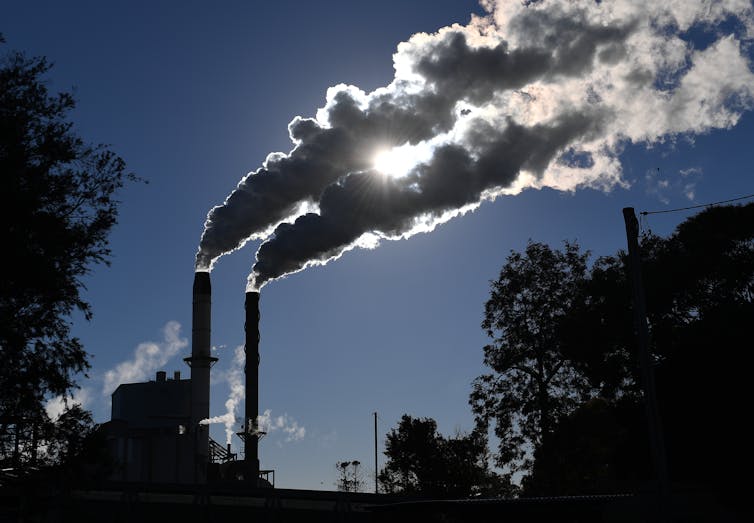 Some industry players oppose carbon pricing.
Dave Hunt/AAP
Some industry players oppose carbon pricing.
Dave Hunt/AAP
Spend, spend?
At least for now, we will probably only see a government-funded carrot given to some, and no stick. Government handouts to individual companies will continue to be the measure of Australia’s climate policy.
In these times of dramatic fiscal spending, sending a few more billion dollars of public money to businesses to subsidise new equipment may not seem a big deal. But one day, all that money needs to be recouped through taxation. It will then be obvious that industry should have been required to spend its own funds to cut emissions, and that a comprehensive market mechanism would have led to more efficient and productive investment choices.
Abolishing Australia’s carbon pricing mechanism in 2014 was a consequential failure of politics. The fine-tuning of the patchwork of policies that followed does not make up for it.
Read more: Coronavirus is a 'sliding doors' moment. What we do now could change Earth's trajectory
Authors: Frank Jotzo, Director, Centre for Climate and Energy Policy, Australian National University


















