

Children aren't liabilities in disasters – they can help, if we let them
- Written by: Christine Eriksen, Senior Research Fellow, Australian Centre for Cultural Environmental Research, University of Wollongong
Our world is becoming increasingly vulnerable to fire, flood and other natural hazards. While our instinct as adults may be to shield children from these possibilities, this does them a real disservice.
Lessons from El Salvador and the Philippines show that when children are given accurate, clear information in accessible and age-appropriate language, they are highly motivated to help reduce disaster risks, both at home and in their communities.
Indeed, there is growing evidence that children can play an active and positive role in making their communities more resilient to climate change, hurricanes and bushfires, and in improving disaster recovery.
Planning for disaster
Children understand and experience the world differently to adults, but they can be highly resourceful.
Recent research shows that an adult’s social characteristics, such as age, gender, sexuality, class, ethnicity, and disability, are central to understanding their coping capacity during disasters.
Yet during disaster planning, children – including teenagers – are rarely given descriptors other than “child” or “youth”. They are treated as blank pages, with no defining features other than their age.
This goes against the best practice recommended by the United Nations’ Office for Disaster Risk Reduction. It recognises that children are disproportionately affected by disasters, and they should be given the opportunity to contribute to disaster risk reduction (DRR).
Omitting children’s voices reveals a blanket assumption that the young are all equally vulnerable. It silences children’s own sense of identity and undermines their capacity for resilience.
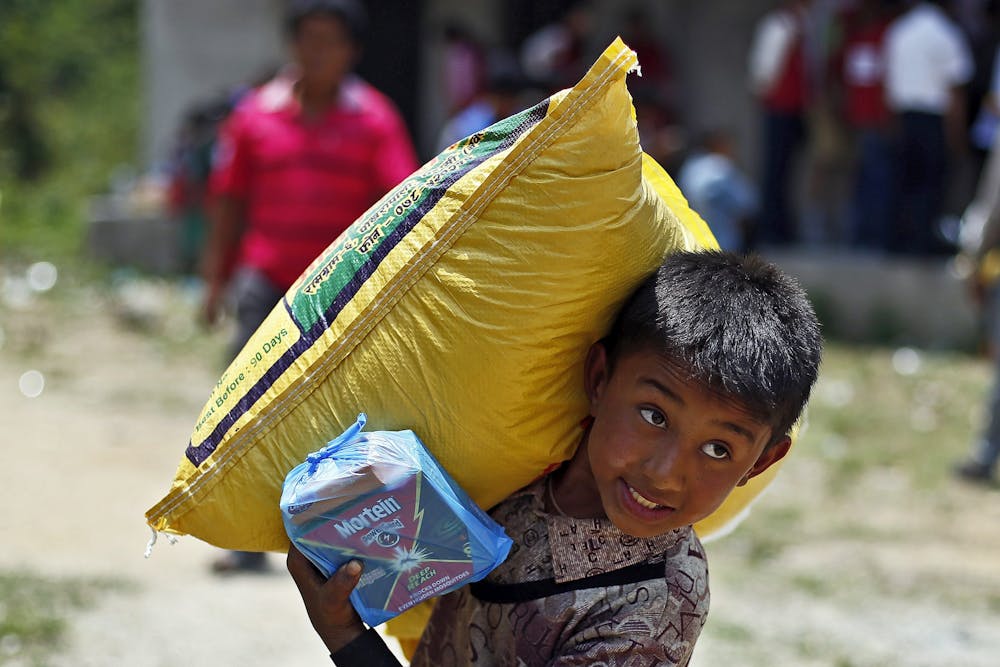 Resilience in the face of the 2015 Nepal earthquake.
Mast Irham/EPA
Resilience in the face of the 2015 Nepal earthquake.
Mast Irham/EPA
It also limits opportunities for children to contribute to the development of disaster response policy and practice. The enduring negative stigma of disability in many countries results in children with disabilities being even further marginalised.
Talking to children
Our collective experience as disaster researchers and practitioners has taught us that children’s individual identities matter in disasters.
Following the devastation of Typhoon Haiyan in the Philippines in 2013 and the Nepal 2015 earthquake, local children received training in storytelling, photography, radio and video-making to record issues affecting their lives.
Rather than having adults interpret and communicate their experiences of the disaster, the children were empowered to tell their own stories. In the process, they were able to actively participate in community recovery processes.
In examples such as the 2015 Nepal earthquake, children were able to identify good practice for reducing disaster risk for themselves.
Research in bushfire-prone areas of Australia highlights the issues and challenges for families with children in preparing a bushfire survival plan. The significant benefits of providing children with genuine opportunities to participate, and practical advice on how to include children in the planning process, are outlined in this booklet.
While household emergency plans are vital, it is quite possible that disaster will strike while children are at school. The inter-agency School Safety Framework is an example of child-centred policies that focus on safe learning facilities, school disaster management, DRR and resilience education. The framework advocates elevating the role of children in community risk reduction, and outlines strategies for student engagement and participation.
Such a child-centred approach guides the delivery of the Pillowcase Project, a program designed for school children in Australia to promote disaster resilience education and coping capacity for a range of hazards.
Research into the disaster experiences of children with disabilities specifically suggests a range of ways to simultaneously acknowledge diverse social characteristics and develop inclusive DRR resilience-building initiatives. These vital steps are applicable to all child-centred activities, not just children with disabilities, and include:
The routine inclusion of children in DRR initiatives that run in their communities, including those run through schools using the School Safety Framework;
The inclusion of children in the development of participatory tools, methods and strategies that not only enable children to access and use DRR resources, but also facilitate ownership and excitement over the power they have in increasing their own resilience and managing their own recovery;
The involvement of children in DRR research and planning using participatory tools and approaches that capture the perspectives and unique capabilities of children;
Engaging parents, teachers, and local leaders to support children’s participation, including communicating the importance of children’s views and roles, and to include children in the decision making process, based on their interests and capacities; and
Exploring ways to increase opportunities for children to voice their own needs and opinions at multi-stakeholder forums.
Rather than labelling children as uniformly vulnerable, we should give them the space to identify their own capacities and agency.
Thank you to the Global Challenges Program at the University of Wollongong, which enabled the authors to spend a day together focusing on the theme of Children in Disasters as part of the 2017 Transforming Vulnerability Conference.
Authors: Christine Eriksen, Senior Research Fellow, Australian Centre for Cultural Environmental Research, University of Wollongong


















