

The government says artists should be able to access JobKeeper payments. It's not that simple
- Written by: Guy Morrow, Lecturer in Arts & Cultural Management, University of Melbourne
This week, Australia’s finance minister Mathias Cormann told ABC radio he didn’t “accept [the] proposition” workers in the arts and entertainment industry were missing out on wage subsidies through the government’s Jobkeeper program.
If they’re not receiving JobKeeper, he said:
… that must mean they can’t demonstrate they’ve had relevant falls in their revenue. […] To the extent [artists are] sole traders […] if their revenue drops on the same basis as any other Australian in similar circumstances in another industry, of course they would be able to participate.
Prior to lockdown, the creative arts contributed an esitmated A$14.7 billion to Gross Domestic Product and employed 193,600 people. The arts also create work of immense value to society in and of itself.
But how exactly are artists employed, and are they eligible for JobKeeper and JobSeeker? The answer is complicated.
Eligibility dilemmas
Some artists and arts workers are eligible for JobKeeper and JobSeeker, while others are not.
Where these workers invoice for their work, they operate as sole traders, setting up an Australian Business Number (ABN) and running their business as an individual. In this, the finance minister is correct in lumping sole trading artists in with any other Australian sole traders.
However, many artists and arts workers do not operate as sole traders and do not issue invoices using an ABN. They are instead employed on contracts for periods under 12 months. This includes actors at major theatre companies, people in the film industry, and administrators moving from festival to festival. If these workers weren’t on contracts when JobKeeper began – or if companies weren’t able to forward JobKeeper payments and so let go of staff – they are ineligible.
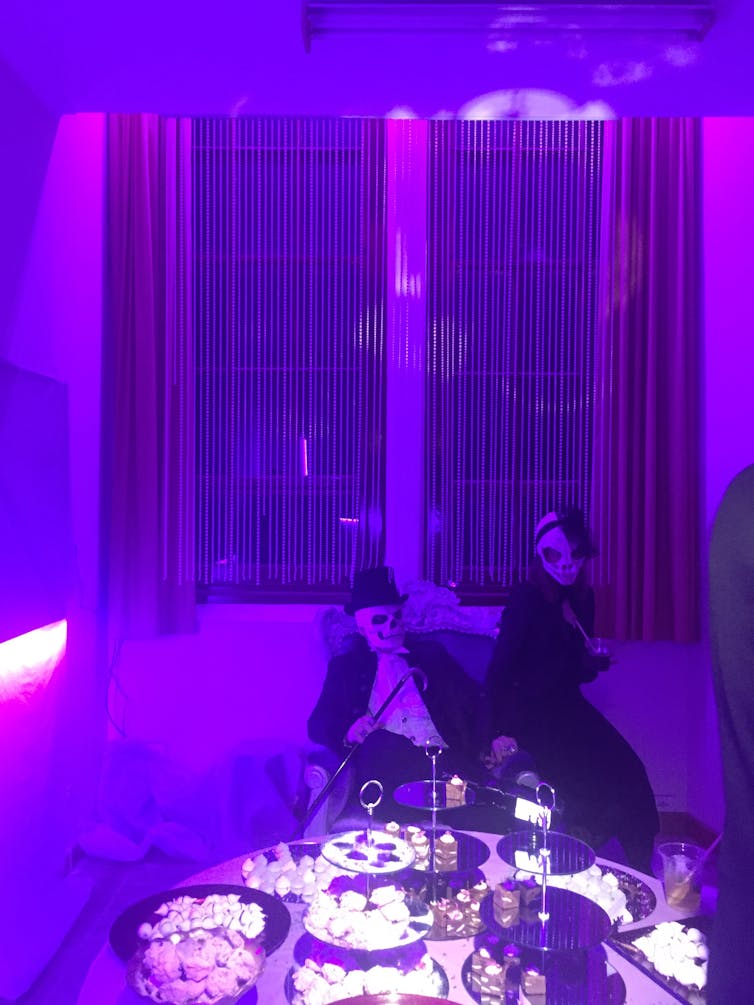 Festivals like Dark MOFO, cancelled for 2020, rely on short-term contract workers who may have been excluded from JobKeeper.
Andrew Drummond/AAP
Festivals like Dark MOFO, cancelled for 2020, rely on short-term contract workers who may have been excluded from JobKeeper.
Andrew Drummond/AAP
Many Australian artists have portfolio careers. They do core creative work, arts related work and non-arts related work often on the same day and often on a casual basis. This is why many in the sector are hurting: they don’t qualify for JobSeeker because their work is a mix of short-term contracts across jobs and across sectors. While their overall income may have fallen by more than 30%, the income earned on their ABN may not have fallen enough to be eligible.
35% of Media Entertainment and Arts Alliance members surveyed were ineligible for JobKeeper. The union is requesting proof from the Morrison government that its JobKeeper and JobSeeker programs will boost the arts industries by $4-$10 billion, as claimed by arts minister Paul Fletcher.
Read more: Coronavirus: 3 in 4 Australians employed in the creative and performing arts could lose their jobs
Not only was the minister’s $4-10 billion estimate based on a working paper published two years ago, it has emerged in the past week that the Treasury’s forecast for JobKeeper spending was out by $60 billion. This estimate of boosting the arts was relative to JobKeeper pumping $130 billion into the economy, not $70 billion.
Realities of arts work
The word “gig” in the term “gig economy” originated in the arts. 81% of artists work as freelancers or are self-employed, with 43% relying on contracts and 35% of artists income from royalties and advances.
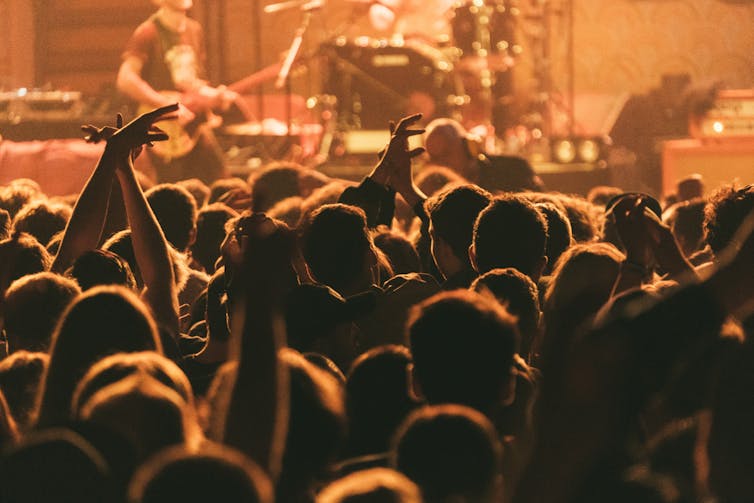 Musicians were the original gig workers.
Jay Wennington/Unsplash
Musicians were the original gig workers.
Jay Wennington/Unsplash
These royalties and advances are a form of capital, further complicating matters and differentiating some artists from other workers. While labour income may have been instantly cut off during the shutdown, capital income from royalties may complicate attempts to claim JobKeeper.
The current support packages (including $27 million targeted federal arts support and various state government programs do not go far enough.
The arts are a public good. Artistic creativity is beneficial in and of itself. While it is difficult to define how far is “enough” when it comes to something as open ended as artistic creativity, international comparisons can be used as reference points.
Germany’s federal government is providing sole traders, freelancers and firms with up to five employees a one-off payment of up to €9,000 (A$15,000). The German equivalent of JobKeeper (known as Kurzarbeitergeld) pays between 60%-80% of a worker’s pre-pandemic salary, with extra allowances for workers with children.
Access to basic income support for unemployed workers has also been simplified and they doubled the Neustart fund providing grants of between €10,000 and €50,000 (A$16,650 - A$83,250) for small-to-medium arts companies reopening after lockdown.
Read more: As we turn to creativity in isolation, the coronavirus is a calamity on top of an arts crisis
The UK’s Self-Employed Income Support Scheme makes grants of up to 80% of prior earnings, capped at £2,500 (A$4,650) a month. The UK government has also allocated £160 million (A$298 million) in emergency funding, and appointed a Commissioner for Cultural Recovery and Renewal.
A comprehensive listing of hundreds of different international measures is available here.
Arts hearts
International comparisons are not new and, as an advocacy approach, there is scant evidence Australian governments pay them much attention.
A better way forward during the current crisis could lie in touting Australians’ enduring desire to enjoy the arts.
As we dust ourselves off after lockdown, high on our lists will be (carefully) returning to pubs playing live music, to regional towns with proud local galleries, making the pilgrimage to green-field summer festivals, sipping bubbly at an edgy exhibition opening at – dare we hope – a resurrected Carriageworks.
The arts are – in their own right – essential threads in the fabric of Australian life. Australians want the arts to still be there on the other side of COVID-19. Let’s try putting this role at the heart of an arts advocacy in a time of crisis.
Authors: Guy Morrow, Lecturer in Arts & Cultural Management, University of Melbourne


















