

Whoever invents a coronavirus vaccine will control the patent – and, importantly, who gets to use it
- Written by: Natalie Stoianoff, Professor, Faculty of Law, University of Technology Sydney
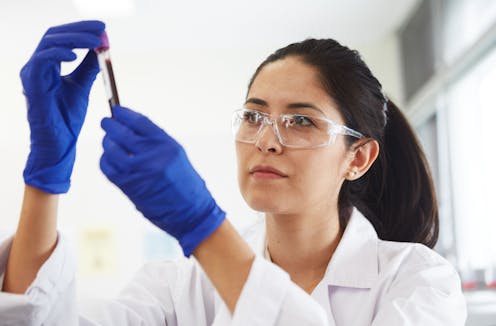
With research laboratories around the world racing to develop a coronavirus vaccine, a unique challenge has emerged: how to balance intellectual property rights with serving the public good.
Questions of patent protection and access to those patents has prompted an international group of scientists and lawyers to establish the Open COVID Pledge.
This movement calls on organisations to freely make available their existing patents and copyrights associated with vaccine research to create an open patent pool to solve a global problem.
The EU is leading the charge to create such a pool by drafting a resolution at the World Health Organisation. The US, UK and a few others have been opposed to this idea.
Read more: A secret reason Rx drugs cost so much: A global web of patent laws protects Big Pharma
For now, however, there are very few pharmaceutical and biotechnology corporations participating in the pledge, raising questions over whether the initiative will work.
Instead, universities, publicly funded research institutes and pharmaceutical and biotechnology corporations are working on vaccine research through international consortia or public-private partnerships.
If one group does develop a viable vaccine, this raises other questions that will soon need to be addressed:
who is funding the research, and who has the rights to any patents coming out of it?
can governments compel the owners of those patents to license other manufacturers to make the vaccines or medicines?
What are patent rights and why are they important?
Patent rights are a form of intellectual property rights. They provide creators of new inventions, like novel vaccines and medicines, with a limited-term monopoly over those inventions in the marketplace to help recover the costs of research and development.
In other words, patents are an incentive to invent or innovate.
Patents are granted by individual nations, but don’t apply across borders. To gain global protection, an inventor needs to apply for patents in every country – something that could be critical when it comes to vaccines. The Patent Cooperation Treaty helps to streamline the process, but it is still expensive and time-consuming.
Read more: Drug companies should drop their patents and collaborate to fight coronavirus
The limited-term monopoly on the market is balanced by the requirement that patent holders share information about their inventions in a register to make it available for anyone to use after the patent protection expires. The term of a standard patent is usually 20 years.
During the patent period, patent holders have exclusive rights to manufacture and sell their inventions. Or, they can choose to license the technology to others to manufacture and sell to the public.
Such licences include a specified time limit and geographical area to exploit the patent. In return, the patent holder receives royalties or licence fees, or both.
So, the race to develop a vaccine for COVID-19 is not just about saving lives during a pandemic, it’s also about owning the patent rights. This gives the owner control over the manufacturing and distribution of the vaccine in the countries where the patent rights are granted.
Who is currently researching a coronavirus vaccine?
The race currently includes universities, publicly funded research institutes and pharmaceutical and biotechnology companies, some working in partnership with government institutions.
The company that just announced early positive results on a vaccine is Moderna, a biotech company based in the US, which is working with the National Institutes of Health. A number of other developers are also doing human trials globally, including many in China.
When private companies and government institutions partner on developing a vaccine, it may result in joint ownership of a patent. This gives each owner the right to manufacture the vaccine, but only together they can license the manufacturing to third parties.
What about the rights of nations?
Even if patent ownership is in the hands of private companies, the state may still have the right to use them for its own purposes or in the case of emergencies. Many countries have specific laws to facilitate these arrangements.
In the US, the Bayh-Dole Act 1980 ensures the government retains sufficient rights to use patents resulting from federally supported research.
Under these rights, the government can be granted a free license to use the patent itself or the right to arrange for a third party to use the patent on its behalf.
In cases where the patent holder of a publicly funded invention refuses to licence it to third parties, the Bayh-Dole Act gives the government “march-in” rights.
Under specific guidelines, this means a forced licence can be granted to a third party on reasonable terms. This includes in cases when the “action is necessary to alleviate health or safety needs” or to ensure the patented invention is actually manufactured within a reasonable time.
In the case of COVID-19 research, this means the US government could order a corporation or university that invents a vaccine with federal funding to license the patent to others to make it.
In Australia, the government can exploit the patented inventions of others under right of “crown use”. In these cases, the patent holder is entitled to financial compensation from the government.
Like most other members of the World Trade Organisation, Australia also has compulsory licensing rules in its patent law that force inventors to license their patents to third parties on reasonable terms in specific circumstances.
In reality, though, such compulsory licences are under-utilised in countries like Australia, New Zealand, the UK and Japan, and rarely granted, if at all.
Working together for the common good
This brings us to the Open COVID Pledge, which is designed to make the relevant intellectual property freely available under an open licence.
Such open-access licensing has been used in the publishing industry for years, for example with Creative Commons publications online, and in the technology industry through open-source licences.
If more of the public-private partnerships working on a coronavirus vaccine do sign up to the pledge, perhaps it will be one of the positives to come out of the pandemic. It could allow open-access licences for lifesaving technologies to become accepted practice.
Authors: Natalie Stoianoff, Professor, Faculty of Law, University of Technology Sydney


















